



TLDR
- The KOSPI index plunged 8.3% in Monday’s session, marking its steepest decline since March and activating circuit breakers that paused trading for 20 minutes
- Chip giants Samsung Electronics and SK Hynix plummeted 10.2% and 7.7% respectively, driving the market downturn
- Robust US employment figures eliminated expectations for Federal Reserve interest rate reductions, triggering widespread tech sector declines
- South Korea’s currency reached its weakest point in 17 years on Friday before stabilizing following an emergency government intervention
- Weak guidance from Broadcom contributed to the Philadelphia Semiconductor Index’s 10%+ Friday decline
South Korea’s primary equity benchmark experienced an 8.3% collapse on Monday, representing its most severe single-session loss in recent months. The KOSPI settled at 7,484.41, a dramatic retreat from its all-time peak of 8,801.49 recorded merely six trading days prior on June 2.
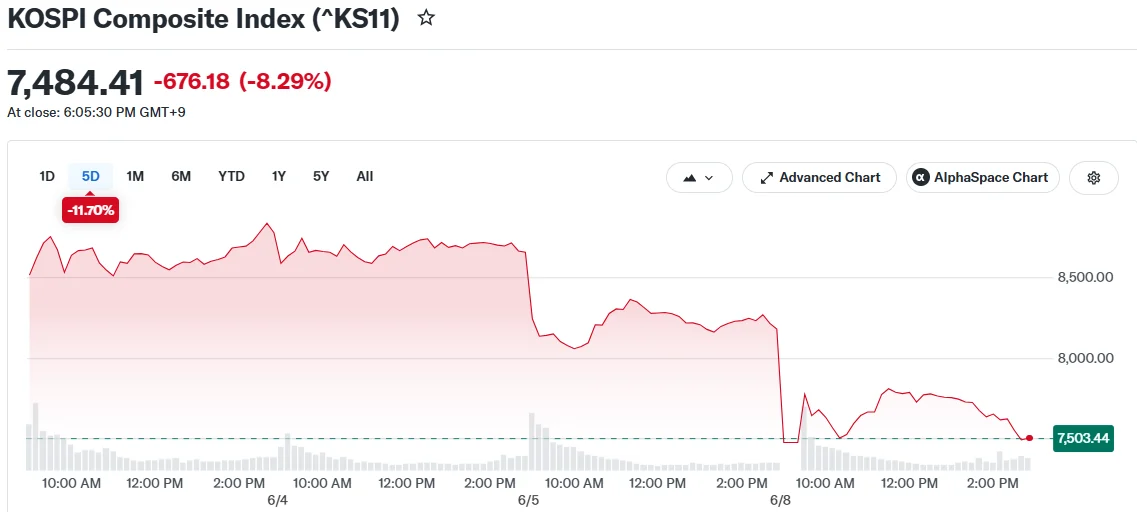
The steep decline activated automatic circuit breakers moments after the opening bell. Market operations were suspended for 20 minutes. This marked just the ninth occurrence of such an event in the exchange’s history.
Two heavyweight stocks drove the majority of losses. Samsung Electronics crashed 10.2%. SK Hynix plummeted 7.7%. These semiconductor powerhouses have been the primary engines behind the KOSPI’s spectacular performance this year, with their valuations surging over 150% and 200% respectively.
Combined, these two technology giants now represent more than half of the entire benchmark’s market capitalization. Both companies recently achieved membership in the exclusive $1 trillion valuation club.

The catalyst for Monday’s dramatic selloff originated across the Pacific. Stronger-than-anticipated employment statistics released Friday demolished market expectations for Federal Reserve monetary easing. Investors had been banking on rate reductions to sustain the technology sector’s momentum.
The Nasdaq tumbled 4.2% in Friday’s session. The Philadelphia Semiconductor Index crashed over 10%, recording its sharpest fall since the pandemic panic of March 2020.
Broadcom Forecasts and Middle East Tensions Add to Pressure
Semiconductor manufacturer Broadcom contributed to the negative sentiment. The company’s underwhelming forward guidance disappointed market participants, intensifying concerns about the chip sector’s outlook worldwide.
Geopolitical developments compounded the market anxiety. Iran’s missile strikes against Israel during the weekend heightened worries about economic growth prospects and potential energy price disruptions.
In an ironic twist of timing, Nvidia CEO Jensen Huang was present in South Korea announcing strategic collaborations. He designated SK Hynix as Nvidia’s “biggest partner.” The GPU maker also revealed agreements with Naver and Doosan to establish AI data center infrastructure across the nation.
Naver stood out as a rare winner, surging 9.2% following the announcement of its Nvidia collaboration. Hyundai Motor declined 8.7% despite also securing a strategic partnership with Nvidia.
The South Korean won depreciated to 1,615 against the dollar on Friday, its most vulnerable position since March 2009. Government officials convened an emergency session. By Monday’s close, the currency had strengthened to 1,533.7 per dollar after authorities issued warnings against speculative activities and executed market interventions.
Market Still Up Sharply for the Year
International investors offloaded domestic equities valued at 355 billion won during Monday’s session. This extended their unbroken selling pattern to 21 consecutive trading days.
Despite the sharp Monday reversal, the KOSPI maintains a remarkable 78% gain year-to-date. South Korea’s benchmark 10-year government bond yield climbed to 4.366%, reaching its highest level since October 2023.
President Lee Jae Myung characterized the market as persistently “undervalued” and described the prevailing exchange rate conditions as “temporary and abnormal.”
Market observers suggest the pullback was inevitable considering the rapid appreciation of semiconductor equities. Earnings trajectories for chip manufacturers remain positive for the immediate term.
