


Key Takeaways
- Wells Fargo reduced its S&P 500 year-end projection from 7,800 to 7,300 due to unexpected Iran conflict escalation
- Market analytics reveal stocks are now factoring in greater war exposure than oil volatility risk for the first time
- The Nasdaq 100 has experienced a 29% decline in its forward price-to-earnings multiple from recent highs
- The bank maintains earnings per share projections of $315 for 2026 and $365 for 2027
- Wells Fargo emphasizes its continued long-term optimism toward U.S. equities despite current headwinds
Wells Fargo’s Ohsung Kwon has adjusted his S&P 500 price target downward from 7,800 to 7,300 for year-end. The adjustment comes as geopolitical tensions surrounding Iran introduce unforeseen market volatility.
According to Kwon, the escalating conflict was not incorporated into the firm’s initial 2026 projections. The analyst emphasized that this development represents an additional risk factor that requires recalibration of market expectations.
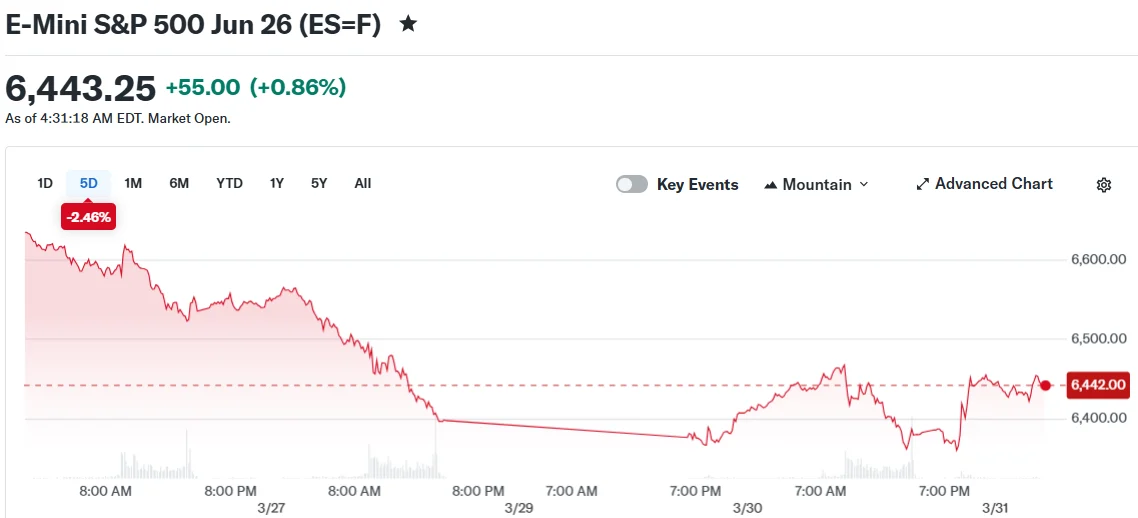
The S&P 500 currently sits near 6,343, reflecting a year-to-date decline of approximately 7.7%. Wells Fargo calculated its updated baseline using averaged pricing data from late February through late March.
The firm’s proprietary conflict assessment model revealed an unprecedented pattern. Market participants are now incorporating more risk premium related to direct war exposure than to oil price volatility, marking a historical shift in risk perception.

Valuation metrics have compressed significantly, with the Nasdaq 100’s forward P/E ratio declining 29% from peak levels. Roughly one-third of S&P 500 constituents now trade at valuations at least one standard deviation beneath their five-year historical averages.
Challenging Economic Backdrop Creates Dual Risk Scenario
Kwon characterized the present macroeconomic environment as presenting a “lose-lose” dynamic as investors await critical economic releases this week. Robust economic indicators could reinforce the Federal Reserve’s inclination to maintain elevated interest rates. Conversely, disappointing data might amplify stagflation concerns and accelerate capital outflows from equities.
The bank’s inventory-tracking model has identified emerging inflationary pressures expected to materialize in the second half of the year. This framework suggests price acceleration above current baseline expectations.
Yet despite these near-term challenges, Wells Fargo maintains it has not adopted an outright pessimistic stance. The institution’s PRSM analytical framework—encompassing Profits, Rates, Sentiment, and Macro factors—continues to project a 14% gain over the coming twelve months.
Earnings forecasts have not been adjusted, with per-share estimates holding at $315 for 2026 and $365 for 2027. The firm anticipates corporate profitability will demonstrate durability despite increasing macroeconomic complexity.
Capital Flows Remain Resilient Through Turmoil
A notable observation from Kwon’s analysis: equity funds have continued to receive positive inflows following the outbreak of hostilities. This pattern diverges from historical responses to geopolitical disruptions, when investors typically withdrew capital rapidly.
Kwon interpreted this behavior as indicating investors are implementing hedging strategies rather than executing wholesale portfolio liquidations. This approach reflects expectations that economic disruptions will prove temporary in nature.
Additionally, March data revealed that analyst upgrades exceeded downgrades across the broader market. This trend demonstrates sustained conviction in corporate earnings trajectories despite the ongoing international crisis.
Wells Fargo outlined five fundamental pillars supporting its constructive long-term outlook. These factors encompass limited oil market disruption, valuation normalization, domestic energy self-sufficiency, robust free cash flow generation among leading technology firms, and accelerating inventory replenishment cycles.
“We believe a lot has been priced into stocks already,” Kwon wrote. “However, other than a firm resolution, we don’t see many upside catalysts.”
The S&P 500 stands at 6,343 as of March 31, 2026, with the market down 7.7% year-to-date.
