


Key Highlights
- SPCE reached $8.90, marking a fresh 52-week peak with gains exceeding 300% from 2026 lows
- SpaceX IPO anticipation has sparked a widespread rally across space-focused equities
- Rich Huang and RichRich Capital revealed a combined 9.9% ownership position
- Space tourism tickets now priced at $750,000, representing a $100,000 increase
- Technical indicators show RSI at 90, suggesting overbought territory; Wall Street targets imply significant downside risk
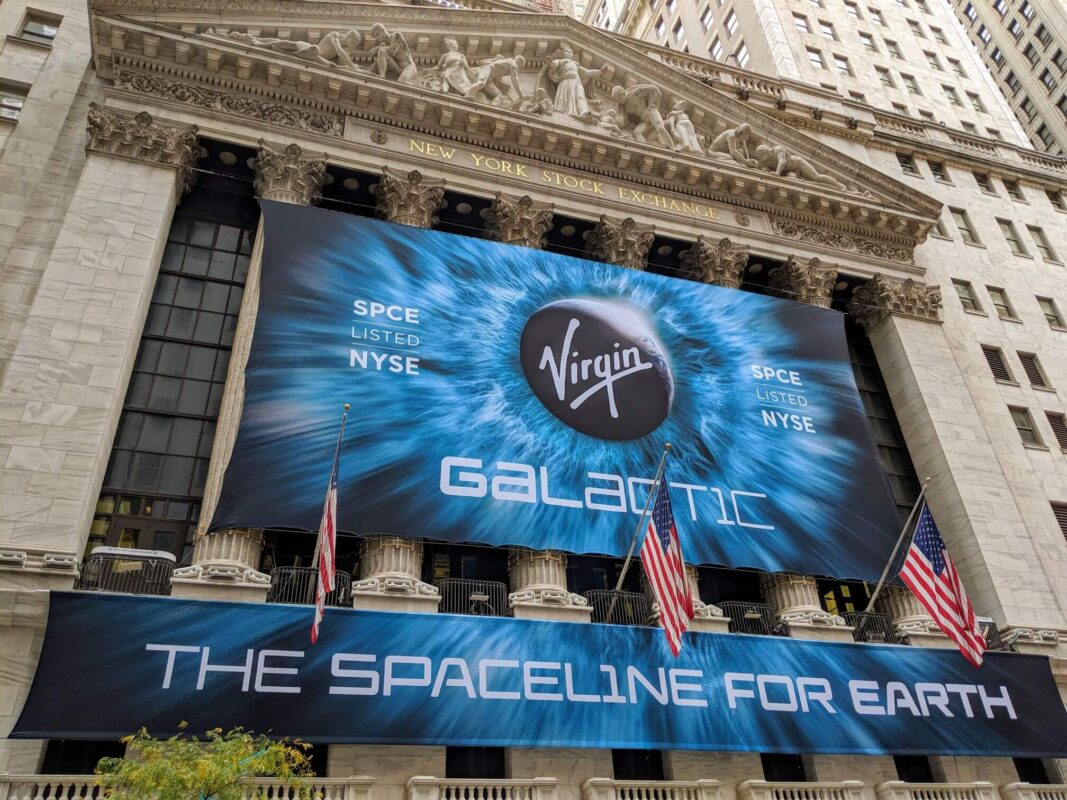
Shares of Virgin Galactic surged to $8.90 on Monday, establishing a new 52-week peak as enthusiasm surrounding the forthcoming SpaceX public offering lifted the entire space sector.
Virgin Galactic Holdings, Inc., SPCE
The company’s stock has skyrocketed more than 300% from its 2026 bottom, bringing its market capitalization near the $700 million threshold.
The space industry has experienced remarkable momentum recently. Companies like Rocket Lab, Planet Labs, and Intuitive Machines have all enjoyed similar upward trajectories as market participants position themselves for what many anticipate will be a historic public offering.

SpaceX is projected to achieve a valuation exceeding $1.78 trillion when it goes public. Speculation on Polymarket suggests the company’s post-IPO valuation could surpass the $2 trillion mark.
This wave of optimism is creating a halo effect throughout the sector—with Virgin Galactic emerging as one of the primary beneficiaries of this sentiment shift.
Major Shareholder Activity Emerges
Recent regulatory filings revealed significant new investment interest, contributing to Monday’s price action. RichRich Capital reported acquiring 4.87 million shares, representing a 4.6% ownership stake. Separately, Rich Huang filed for 5.58 million shares, accounting for 5.3% of the company.
Given that Huang maintains control over RichRich Capital, his combined economic interest totals 9.9%. Such substantial ownership disclosures typically generate heightened market interest and trading activity.
Higher Pricing and Operational Progress
Virgin Galactic recently announced an increase in its spaceflight ticket pricing to $750,000 per seat—a substantial $100,000 jump from previous rates.
The organization aims to resume commercial operations later this year, with flight frequency expected to accelerate progressively thereafter.
VSS Unity, the company’s prototype spacecraft, has resumed flight operations at Spaceport America in New Mexico. The firm has scheduled glide testing for its next-generation spacecraft during the third quarter, followed by powered flights reaching space in the fourth quarter.
These advanced vehicles are engineered to complete twice-weekly missions and maintain operational capability for over 500 flights each.
Financial Performance Remains Negative
The company’s latest quarterly report revealed a net loss of $65 million, showing improvement compared to the $84 million loss recorded in the corresponding period last year. Adjusted EBITDA loss narrowed to $55 million from $72 million.
Virgin Galactic concluded the quarter holding $251 million in cash and short-term investments. The company generated $52 million last quarter through at-the-market equity offerings—a capital-raising mechanism it could potentially deploy again given the stock’s current momentum.
Technical Analysis and Street Sentiment
The Relative Strength Index currently registers at 90, indicating deeply overbought conditions. From a technical perspective, the stock appears to be in the markup phase of a Wyckoff cycle, which historically precedes distribution and correction.
While a move toward $10 remains feasible in the short term, Wall Street analysts maintain a cautious outlook. The consensus rating stands at Hold, based on two Buy ratings, three Hold ratings, and one Sell rating issued over the past three months.
The average analyst price target sits at $3.61—suggesting potential downside exceeding 50% from current trading levels.
