


Key Highlights
- The greenback hovered close to a 10-day trough as market participants anticipated the Federal Reserve’s inaugural policy announcement under newly appointed Chair Kevin Warsh.
- Interest rates are anticipated to remain unchanged, though investors are monitoring for potential changes in the Fed’s dovish stance.
- An interim peace agreement between Washington and Tehran boosted risk sentiment, diminishing safe-haven dollar demand.
- The yen traded at 160.27 against the greenback, approaching thresholds where market participants anticipate possible Japanese intervention.
- Japan’s central bank increased borrowing costs to their highest point in over three decades, though provided limited forward guidance.
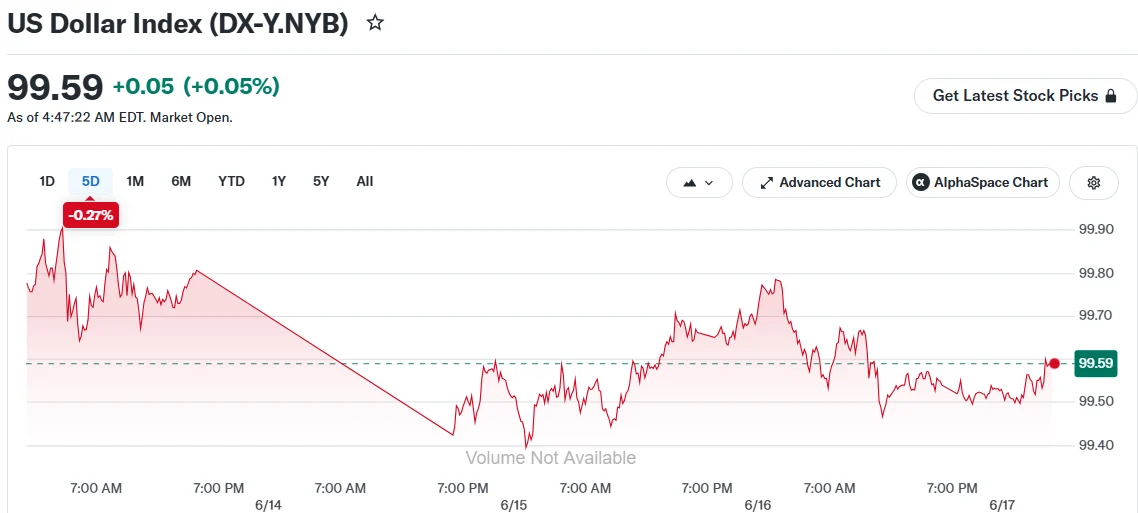
The greenback maintained stability near its weakest position in ten days during Wednesday’s trading session as market participants adopted a cautious stance ahead of the Federal Reserve’s monetary policy announcement scheduled for later in the day.
The benchmark U.S. Dollar Index fluctuated around the 99.50 to 99.55 range, showing minimal movement following four straight sessions of declines.
Traders are not anticipating any adjustment to borrowing costs during this session. Kevin Warsh, who assumed the position of Fed Chair in the previous month, is presiding over his inaugural policy gathering, with considerable attention focused on his approach to guiding the central bank’s future direction.
Strategists at ING noted that dollar performance is increasingly dependent on market expectations regarding Fed tightening. They cautioned that any deviation from anticipated messaging by Warsh could trigger significant greenback weakness.

Market sentiment exhibited greater stability than typical recent sessions. A provisional peace framework between the United States and Iran revealed earlier this week diminished appetite for traditional safe-haven assets including the dollar.
The arrangement involves Iran resuming petroleum exports and pausing its nuclear activities for a 60-day period while diplomatic discussions proceed. The pact also potentially facilitates renewed maritime traffic through the Strait of Hormuz.
Brent crude prices dropped beneath $80 per barrel in response to the announcement, further reducing safe-haven currency appeal.
Japanese Currency Approaches Intervention Threshold While BOJ Offers Limited Guidance
The Japanese currency remained under pressure at 160.27 versus the dollar, a threshold market observers identify as potentially triggering Japanese governmental currency support operations.
The Bank of Japan elevated its benchmark rate to 1% during Tuesday’s session — marking the steepest level in 31 years — as policymakers address inflationary pressures stemming from energy cost increases linked to Middle Eastern geopolitical tensions.
Notwithstanding the rate adjustment, the yen failed to appreciate. Market analysts attribute this to the BOJ providing minimal insight regarding the timing of subsequent rate movements, constraining market response.
Jane Foley, senior FX strategist at Rabobank, observed that the BOJ’s action remained secondary to the Fed meeting. Market participants are seeking more definitive signals before adjusting yen positions.
The Reserve Bank of Australia maintained its benchmark rate unchanged at 4.35% while signaling potential future tightening if inflationary pressures persist. The Australian dollar exchanged hands near $0.7063.
The common European currency steadied at $1.1613 while sterling showed minimal movement at $1.3431.
Erik Weisman of MFS Investment Management suggested that Warsh may still be developing consensus among Federal Reserve officials before articulating decisive policy guidance.
The results of Warsh’s inaugural media briefing are expected to establish the trajectory for dollar movements in coming weeks.
