


Key Highlights
- The semiconductor company purchased AI software firm Modular for approximately $4 billion in an all-stock transaction, securing AI inference capabilities and a new programming language.
- During its investor presentation, Qualcomm introduced the Dragonfly C1000 CPU alongside the HBC inference chip platform designed for data center operations.
- A multi-year partnership with Meta was announced for deploying Qualcomm processors in Meta’s data center infrastructure, while Microsoft emerged as a possible HBC platform customer.
- The chipmaker completed its Alphawave Semi purchase in December, gaining high-performance data center connectivity solutions and custom silicon development capabilities.
- Company leadership forecasts $15 billion in AI infrastructure sales by fiscal year 2029 and identifies a $1.7 trillion opportunity across markets by 2030.
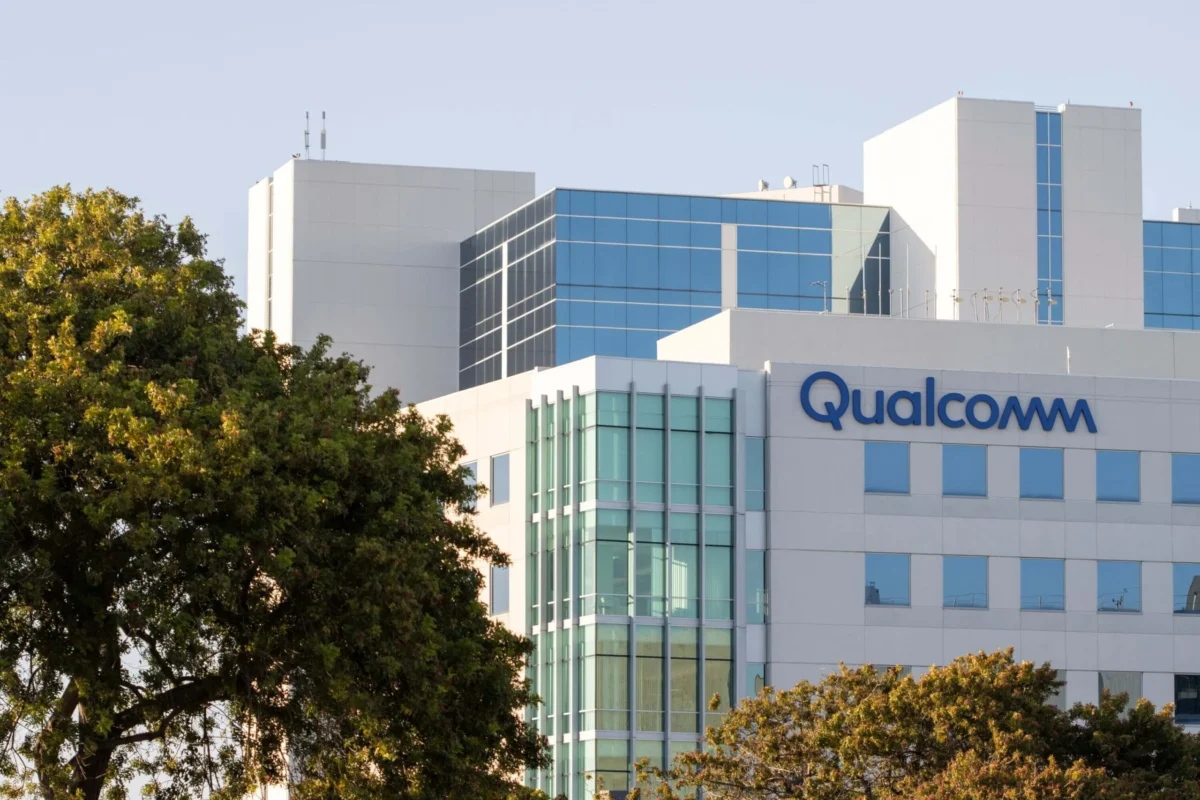
Qualcomm (QCOM) stock has surged 66% during the last three months as the semiconductor manufacturer unveils an ambitious strategy to penetrate AI data centers, a territory currently controlled by Nvidia (NVDA).
Shares of QCOM were changing hands at $189.36 during trading hours, reflecting a 7.58% decline for the session, though remaining significantly above the 52-week minimum of $121.99. The stock’s price-to-earnings multiple stands at 21, notably below the technology sector’s 44 average.
Recent days have witnessed considerable activity. During the company’s investor day event, CEO Cristiano Amon articulated that Qualcomm seeks to evolve beyond its traditional smartphone chip identity.

The strategic vision: reduce smartphone chip dependency to one-third of overall revenue by 2029. During the previous fiscal period, revenue from non-smartphone semiconductors reached 28% of total chip sales.
Strategic Acquisitions Driving Transformation
Last December, Qualcomm completed its Alphawave Semi acquisition, obtaining advanced data center connectivity semiconductors and custom silicon engineering facilities. Tony Pialis, one of Alphawave’s original founders, now serves as Qualcomm’s executive vice president overseeing data center technology. The networking semiconductor products are currently available commercially, with two custom chip clients secured and expected to generate revenue in the upcoming fiscal year.
The Modular transaction followed shortly after. Qualcomm revealed its acquisition of the AI software developer through an all-stock arrangement valued around $4 billion. Modular’s technology enables AI model deployment across diverse hardware architectures. The acquisition also brought Chris Lattner, Modular’s co-founder and chief executive, who commands significant respect within software engineering communities.
The Modular acquisition holds strategic importance by providing Qualcomm with a software infrastructure layer — a competitive advantage Nvidia has maintained for years through its CUDA platform.
Product Launches and Customer Wins
Qualcomm revealed its Dragonfly C1000 CPU during the investor event. Meta represents the inaugural confirmed data center client for this processor, operating under a multi-year commercial agreement.
The company also presented the HBC inference chip platform. Microsoft CEO Satya Nadella participated via video presentation, highlighting HBC’s “high memory bandwidth and integrated compute” capabilities as delivering enhanced cost efficiency and performance for AI infrastructure deployments. While Microsoft appears positioned as a potential customer, specific arrangement details remained undisclosed.
The initial HBC generation will become available for customer evaluation in 2027. A successor generation is scheduled for 2028.
The business rationale is clear. Nvidia established its data center leadership through four foundational elements: AI accelerator semiconductors, CPUs, high-performance networking, and software platforms. Qualcomm has now assembled comparable versions of each component, either available currently or under development.
The AI inference segment represents Qualcomm’s strategic entry point. Inference operations — executing AI models versus training them — are becoming the predominant computational workload as organizations deploy AI agents. Recent research from Google, Microsoft, and leading academic institutions revealed that AI coding assistants consume approximately one thousand times more inference computing resources than human developers performing identical tasks.
Qualcomm’s executive team projects AI infrastructure revenue surpassing $15 billion by fiscal 2029, growing from essentially zero currently. The organization also identifies a combined addressable market opportunity of $1.7 trillion by 2030, spanning data center, edge computing, and additional segments.
The HBC chip sampling phase commences in fiscal 2027, with Qualcomm’s comprehensive data center product portfolio expected to achieve full market deployment throughout the subsequent two-year period.
