


Key Takeaways
- On May 14, the U.S. Senate Banking Committee examines the CLARITY Act, legislation that could determine regulatory classification for digital assets
- Debate over stablecoin reward structures remains central to the bill, with traditional banks advocating restrictions while crypto companies seek operational freedom
- Bitcoin (BTC) maintains support above $80,000 while encountering significant resistance in the $81,000–$83,000 range
- While Bitcoin ETF inflows show signs of improvement, they haven’t offset the substantial outflows recorded from late 2025 through early 2026
- Coinbase reported consecutive quarterly losses, with annual revenue declining from $2.03 billion to $1.43 billion
Multiple significant developments converge this week that may influence cryptocurrency market trajectories. Regulatory proceedings, Bitcoin’s critical price levels, institutional investment flows, and major exchange financial results all demand investor attention simultaneously.
The U.S. Senate Banking Committee will examine the CLARITY Act on May 14. This proposed legislation seeks to establish clear distinctions between securities and commodities classifications for digital assets. Additionally, it would delineate separate jurisdictional responsibilities between the SEC and CFTC regarding cryptocurrency oversight.
Stablecoin rewards represent the most contentious component of the proposed legislation. According to Reuters reporting, the bill would permit rewards connected to transaction activity while prohibiting rewards on stablecoin balances held without movement. Cryptocurrency companies advocate for operational flexibility to provide payment-based incentives. Traditional banking institutions prefer restrictions on any mechanisms resembling deposit interest.
The implications extend broadly since stablecoins serve fundamental roles in trading operations, payment systems, and decentralized finance applications. Establishing regulatory clarity could enable companies to develop offerings with reduced legal uncertainty. Alternatively, more restrictive provisions might compel exchanges and token issuers to restructure their user reward programs.

Bitcoin Maintains $80,000 Support While Testing Overhead Resistance
Bitcoin climbed above $80,000 during the previous week, partially supported by positive momentum in Asian equity markets. Market analysts suggest that a more sustainable bullish structure would require clearing resistance between $81,000 and $83,000, as reported by Barron’s.
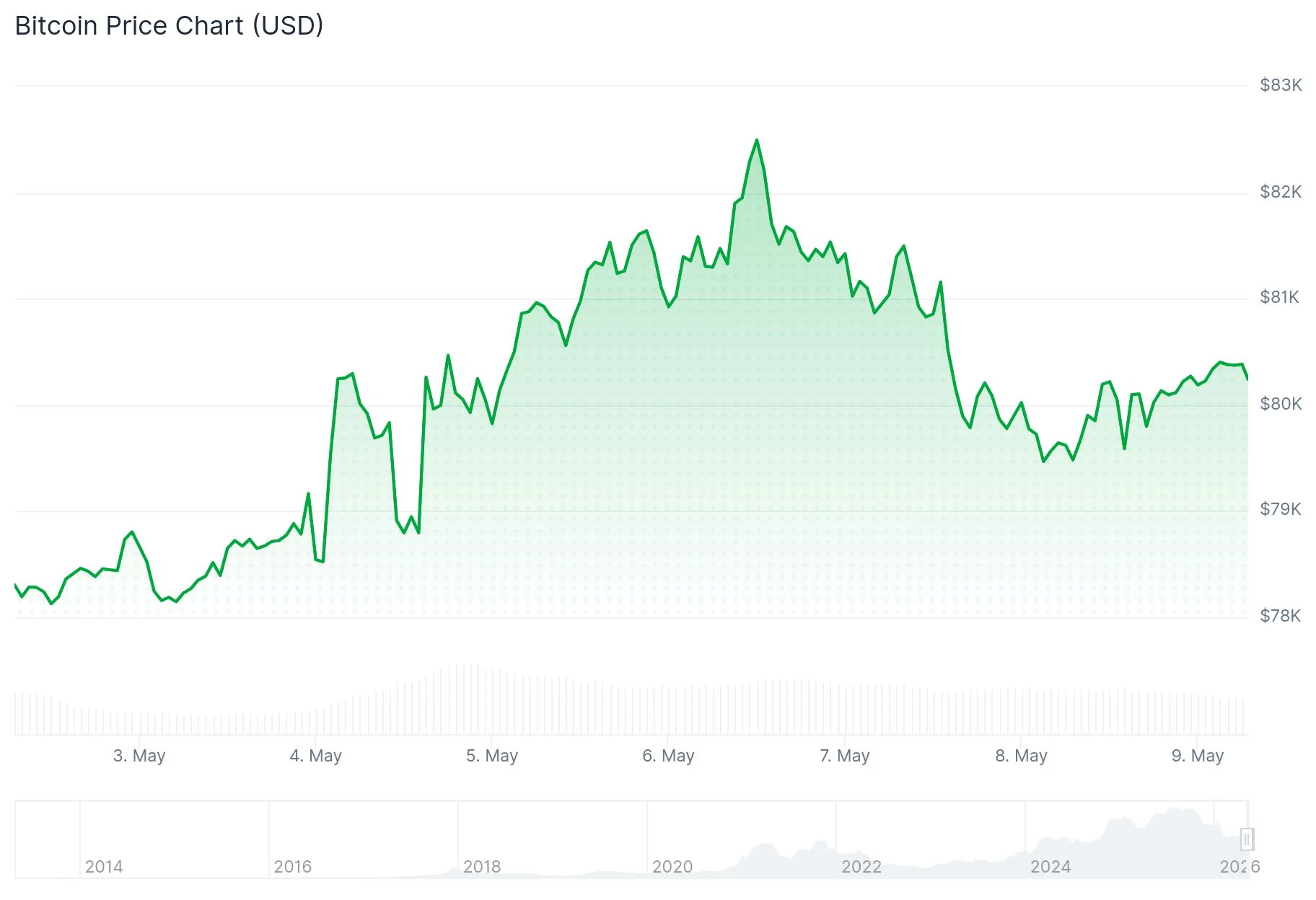
Should Bitcoin preserve current price levels while ETF demand remains consistent, retail participation could expand. However, if the cryptocurrency stalls near resistance zones, market participants may adopt more conservative positions following the recent price recovery.
Institutional investment flows through ETFs contribute significantly to this dynamic. Demand for Bitcoin ETFs has shown improvement during recent weeks. Nevertheless, CoinDesk analysis indicates the recovery hasn’t completely compensated for the substantial outflows documented between November 2025 and February 2026.
Daily flow metrics throughout this week will provide investors insight into whether institutional participants continue accumulating positions. Robust inflows would reinforce the recovery narrative. Conversely, weak or negative flows would generate uncertainty regarding the sustainability of the recent rebound.
Coinbase Reports Consecutive Quarterly Losses
Coinbase disclosed another quarterly loss as platform trading volumes declined. Revenue contracted to $1.43 billion compared with $2.03 billion in the corresponding period last year. Transaction-based revenue decreased 40% to $756 million, according to Reuters coverage.
As a publicly traded entity, Coinbase serves as one of the most transparent indicators of cryptocurrency trading demand. Diminished trading volumes on the platform frequently mirror reduced retail participation throughout the wider cryptocurrency ecosystem.
Alternative cryptocurrencies also warrant attention. Following Bitcoin price stabilization, investors frequently shift capital into assets like Solana, Ethereum, and XRP seeking amplified returns. This week, narratives surrounding stablecoins, regulatory frameworks, and tokenization initiatives will likely influence interest in associated tokens.
Alternative cryptocurrencies display heightened sensitivity to market sentiment fluctuations. Should Bitcoin encounter difficulty breaking resistance levels or ETF flows prove disappointing, smaller-capitalization tokens could experience more pronounced declines than the broader market.
The CLARITY Act examination scheduled for May 14 represents the most significant individual catalyst to monitor this week. The hearing’s developments could impact cryptocurrency exchanges, stablecoin issuers, and digital asset valuations across the entire sector.
