



Key Highlights
- ETH declined more than 10% over the past seven days, sliding to approximately $2,110, underperforming most leading cryptocurrencies.
- Surging US Treasury yields and fresh inflation figures sparked widespread selling across crypto markets, with the 30-year yield reaching 5.19%—a level not seen since 2007.
- Over $700 million worth of long positions on ETH were wiped out during the past week.
- Medium-sized wallets offloaded a total of 386,000 ETH from May 11 through May 18, while large holder accumulation also showed signs of slowing.
- Crypto analyst Patel highlighted $1,500 as a potential downside objective following ETH’s break beneath a critical trendline at $2,170.
Ethereum is currently hovering near $2,110, showing a modest bounce after enduring intense selling throughout the week. The digital asset has gained approximately 0.5% on Tuesday, though the overall momentum remains fragile.
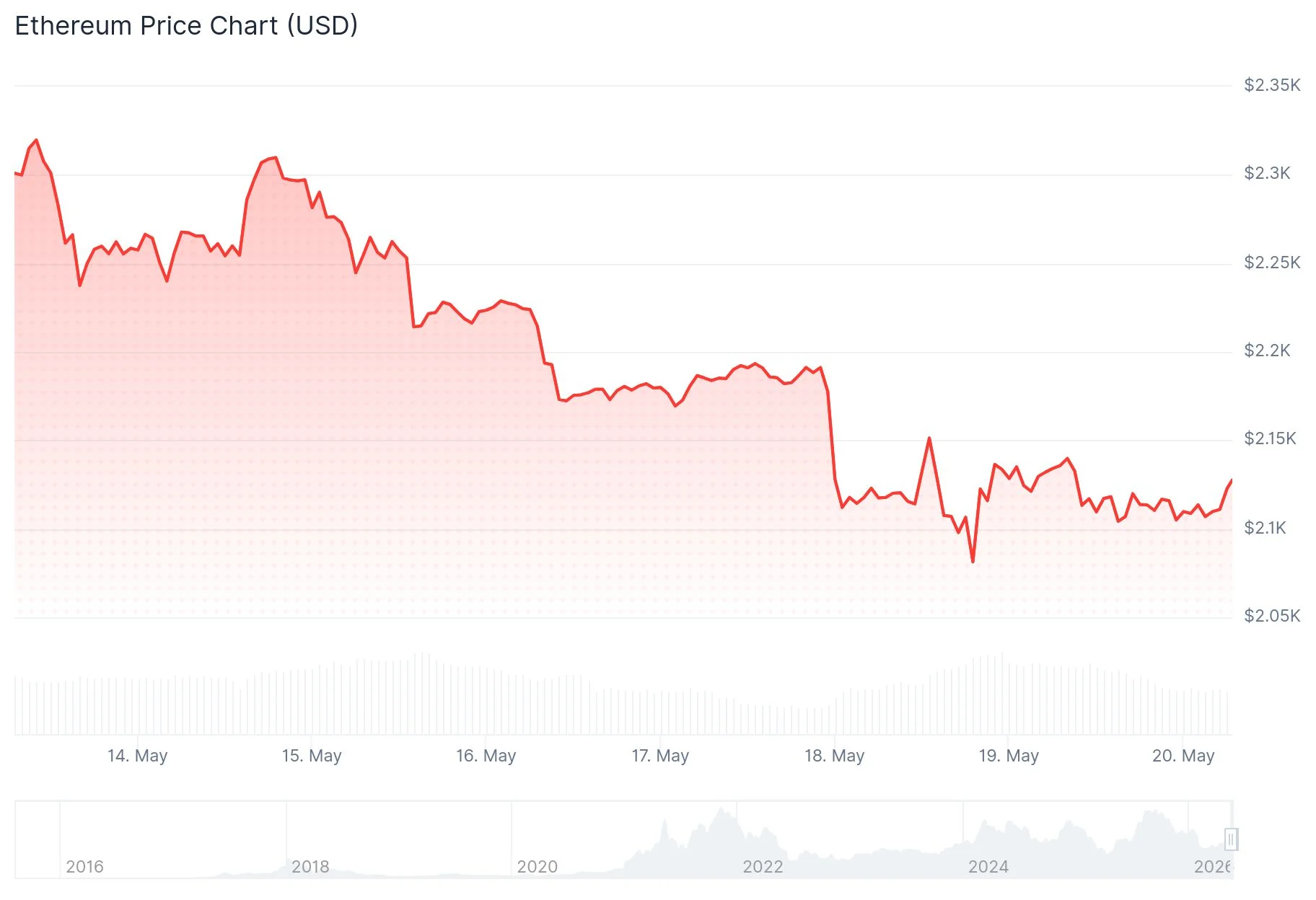
The downturn wasn’t unique to ETH alone. A dramatic increase in US Treasury yields drew capital away from riskier investments throughout financial markets. The 30-year Treasury yield surged to 5.19%, marking its peak since 2007. Meanwhile, Japan’s 10-year government bond yield also reached an unprecedented 2.81%. Higher yields typically encourage investors to migrate toward more secure, yield-bearing instruments, creating headwinds for digital currencies.
Nevertheless, ETH experienced a more severe decline compared to its peers. Data from Coinglass indicates that over $700 million in long positions were liquidated across ETH markets during the past week, surpassing Bitcoin’s liquidation figures for the same timeframe. Futures market indicators had already begun signaling a potential long squeeze before the price collapse materialized.
Blockchain Data Reveals Ongoing Selling Pressure
Onchain analytics from CryptoQuant demonstrate that addresses holding between 100 and 10,000 ETH disposed of approximately 386,000 ETH from May 11 through May 18. This selling behavior has been consistent across recent months.

Large holders initially attempted to support prices, accumulating roughly 330,000 ETH during the identical timeframe. However, they subsequently reduced their positions by 60,000 ETH in the days that followed, indicating weakening confidence at these valuation levels.
Analyst Ali Charts highlighted a troubling development on social platforms: roughly 60 whale addresses containing 10,000 ETH or more have either completely emptied or consolidated their holdings during the past two months. He observed this coincides with substantial exchange deposits and suggested the trajectory of least resistance points “down,” while monitoring the $2,000 threshold carefully.
Chart Analysis Signals Continued Weakness
On the daily timeframe, Ethereum is positioned beneath its 20-, 50-, and 100-day exponential moving averages, which cluster between $2,245 and $2,333. The RSI indicator registers near 34 while the Stochastic Oscillator hovers around 12, both reflecting persistent bearish momentum without any definitive reversal pattern.
Analyst Crypto Patel pointed out on social media that ETH violated a significant ascending trendline at $2,170, transforming the technical structure to bearish. He established a downside objective of $1,500 with an invalidation threshold at $2,327.
On the hourly timeframe, ETH is developing a descending trend line with overhead resistance positioned near $2,120. Inability to push through $2,150 could trigger a pullback toward $2,075, with $2,000 representing the subsequent critical support zone beneath that level.
Significant resistance overhead is located at $2,120, followed by $2,150, and $2,200. Immediate support levels are positioned at $2,085 and $2,075. A breakdown below these areas could expose the psychologically important $2,000 level.
As of May 20, ETH is trading marginally above $2,108, with both technical signals and blockchain metrics suggesting a cautious outlook for the immediate future.
