


Key Highlights
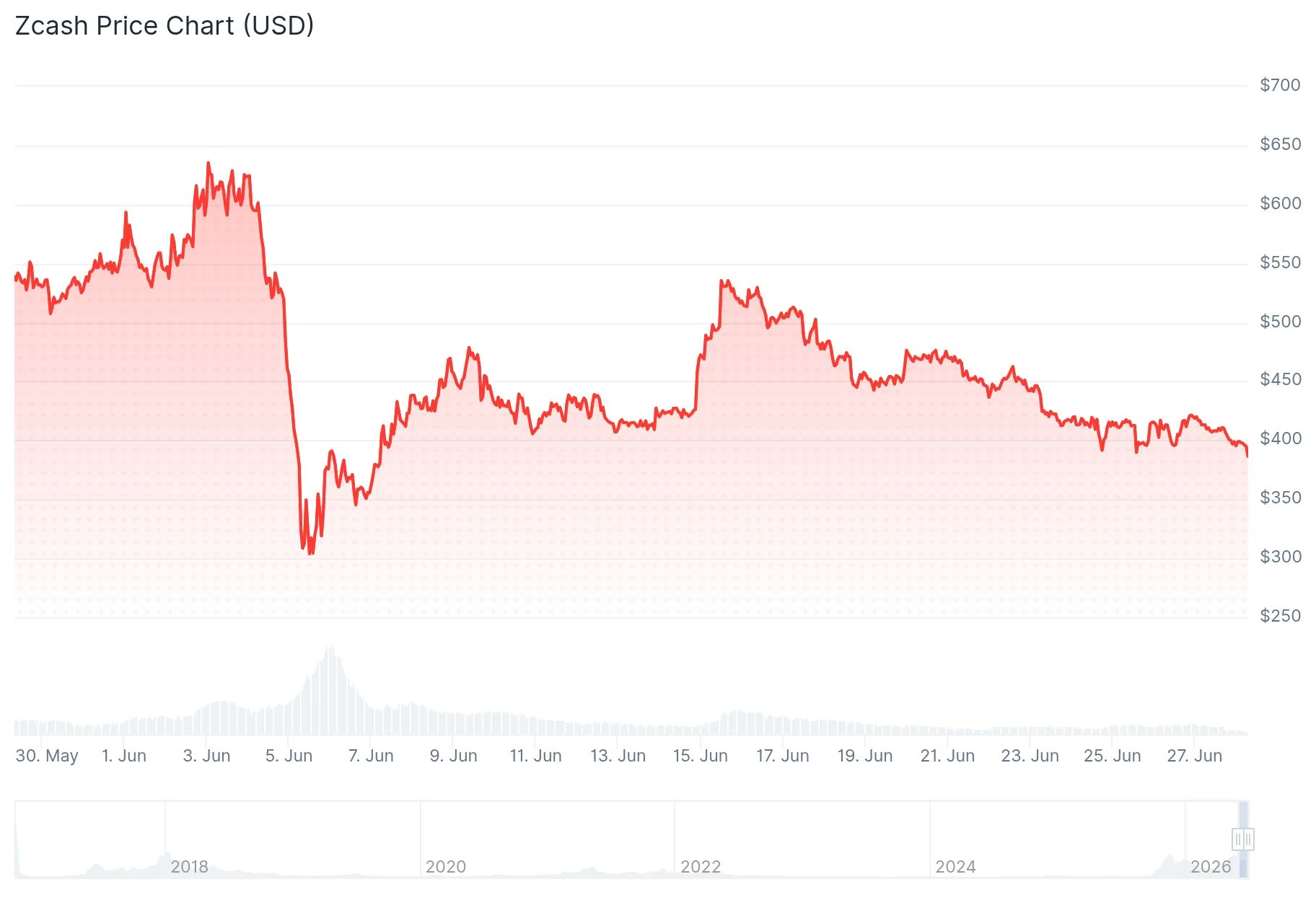
- ZEC is currently valued at approximately $388 with a market capitalization approaching $6.7 billion
- Mid-range scenario projects ZEC trading between $600–$1,000 by the end of 2031
- Optimistic projection reaches $2,000–$3,500 should privacy features gain mainstream acceptance
- Pessimistic scenario anticipates a decline to $120–$220 amid increased regulatory challenges
- Weighted average price projection stands at approximately $850 for 2031
Introduced in 2016, Zcash emerged as a privacy-centric cryptocurrency designed to address Bitcoin’s transparency limitations. Unlike Bitcoin’s completely transparent ledger, Zcash enables users to conduct confidential transactions through advanced zero-knowledge proof cryptography.
This positions ZEC as a unique investment proposition. Rather than challenging platforms like Ethereum or Solana, it represents a fundamental bet on whether financial confidentiality will become essential for cryptocurrency participants and institutional players.
Currently trading near $388, ZEC maintains a market capitalization around $6.7 billion with approximately 16.7 million tokens currently circulating. Similar to Bitcoin’s tokenomics, it features a maximum supply capped at 21 million coins and implements halvings of block rewards approximately every four years.
Industry observers at CoinDesk noted that privacy-oriented cryptocurrencies including Zcash and Monero were projected to maintain investor interest throughout 2026, despite ongoing challenges related to exchange delistings and banking sector restrictions.

Mid-Range Scenario: $600–$1,000
The moderate forecast for ZEC through 2031 anticipates valuations ranging from $600 to $1,000. This translates to a market capitalization approximately between $12 billion and $20 billion.
This projection doesn’t depend on Zcash breaking into the top tier of cryptocurrency assets. Instead, it requires maintaining its status as the premier regulated privacy token offering selective transparency options.
Three fundamental factors support this trajectory: increasing demand for transaction privacy, sustained availability on major exchanges, and ongoing technical innovation. Zcash’s Bitcoin-inspired emission schedule and proof-of-work consensus mechanism reinforce this moderate outlook.
Optimistic Scenario: $2,000–$3,500
Should privacy emerge as a central theme within cryptocurrency markets, ZEC could potentially climb to $2,000–$3,500. Such valuations would establish a market capitalization ranging from $40 billion to $70 billion.
Reaching this outcome would require widespread implementation of confidential transactions, significant wallet infrastructure improvements, and resurgent institutional appetite for privacy-preserving technologies.
Additionally, this scenario depends on Zcash establishing itself as the “private version of Bitcoin” instead of being perceived merely as legacy alternative cryptocurrency.
Pessimistic Scenario: $120–$220
The downside risk centers primarily on regulatory headwinds. Privacy-focused cryptocurrencies currently face mounting delisting threats across various jurisdictions, representing tangible rather than theoretical concerns.
Should major exchanges impose trading restrictions or completely remove ZEC listings, combined with evaporating liquidity, valuations could plummet to $120–$220 by 2031.
Maintaining exchange accessibility represents perhaps the most critical factor determining Zcash’s long-term valuation prospects.
Calculating probability-weighted outcomes across these three distinct scenarios produces an approximate target price of $850 by 2031.
