


TLDR
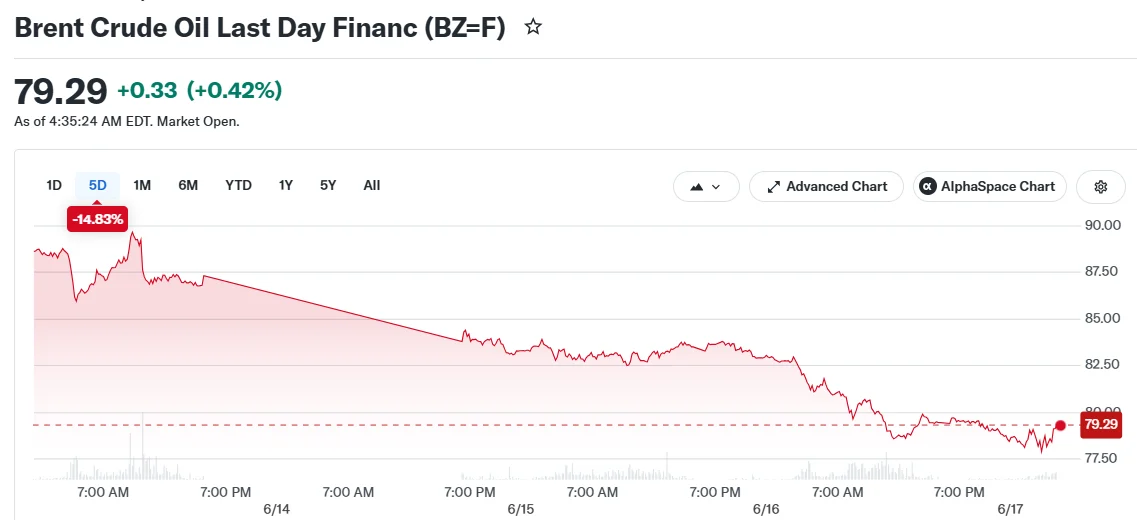
- Brent crude tumbled to approximately $78 per barrel, marking the lowest point since early March
- Diplomatic breakthrough between Washington and Tehran set for Friday signing would restore Hormuz Strait access
- Tehran receives authorization to commence oil sales immediately following agreement execution
- American crude stockpiles declined 8.33 million barrels last week, exceeding forecasts by over 100%
- National gasoline prices in the US retreated to near $4 per gallon after touching $4.56 in May
Crude oil markets extended their decline for a fifth consecutive trading day on Wednesday, plummeting to levels not witnessed since early March, as market participants factored in the prospect of additional Iranian barrels entering the global supply chain following a diplomatic accord between Washington and Tehran.
Brent crude futures slid to approximately $78.23 per barrel, while West Texas Intermediate declined to $75.16. The two primary benchmarks have shed roughly 10% of their value across the previous two sessions.
The Deal Driving the Selloff
The United States and Iran have finalized an interim diplomatic arrangement scheduled for signing on Friday. According to the agreement terms, Iran will restore commercial shipping access through the Strait of Hormuz, while Washington will terminate its naval blockade of Iranian port facilities.
The Islamic Republic will gain authorization to market its petroleum products immediately upon executing the agreement. The arrangement encompasses American exemptions applicable to Iranian crude oil, petrochemical products, and associated services including financial transactions and insurance coverage.

A fourteen-point draft memorandum details the agreement provisions. The document also initiates a 60-day period of structured negotiations designed to terminate hostilities and establish constraints on Iran’s nuclear development activities.
The Strait of Hormuz represents a critical maritime chokepoint linking the Persian Gulf with the Indian Ocean. During normal operations, approximately one-fifth of global oil supplies transit through this waterway.
Supply and Shipping Outlook
Market participants are closely monitoring the timeline for actual supply restoration. Maritime transport companies await additional information regarding security protocols before dispatching vessels through the strait.
Dennis Kissler, senior vice president for trading at BOK Financial Securities, indicated that American naval forces would probably provide escort services for commercial ships during the initial weeks, while mine clearance activities would also constrain traffic flow.
Parash Jain, global head of transport and logistics research at HSBC, emphasized that any resumption would occur incrementally. He noted that shipping companies invested considerable time reorganizing vessel routes and would exercise caution before reversing those decisions until operational conditions stabilize.
Vessel tracking systems have already detected two tankers previously bound for African destinations that have reversed course in the Indian Ocean and redirected toward Middle Eastern ports.
Inventory Data Limits the Losses
Notwithstanding the bearish sentiment surrounding supply prospects, a substantial reduction in American crude stockpiles provided some market support.
The American Petroleum Institute disclosed that US crude inventories contracted by 8.33 million barrels during the week concluding June 12. This figure substantially exceeded the projected 4.5 million barrel withdrawal.
The statistics indicated robust consumption within the United States, the planet’s largest petroleum consumer. Official government stockpile data was scheduled for release later Wednesday.
Fuel prices at the pump have also moderated. The national average throughout the United States has retreated toward $4 per gallon following a May peak exceeding $4.56, based on American Automobile Association tracking.
The Federal Reserve was convening Wednesday to determine monetary policy direction. No adjustment was anticipated, although declining energy expenses represented a consideration for policymakers.
