


Key Takeaways
- Q2 earnings from Alphabet and Tesla scheduled for Wednesday, July 22
- Semiconductor stocks have shed more than $3 trillion in value since late June
- Brent crude climbs past $87.50 per barrel following US-Iran ceasefire breakdown
- Bank of America projects continued dollar appreciation through late 2026
- Market sentiment shifting from AI potential to demanding measurable profitability
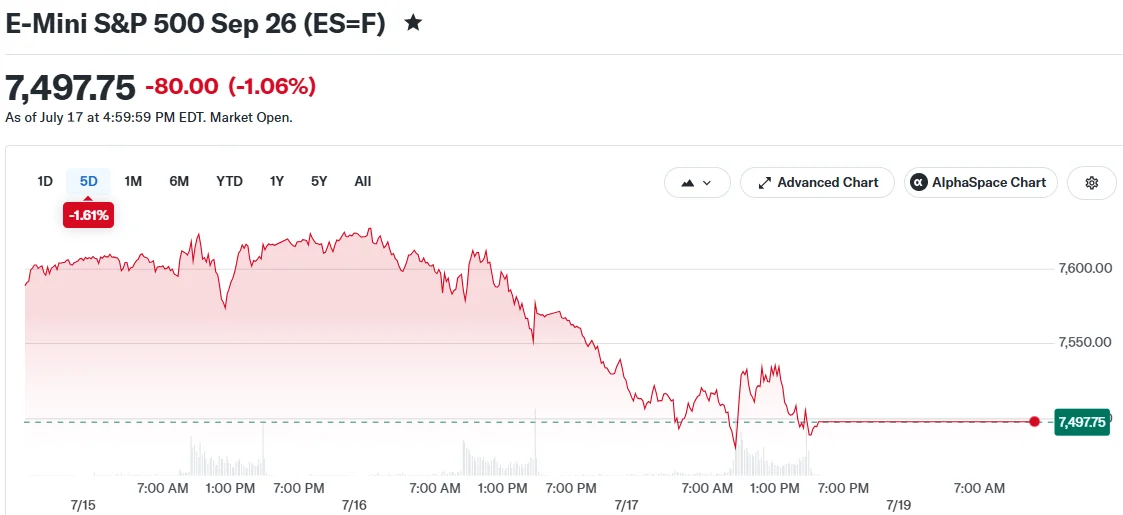
This week marks a critical juncture for Big Tech as Alphabet and Tesla prepare to unveil their quarterly results on Wednesday. The earnings announcements follow a turbulent market period that saw the Nasdaq plunge 2.9% while the S&P 500 declined 1.6%.
Alphabet shares have demonstrated remarkable strength over the previous twelve months, nearly doubling in value. The tech behemoth recently executed a stock offering specifically designated for financing AI-focused data center infrastructure. Market participants are keenly observing whether this substantial capital deployment is yielding tangible results.
However, headwinds have emerged. Intelligence suggests potential postponement of the Gemini 3.5 Pro model rollout, creating downward pressure on Alphabet’s stock price in recent trading sessions.
Scrutiny Intensifies on AI Capital Allocation
The fundamental question facing this earnings cycle centers on whether artificial intelligence investments are converting into actual bottom-line results. Jeff Buchbinder, chief equity strategist at LPL Financial, articulated the shift succinctly: “The market is moving from pricing in promise to pricing in execution.”

Capital expenditure on data center infrastructure from the five dominant hyperscale providers — Microsoft, Alphabet, Amazon, Meta, and Oracle — is projected to reach $644 billion by 2026, representing a staggering 79% annual increase. The investment community is demanding demonstrable returns justifying these massive outlays.
The semiconductor sector posted 79% year-over-year revenue growth during Q1 2026. BNP Paribas analysts anticipate acceleration to 132% expansion in the second quarter. Despite these impressive metrics, chip manufacturer equities have experienced significant correction, with the PHLX Semiconductor index shedding over $3 trillion in aggregate market capitalization since the final days of June.
Tesla’s Wednesday earnings release carries additional significance given CEO Elon Musk’s strategic pivot toward robotics and artificial intelligence applications beyond automotive manufacturing. The electric vehicle manufacturer is implementing a threefold increase in capital spending to support these ambitious initiatives.
Intel’s Thursday earnings announcement will serve as an important barometer for semiconductor sector health overall. The chipmaker’s impressive prior-quarter performance drove share price appreciation, while recent partnerships with Google and participation in the Terafab initiative continue fueling investor optimism.
Crude Prices Surge Amid Deteriorating Middle East Situation
Financial markets absorbed additional volatility from escalating Middle East conflict last week. A tentative diplomatic arrangement between the United States and Iran that had temporarily reduced regional tensions completely unraveled, with military engagement between American and Iranian forces resuming.
Oil flows transiting the strategically vital Strait of Hormuz had rebounded to approximately 10 million barrels daily during early July. By mid-July, that throughput had contracted sharply to a range between 3 and 5 million barrels per day. Goldman Sachs analysts calculate the market now faces a shortfall of 13.4 million barrels daily from Persian Gulf sources.
Brent crude advanced roughly 15% over the week, reclaiming territory above $87.50 per barrel. West Texas Intermediate registered comparable gains of approximately 14%.
Greenback Momentum Persists
The US dollar has appreciated approximately 2.5% relative to a basket of major global currencies year-to-date. Bank of America strategists anticipate further strengthening, attributing their outlook to Middle Eastern instability, international capital flows into American technology equities, and expectations for sustained elevated interest rates.
Bank of America’s forecast incorporates three separate 25-basis-point Federal Reserve rate increases during 2026. Current market pricing reflects expectations for only a single hike. Should Bank of America’s projection prove accurate, this gap between market expectations and actual policy could deliver additional tailwinds for dollar strength.
