



Key Highlights
- Total value locked on Aave plummeted from approximately $48.5B to $30.7B in the aftermath of KelpDAO’s rsETH bridge breach on April 18
- The security incident resulted in estimated bad debt ranging from $196M to $280M for the protocol
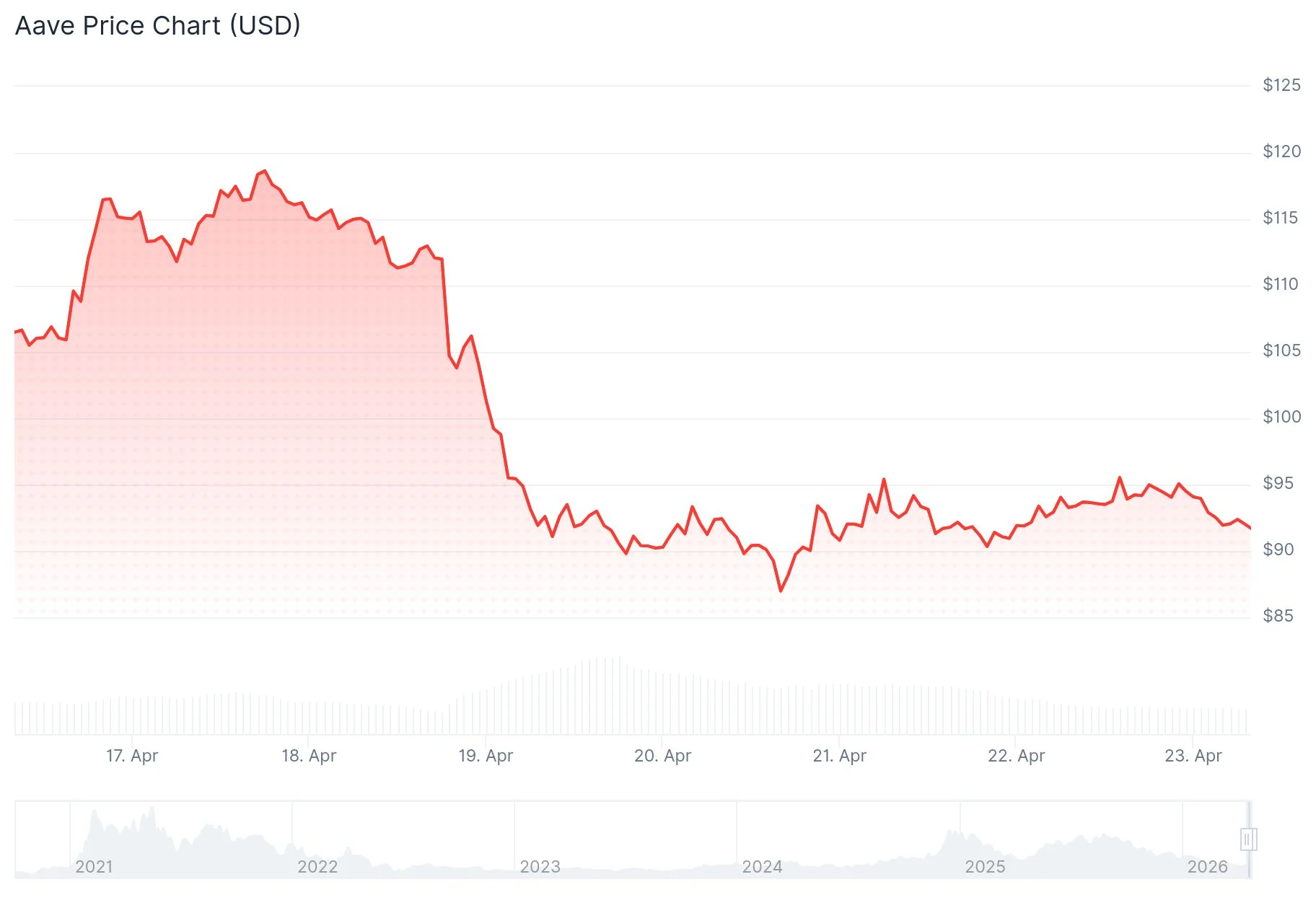
- AAVE token currently trades near $93, reflecting a 7% weekly decline
- Token reserves on exchanges jumped to 2.39M, indicating heightened distribution activity
- Competing platform SparkLend captured approximately $1.3B in deposits as users migrated from Aave
The DeFi lending giant Aave experienced a dramatic $15 billion reduction in total value locked over a span of less than four days, triggered by a critical security breach involving the KelpDAO protocol that sent shockwaves through decentralized finance markets.
The attack exploited a critical weakness in KelpDAO’s rsETH bridging infrastructure. The perpetrator leveraged this vulnerability to generate counterfeit collateral assets, which were then used to extract legitimate ETH holdings from Aave’s lending pools before abandoning the positions. Current assessments place the resulting bad debt exposure somewhere between $196 million and $280 million.
Prior to the April 18 security event, Aave’s platform maintained roughly $48.5 billion in aggregate deposits. Just four days later, on April 22, that metric had contracted to approximately $30.7 billion. Prominent blockchain analyst Wu Blockchain highlighted on X that total withdrawals reached $16.2 billion, effectively erasing over one-third of the protocol’s deposited assets.
Morpho Labs experienced similar turbulence, watching its total value locked decline from $11.7 billion down to $10.2 billion across the identical timeframe.

SparkLend Emerges as Primary Beneficiary
The capital exodus didn’t entirely abandon decentralized finance. SparkLend’s total value locked climbed to $3.2 billion, absorbing roughly $1.3 billion in fresh deposits throughout this turbulent period. Blockchain analytics indicate that depositors actively repositioned their assets toward platforms perceived as offering enhanced security profiles.
The AAVE token was changing hands around $93.45 during publication, showing a modest 1.06% gain over 24 hours. Nevertheless, the asset remains down 7.09% across the trailing seven days and approximately 11% over the monthly timeframe.
Technical indicators on the four-hour chart show the MACD histogram shifting into positive territory while attempting a bullish crossover signal. That said, the RSI indicator hovers around 46, positioned marginally beneath the neutral 50 threshold.
Blockchain Metrics Suggest Continued Selling Activity
Exchange-held reserves of AAVE tokens surged to nearly 2.39 million units. Historically, substantial token transfers to centralized exchanges correlate with impending sell orders from holders.
Active lending positions within Aave are stagnating, borrowing activity has declined, and new capital deployment has noticeably weakened. The divergence between declining TVL and rising exchange flows represents a configuration that market analysts typically interpret as distribution behavior rather than accumulation patterns.
The token price has faced consistent rejection attempts near the $100–$105 zone, establishing this range as immediate overhead resistance. Meanwhile, the $85–$90 corridor represents the critical support threshold requiring close monitoring.
Interestingly, large wallet addresses have continued accumulating AAVE tokens despite the broader outflow trend. Bitcoin maintained levels above $78,000 while Ethereum held above $2,300 at press time, offering generally constructive macro market conditions.
Should buying momentum push prices beyond $96, the subsequent target becomes $100. Successfully breaching $100 would establish a trajectory toward $108. Conversely, failure to maintain $90 support could expose the $88 level, with $84 representing the next significant floor beneath that.
