


Quick Summary
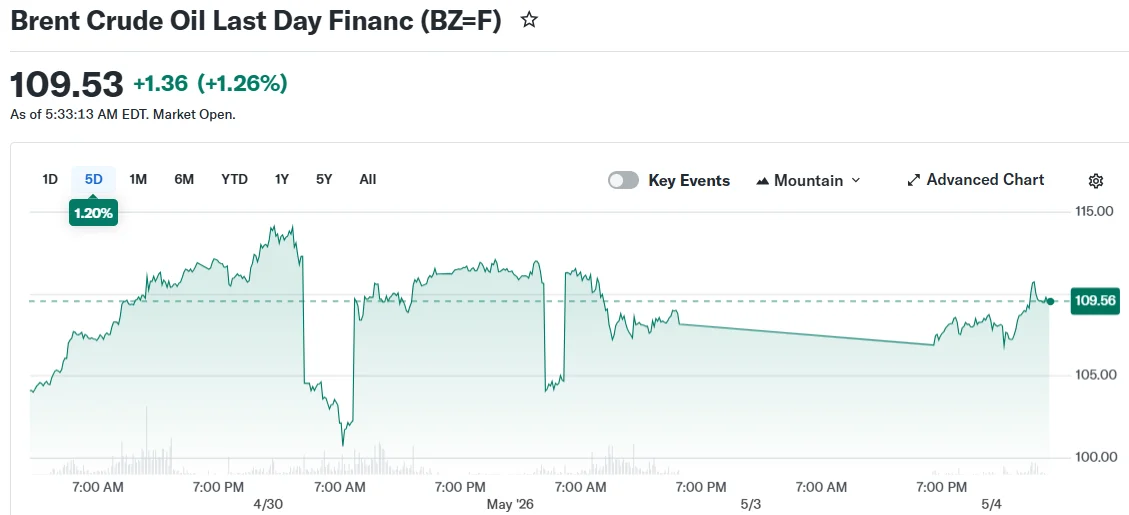
- Brent crude maintained levels above $108 per barrel following a brief 2.4% decline at Monday’s market opening
- Trump declared the United States would assist stranded merchant vessels in departing the Strait of Hormuz
- The initiative currently excludes direct naval warship convoy protection for commercial ships
- A commercial tanker sustained projectile damage 78 nautical miles north of Fujairah on Sunday
- Traders demonstrated minimal belief that the strategy would substantially restore strait operations
Oil prices stabilized on Monday following initial weakness, as market participants evaluated a fresh American initiative to assist trapped vessels in leaving the Strait of Hormuz.
Brent crude remained relatively stable above the $108 per barrel mark after declining as much as 2.4% during opening trade. West Texas Intermediate maintained position near $102 per barrel.
President Donald Trump disclosed via social media platforms that America would commence guiding neutral merchant ships from the strait beginning Monday. “We will use best efforts to get their Ships and Crews safely out of the Strait,” he posted.
US Central Command verified it would deploy military assets, including guided-missile destroyers, aviation resources, and unmanned aerial vehicles. Nevertheless, the Wall Street Journal indicated the strategy currently omits Navy warships providing direct physical escort services.
The declaration proved unable to sustain price increases. Market analysts and commodity traders swiftly raised doubts about the initiative’s potential effectiveness.

“The market does not seem convinced by the plan,” analysts at ING said. “Even if this allows vessels to leave the Persian Gulf, we’re likely to see little inbound traffic.”
Haris Khurshid, chief investment officer at Karobaar Capital, said markets have grown tired of Trump’s statements on the conflict. “Trump fatigue is setting in more and more — I don’t think the market’s really taking it seriously,” he said.
Commercial Vessel Attacked Amid Persistent Regional Tensions
A commercial tanker reported sustaining projectile strikes on Sunday, positioned 78 nautical miles north of Fujairah within United Arab Emirates waters. The UK Maritime Trade Operations documented the incident. While the vessel’s identity remained undisclosed, all crew members were confirmed safe.
Trump additionally suggested military action might be employed should Iran attempt to prevent vessels from departing. He characterized ongoing discussions with Tehran by US representatives as “very positive” without providing additional specifics.
Iran dismissed the American proposal. Any United States intervention in the strait would constitute a ceasefire violation, Al Mayadeen reported, quoting Ebrahim Azizi, chairman of Iran’s parliament’s National Security Commission.
The confrontation originated in late February following combined US and Israeli military operations against Iran, justified by concerns regarding Tehran’s nuclear development. Subsequently, a dual blockade emerged, with Iran preventing outbound Persian Gulf shipping while the US intercepts vessels traveling to or from Iranian harbors.
Supply Constraints Intensify
Treasury Secretary Scott Bessent indicated over the weekend that Iranian oil production facility shutdowns might commence “in the next week” as the nation’s storage capacity reaches maximum levels.
ANZ Group analysts said supply losses are growing each day the strait stays closed. “With the demand response muted, a significant drawdown in inventories has ensued,” they wrote.
Crude oil reached its most elevated price point since 2022 in recent weeks attributable to the ongoing conflict.
OPEC+ members agreed during weekend discussions to implement a modest symbolic June quota increase, as the organization attempted to demonstrate stability following the United Arab Emirates’ withdrawal.
