Key Highlights
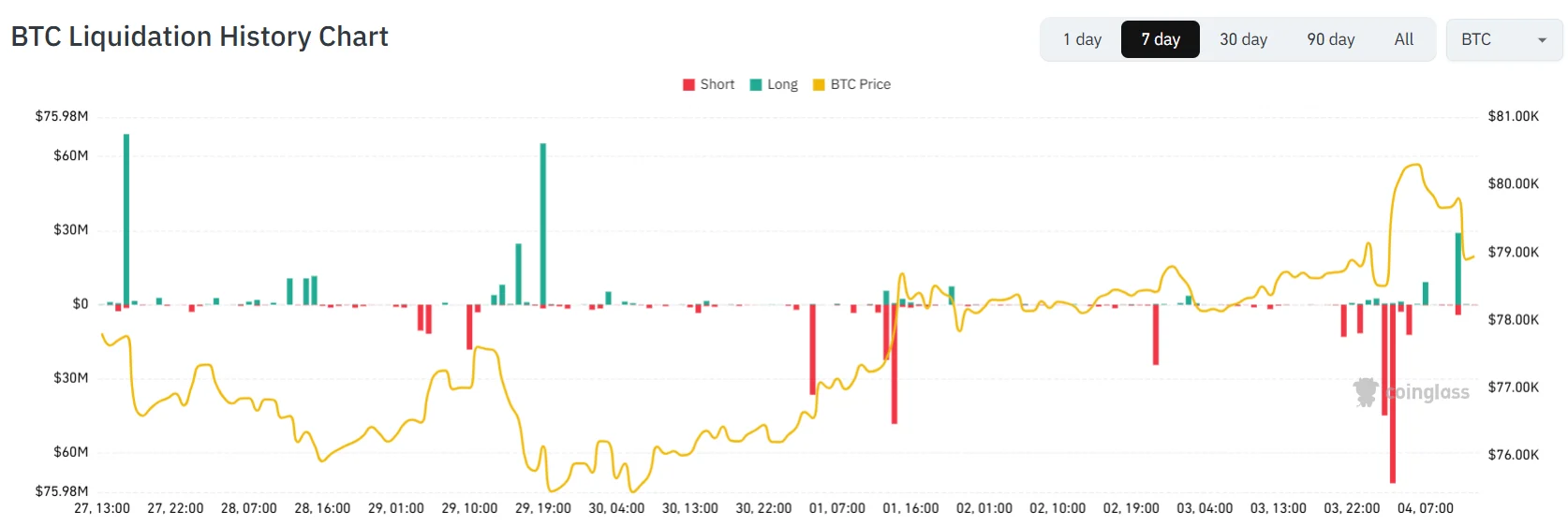
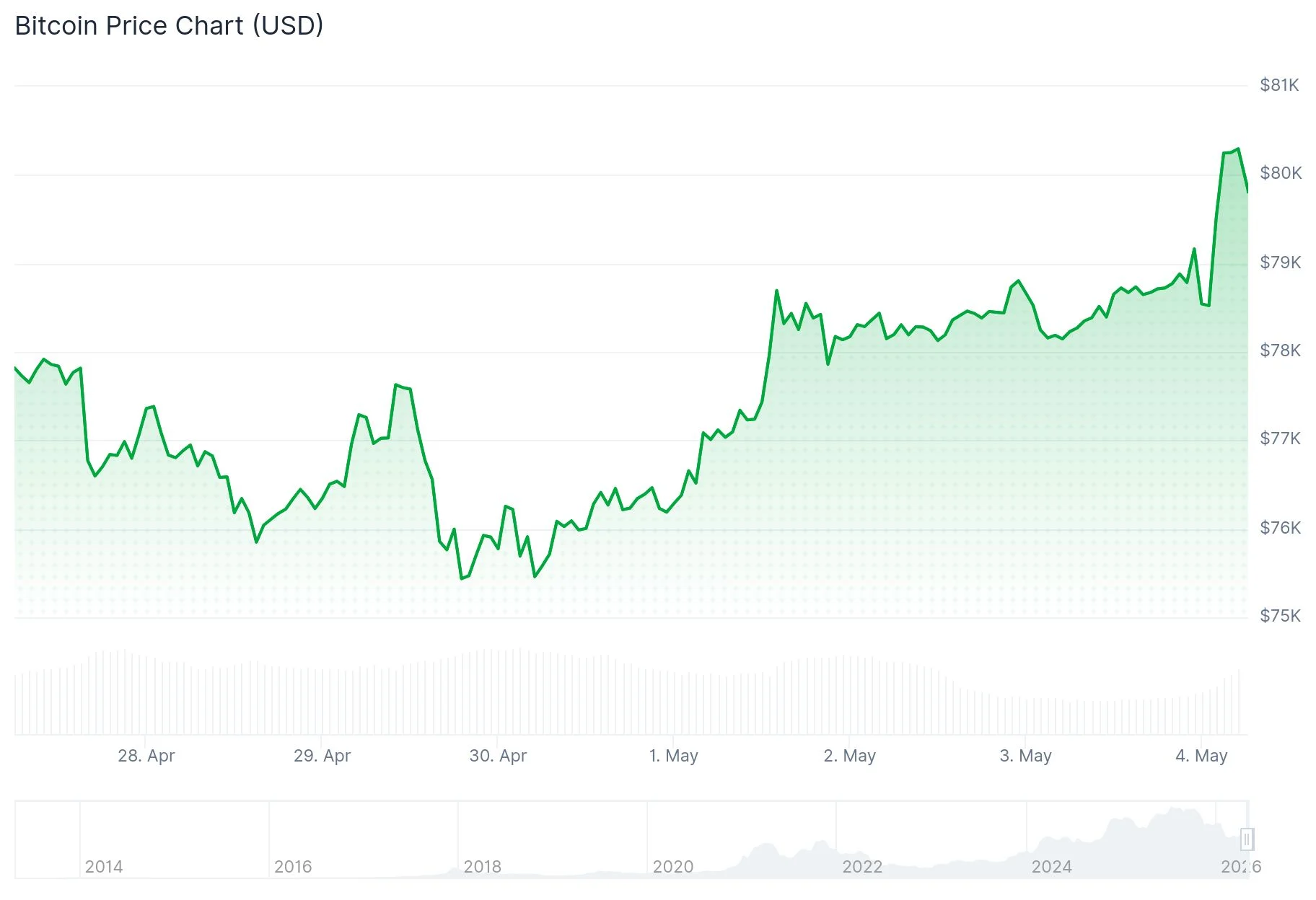
- BTC surpassed the $80,000 threshold for the first time since the beginning of the year, sparking a significant liquidation cascade
- More than $150 million worth of bearish positions were eliminated in just one hour
- Before the price surge, 62.8% of Binance futures contracts were positioned short, with negative funding rates costing traders daily
- Direct spot market demand shows signs of weakness — the price movement was fueled by leveraged positions and ETF capital flows rather than organic market purchases
- According to Polymarket prediction markets, there’s only a 23% probability that Bitcoin will hit $90,000 before the month ends
Bitcoin pushed through the $80,000 price level on Sunday, marking its first appearance above this threshold since early January. The breakout happened swiftly, catching the heavily positioned bearish side of the market off guard.
Based on data from Bitcoin.com News, approximately $150 million in cryptocurrency short positions were forcibly closed during a single 60-minute period. During this timeframe, Binance futures showed that 62.8% of all open positions were betting against BTC.
Funding rates had already shifted into negative territory at -0.0051%, meaning bearish position holders were actually compensating long position holders on a daily basis simply to maintain their trades. Ironically, they were paying a premium to hold positions that would ultimately result in their liquidation.
Anton Palovaara, who founded Leverage.Trading, provided clarity on the situation: “62% of Binance futures traders were short, and funding was negative. The market was literally paying them to hold the position. Bitcoin broke $80,000 and liquidated $150 million of them anyway. The issue was not direction. They ran out of margin before the move resolved. Being paid to hold does not mean you survive it.”
This differentiation is critical. Someone holding a spot position during a downturn can simply wait for market conditions to improve. However, a derivatives trader who exhausts their margin collateral has no such luxury — the platform automatically closes their position, and their capital is lost.

Derivatives Market Amplified the Movement
Call option contracts were heavily concentrated around the $82,000 strike price leading up to the rally. When gamma exposure accumulates at a specific price point, market makers who hedge their exposure tend to sell into upward momentum, establishing resistance precisely where buying pressure needs to break through.
The forced closure of short positions combined with options market dynamics worked in tandem, magnifying the surge beyond $80,000.
However, beneath the surface of these price dynamics, the fundamental demand structure presents a contrasting narrative. CoinDesk, referencing data from CryptoQuant, indicated that actual spot market demand continues to decline.
ETF Capital Flows Haven’t Strengthened Spot Demand
Approximately $2.7 billion in ETF inflows accumulated over a three-week period has failed to generate corresponding support in the spot market. The upward price movement has been sustained primarily through leveraged trading activity and institutional ETF allocations rather than direct marketplace buying.
Polymarket’s prediction markets currently estimate a 56% probability of Bitcoin reaching $85,000 before month-end, with only a 23% chance of touching $90,000.
The $82,000 price point holds the greatest concentration of call option interest, where market maker hedging activities introduce additional selling pressure at precisely the level where upward momentum needs to overcome resistance.
According to the most recent market data, Bitcoin trades above $80,000 following the liquidation event that eliminated $150 million in positions, with 62.8% of Binance futures traders positioned short beforehand, while underlying spot demand remains contracted.