


Key Takeaways
- Zcash experienced approximately 4% growth following Robinhood’s listing announcement
- The privacy coin demonstrated strength while overall cryptocurrency markets declined 2%
- Grayscale submitted documentation to transform its Zcash Trust into a regulated spot ETF
- Technical analyst thatsavibe_eth projects potential $600 valuation upon breaking $390 threshold
- BitMEX founder Arthur Hayes maintains ambitious $10,000 long-term forecast for ZEC
The Zcash (ZEC) token posted nearly 4% gains on Thursday following Robinhood’s confirmation that the privacy-centric digital asset would join its trading platform. At press time, ZEC exchanged hands near $332, bouncing back from its intraday bottom of $312.56.
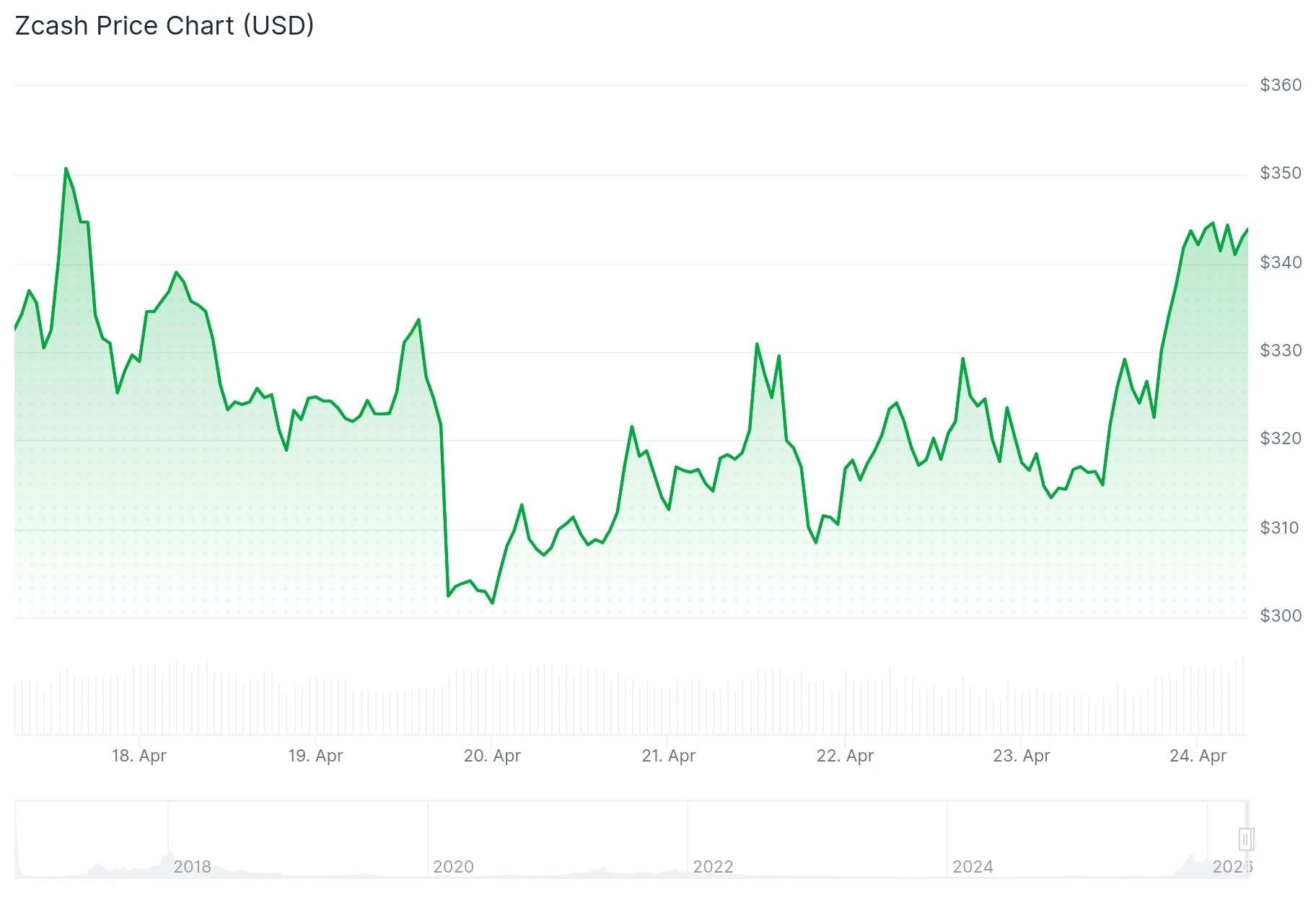
This upward movement occurred against a backdrop of broader market weakness. The aggregate cryptocurrency market capitalization contracted by approximately 2% during the same trading session, highlighting ZEC’s relative outperformance.
Helius CEO Mert Mumtaz emerged as an early supporter of the announcement. Mumtaz has historically advocated for Robinhood to incorporate ZEC and characterized this development as meaningful progress for privacy-oriented digital assets.
Meanwhile, Robinhood continues expanding its international footprint. The trading platform secured In-Principle regulatory approval from Singapore’s Monetary Authority, enabling it to deliver brokerage solutions throughout that jurisdiction.

Growing Institutional Interest
Grayscale has submitted formal paperwork seeking to restructure its Zcash Trust into a spot exchange-traded fund. Should regulators grant approval, this would represent the inaugural privacy-focused cryptocurrency ETF operating under traditional market oversight. Market observers forecast potential capital inflows ranging from $500 million to $2 billion.
The Zcash Open Development Lab successfully concluded a $25 million capital raise in recent months. The funding round attracted participation from prominent investors including Paradigm, a16z, and Coinbase Ventures. This initiative aims to construct an expansive private financial ecosystem rather than simply supporting a specialized digital currency.
Emerging products such as the cashZ wallet alongside enhancements to the Zashi wallet platform are designed to streamline private transaction capabilities for mainstream adoption.
Blockchain analytics reveal an increasing percentage of ZEC tokens are being secured within shielded pools. When combined with diminished token issuance rates following the 2024 halving event, the circulating supply available for trading continues contracting.
Critical Resistance and Support Zones
Examining the 4-hour technical chart, ZEC successfully escaped a descending parallel channel formation—a pattern traders commonly interpret as signaling the conclusion of a corrective movement. The Supertrend indicator transitioned to bullish territory, while the MACD histogram registered a positive crossover.
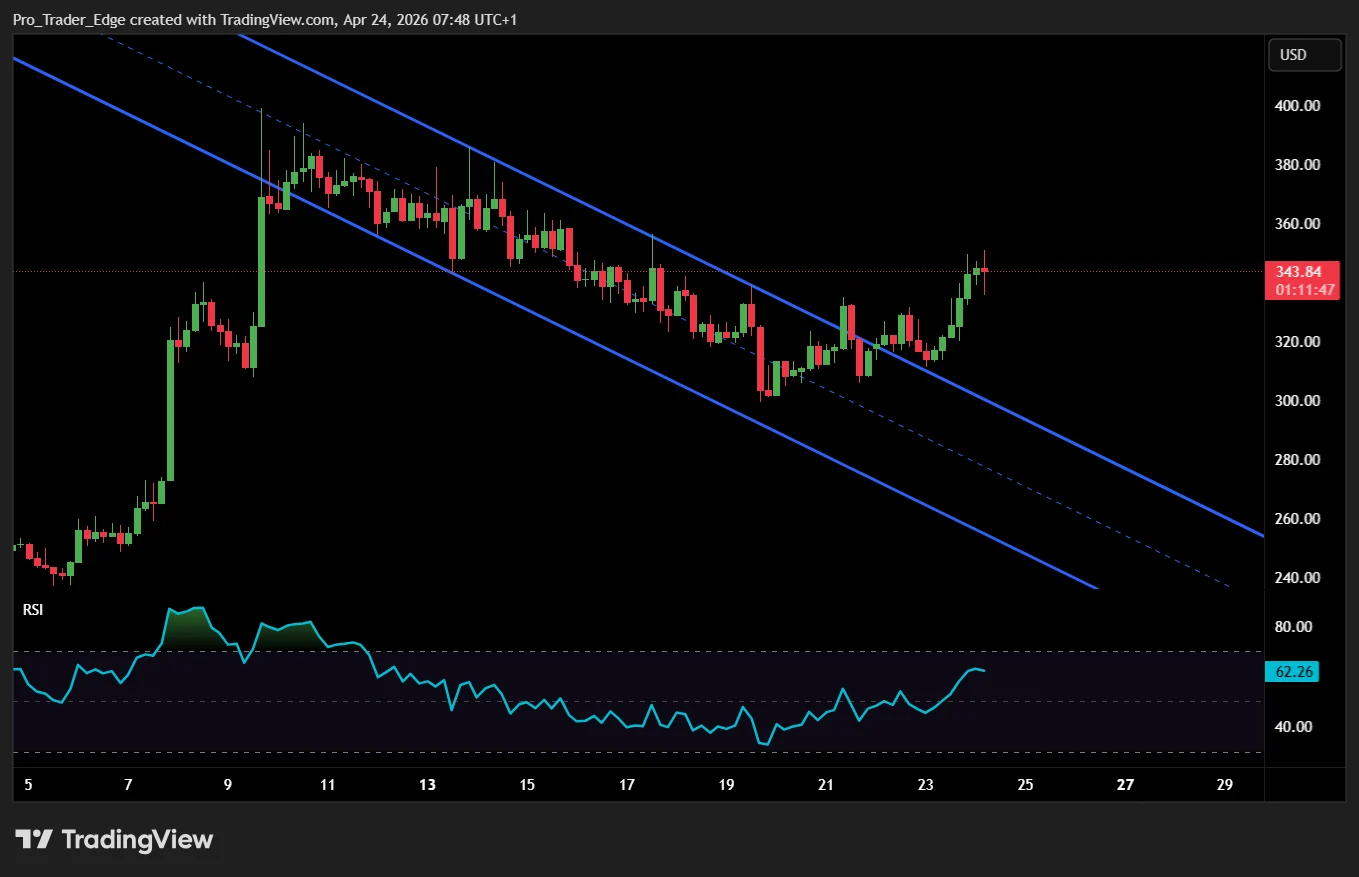
ZEC currently confronts overhead resistance spanning the $337 to $361 range. A decisive breakthrough above this consolidation area could establish a trajectory toward the psychologically significant $400 benchmark, with potential extension to $450 should buying pressure persist.
Technical analyst thatsavibe_eth, publishing analysis through TradingView, established a $600 price objective while emphasizing that ZEC must initially overcome the $390 barrier. The optimistic scenario becomes invalidated should ZEC surrender the $300–$310 foundational support region.
Arthur Hayes, co-founder of BitMEX, has publicly identified ZEC as his preferred alternative cryptocurrency investment. In a 2025 social media statement on X, Hayes outlined an ambitious long-range price projection of $10,000 for the privacy token.
As of this writing, ZEC maintained trading activity around the $332 level, preserving gains above the $330 threshold established following Robinhood’s integration announcement.
