



Key Highlights
- ZEC surged over 12% during Tuesday’s session, crossing the $500 threshold for the first time since early June
- Developers behind Project Tachyon are approaching completion of a mathematical verification confirming Ironwood’s shielded pool is free from undetectable inflation vulnerabilities
- The Ironwood network upgrade is set to launch later this month, featuring a “turnstile” mechanism for secure migration
- AI-powered proof systems have accelerated verification timelines from years to mere weeks
- Market observers identify the $480–$500 zone as critical support, with upside targets approaching $530
Zcash (ZEC) posted impressive gains exceeding 12% during Tuesday’s trading session, temporarily pushing past the $500 mark for the first time in over three months. The price surge followed a significant development update regarding Project Tachyon, an initiative focused on providing mathematical certainty that the forthcoming Ironwood shielded pool contains no exploitable counterfeiting vulnerabilities.
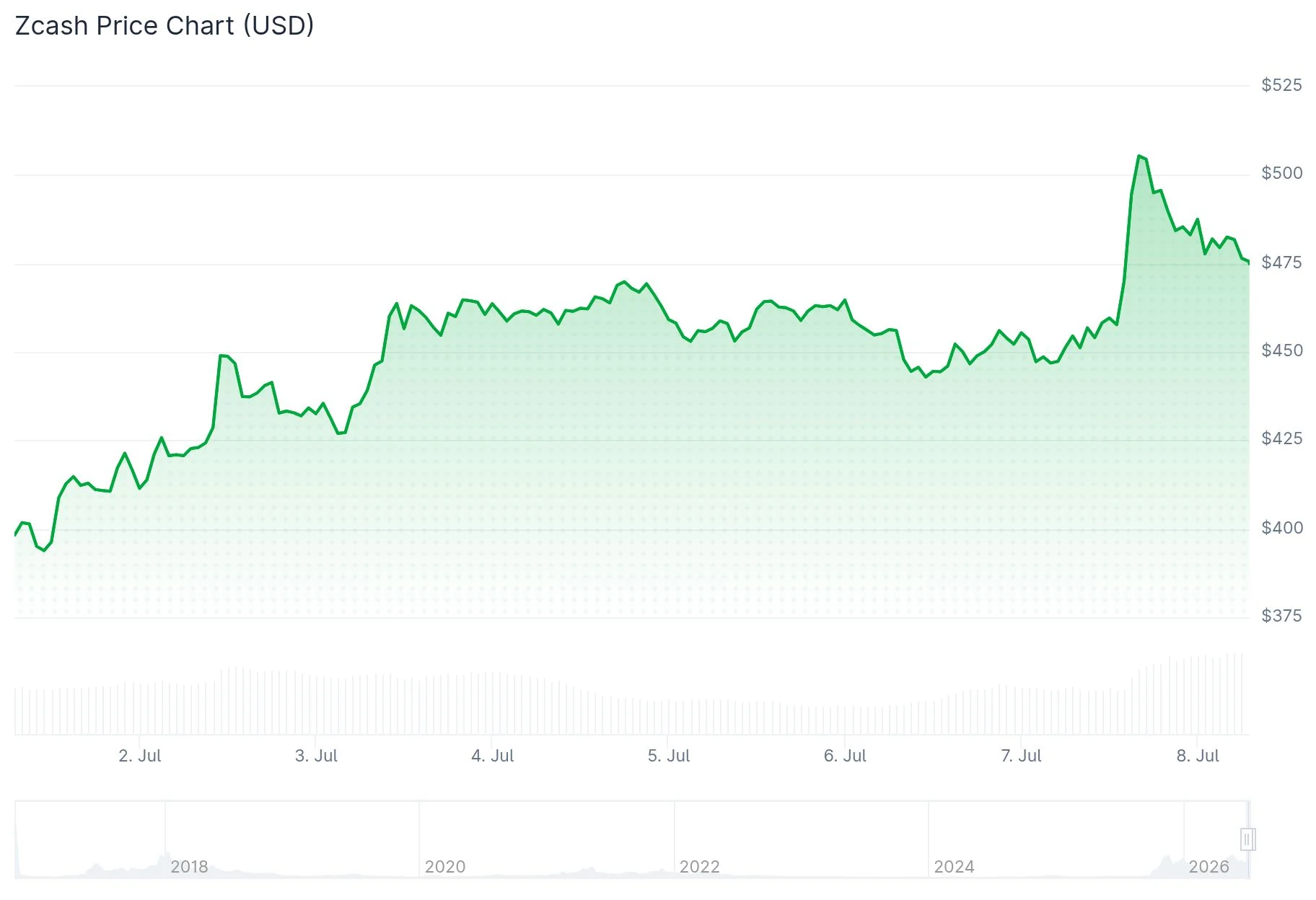
As of the latest data, ZEC was changing hands near $496.
The price action was particularly noteworthy given Bitcoin’s relatively muted performance during the same period. ZEC emerged as one of the top-performing alternative cryptocurrencies in the session, breaking away from an otherwise stagnant market environment.
Understanding Project Tachyon’s Mission
Zcash creator Zooko Wilcox announced that the initiative is “on the verge of producing a mathematical proof that there are no undetectable counterfeiting bugs in the latest Zcash shielded pools.”

The significance of this development becomes clear when examining recent events. Just last month, security researchers identified a critical vulnerability within Zcash’s Orchard shielded pool that theoretically allowed malicious actors to mint counterfeit ZEC tokens without detection. While developers successfully implemented a fix and maintained that the exploit was never activated, Zcash’s privacy-focused architecture made absolute verification impossible. News of the vulnerability triggered a dramatic 40% price decline over two days.
Ironwood represents the protocol’s next-generation replacement for the Orchard pool. The upgrade incorporates a “turnstile” migration framework that enables users to transfer assets from Orchard while simultaneously generating verifiable evidence that no hidden inflation occurred during the process.
Vadim Zacodil, formerly with NEAR Protocol, drew parallels to Bitcoin’s notorious 2010 inflation exploit, when an attacker briefly generated 184 billion fraudulent bitcoins. Bitcoin’s transparent ledger structure allowed immediate detection and remediation. Zcash’s privacy-preserving transaction model operates under different constraints, necessitating the formal verification approach Project Tachyon is pursuing.
According to Project Tachyon representatives, AI-enhanced proof generation technology has dramatically accelerated the verification timeline—transforming what previously required years into a process measured in weeks.
Critical Price Levels Under Market Surveillance
ZoneCrypto’s analysis highlighted that ZEC successfully breached its 30-day exponential moving average positioned around $448 and recovered the 23.6% Fibonacci retracement level near $498, signaling improved market momentum.
Analyst Ardi identified a composite resistance cluster around $480, where a declining trendline intersected with horizontal resistance. According to his assessment, multiple failed attempts to break this level established conditions for the subsequent breakout. Sustained trading above $480 could pave the way toward the lower $530 range.
ChiefraF’s analysis emphasized a longer-duration trendline originating in February that has provided consistent support during multiple corrections. He observed that the prior rebound from this support zone propelled ZEC from approximately $360 to $730.
The Ironwood upgrade remains on schedule for deployment within the current month. Market participants are now focused on confirmation of the precise activation date as the next critical catalyst.
