


Key Takeaways
- Zcash (ZEC) experienced approximately 40% decline following revelation of a severe security vulnerability in its Orchard shielded pool
- The flaw was identified as a “soundness” issue within the zero-knowledge proof circuit, potentially existing since 2022
- Taylor Hornby, a security specialist, discovered the vulnerability utilizing Anthropic’s Claude Opus 4.8 AI technology
- Investigation revealed no confirmed instances of exploitation, with the network’s turnstile safeguard preventing unauthorized token creation
- The Zcash team executed a rapid emergency soft fork followed by a comprehensive hard fork (NU6.2) to resolve the vulnerability
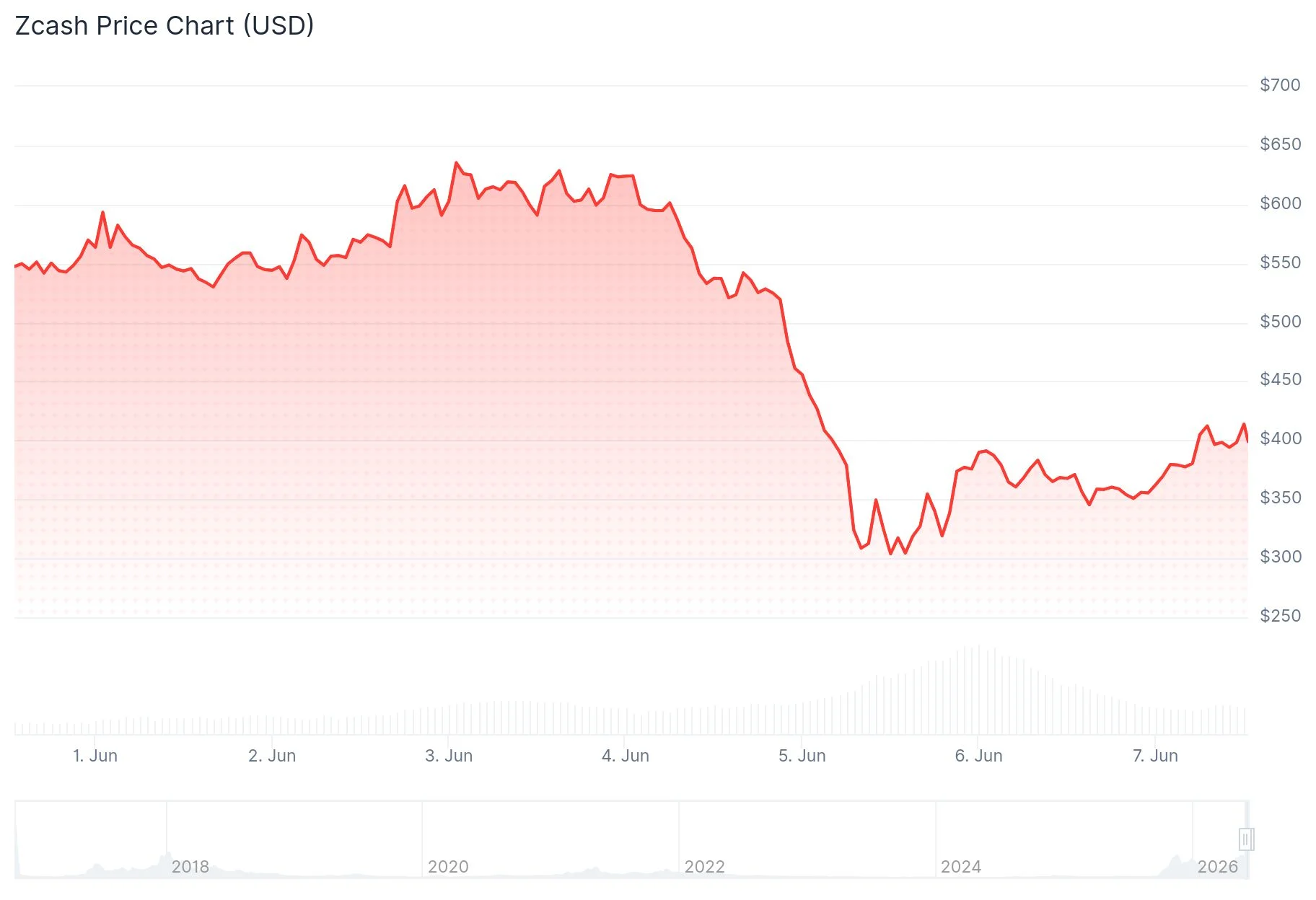
In early June 2026, Zcash (ZEC) experienced a dramatic 40% price decline after the network revealed and remediated a critical security vulnerability affecting its Orchard shielded pool. The market reaction wiped out over $3 billion in market capitalization, sending the token price beneath the $350 threshold.
The security issue was characterized as a “soundness” defect within Zcash’s zero-knowledge proof circuit architecture. Evidence suggests the vulnerability may have been present since the Orchard pool’s initial deployment in May 2022, remaining undetected despite numerous security assessments.
On May 29, 2026, security expert Taylor Hornby identified the flaw during research activities funded by Shielded Labs. The breakthrough came through utilizing Anthropic’s Claude Opus 4.8 AI system combined with specialized analytical tools.
Hornby successfully collaborated with the AI to create a functional proof-of-concept capable of generating fraudulent ZEC tokens within a controlled testing environment. Despite this capability, the network’s built-in turnstile mechanism effectively prevented any real-world unlimited supply inflation.

Implementation of the Emergency Patch
The Zcash development community responded with exceptional speed. On June 2, an emergency soft fork was released through Zebra 4.5.3, which temporarily halted Orchard transactions to eliminate the vulnerability vector.
A comprehensive solution arrived on June 3 via the NU6.2 hard fork, which activated at block height 3,364,600. This update implemented a corrected circuit design and deployed a new verifying key. Following this implementation, Orchard capabilities were fully restored.
On June 4, Zcash co-founder Zooko Wilcox joined Jason McGee and Taylor Hornby in publishing a comprehensive public disclosure of the security incident. Their statement confirmed no evidence of exploitation and verified the total ZEC supply remained accurate.
Cryptocurrency analyst Ardi (@ArdiNSC) provided his perspective on the price movement following the collapse. He observed that ZEC relinquished nearly its entire multi-month rally—approximately 250% gains—within just days. He anticipates a temporary relief bounce toward the $430–$480 zone, potentially followed by further downside if that region fails to establish support. His outlook would shift only upon seeing consecutive closes exceeding $520.
Community Response and Market Volatility
ZEC had momentarily exceeded $600 before market sentiment deteriorated once vulnerability details became public knowledge. The decline below $350 intensified following reports that prominent investor Arthur Hayes had exited his ZEC holdings.
A primary concern among market participants centered on Zcash’s privacy-focused architecture, which makes complete verification of potential exploitation practically impossible. Unlike Bitcoin’s transparent ledger, transactions within the shielded pool remain privately encrypted.
Shielded Labs announced future initiatives including expanded AI-powered security audits, a formal verification program for the Orchard circuit, and potential development of an enhanced shielded pool featuring improved supply verification capabilities.
Cameron Winklevoss characterized the incident as evidence of the project’s resilience, noting that top-tier security researchers continuously examine and strengthen the network infrastructure.
Current reports indicate no exploitation has been verified, the NU6.2 upgrade is operational, and ZEC continues trading below the $400 level.
