



TLDR
- Federal Reserve’s April policy meeting minutes revealed most central bank officials remain willing to increase interest rates should inflationary pressures persist.
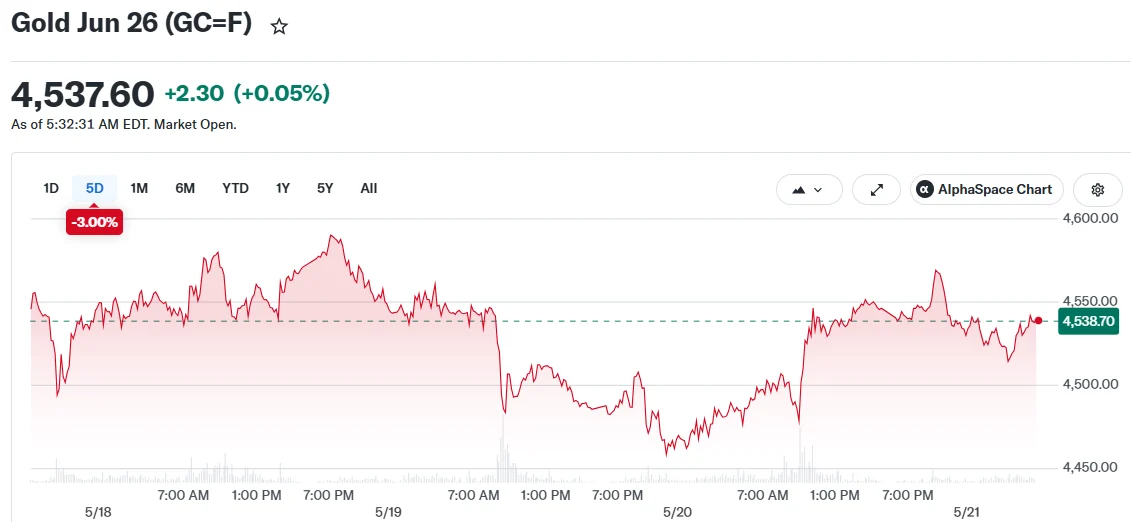
- Gold prices declined approximately 0.4% to roughly $4,526 per ounce during Thursday’s Asian trading session.
- Inflationary pressures have accelerated significantly in recent months, primarily fueled by elevated energy costs stemming from the ongoing U.S.-Iran military conflict.
- Iranian officials announced they are examining Washington’s most recent peace offering, while President Trump cautioned that additional military operations may occur without a diplomatic agreement.
- The critical Strait of Hormuz shipping passage continues to operate at severely restricted capacity, maintaining pressure on oil markets.
Precious metal prices retreated during Asian market hours Thursday following the release of Federal Reserve meeting minutes that suggested potential monetary tightening ahead. The decline occurred as conflicting developments in the U.S.-Iran military standoff continued to generate market volatility.
Spot gold decreased 0.4% to reach $4,526.48 per ounce. Corresponding gold futures contracts similarly declined 0.4% to close near identical levels.
Central Bank Minutes Trigger Rate Increase Concerns
The official record from the Federal Reserve’s late-April policy gathering indicated that a substantial majority of committee members expressed readiness for “some policy firming.” This language suggests interest rate increases could materialize should inflation fail to moderate.
Inflationary dynamics have intensified considerably across the previous two-month period. Escalating energy costs, directly attributable to the continuing Iranian military engagement, represent the primary catalyst.

Escalating inflation has driven bond yields significantly higher. This development creates headwinds for gold, which generates no income stream. As yields climb, the opportunity cost of maintaining gold positions increases, diminishing its appeal to market participants.
Gold has experienced approximately 14% depreciation since military hostilities commenced in late February. Recent trading activity has confined prices within a compressed range, lacking clear directional momentum.
Other precious metals experienced similar weakness Thursday. Spot platinum retreated 0.8% to $1,938.92 per ounce, while silver declined 0.4% to $75.53 per ounce.
Market strategists at MUFG indicated that gold would probably require either diminishing inflationary pressures or more definitive evidence that economic deceleration concerns are superseding inflation worries before meaningful price recovery can materialize.
Iranian Diplomatic Developments Maintain Market Uncertainty
Regarding geopolitical developments, Iranian authorities confirmed they are assessing the United States’ most recent diplomatic proposal. This announcement followed President Trump’s earlier statements this week characterizing negotiations as progressing favorably.
Trump declared the military conflict has entered its “final stages” and expressed willingness to allow “a few days” for Iranian officials to engage in substantive talks. However, he simultaneously cautioned that absent a diplomatic resolution, American military operations would recommence.
Trump emphasized that Washington’s paramount objective continues to be preventing Iranian nuclear weapons capability.
The Strait of Hormuz, representing a critical artery for international petroleum transportation, remained substantially restricted. This situation continues preventing any substantial decline in crude oil prices despite modest relief observed earlier in the trading week.
Gold traditionally appreciates during periods of geopolitical instability, yet those safe-haven characteristics were eclipsed Thursday by mounting apprehension regarding higher borrowing costs.
Market analysts emphasized that gold’s subsequent trajectory hinges upon whether inflationary forces subside or economic growth anxieties emerge as the dominant narrative.
Presently, market participants are monitoring both Federal Reserve communications and Iranian situation developments closely for emerging signals.
