



Key Takeaways
- For the first time since 2014, XRP has recorded six straight months of negative price action, plummeting over 60% from its peak of $3.65.
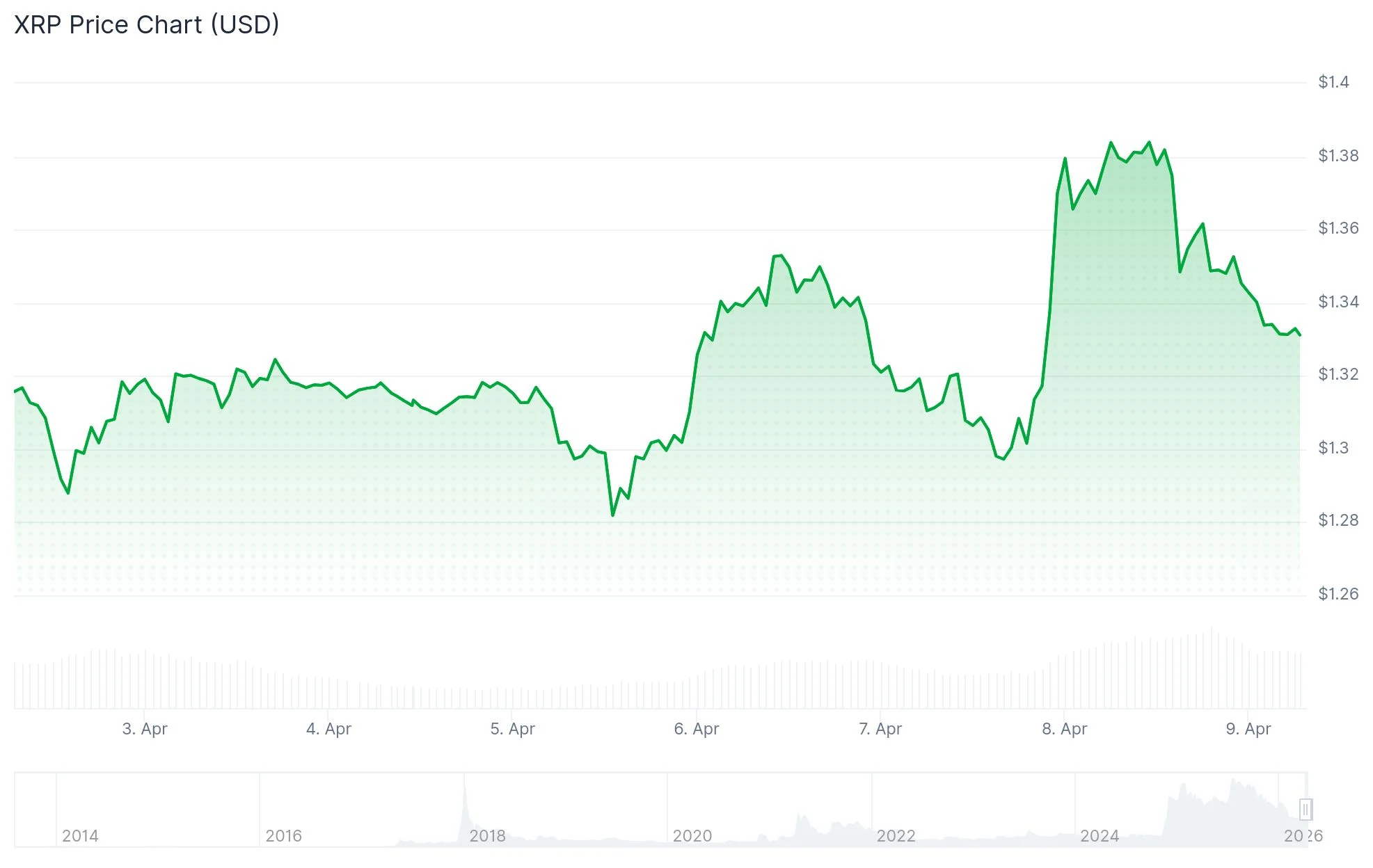
- Recent trading saw XRP slip from $1.37 down to $1.33, as profit-takers consistently emerged at the $1.37–$1.38 resistance barrier.
- Exchange-traded products tied to Ripple registered $3.32 million in capital inflows, marking a departure from March’s outflow trend, though insufficient to halt downward momentum.
- Data from CryptoQuant reveals that large holder addresses have been accumulating more than 11 million XRP daily based on 30-day rolling averages as of early April.
- Breaking the losing pattern requires just a monthly settlement above $1.33, with potential triggers including the CLARITY Act passage and Bitcoin’s ongoing rally.
Ripple’s XRP token has now recorded half a year of consecutive monthly declines, representing its longest bearish run in a decade. From its cycle peak of $3.65 achieved last July, the asset has shed more than 60% of its value. While brief momentum toward $1.40 materialized recently, selling pressure quickly reasserted control.
The downward spiral commenced in October 2025 when former President Trump’s announcement of comprehensive 100% tariffs on Chinese goods sparked the crypto market’s most severe single-day liquidation event on record. Approximately $19 billion in leveraged trading positions evaporated within a 24-hour window. XRP tumbled from above $2.80 to sub-$2.00 levels in the immediate aftermath.
Attempts at price recovery during November and December faltered amid persistent ETF capital flight and deteriorating institutional sentiment. Subsequently, in late February 2026, geopolitical tensions intensified when the Iran situation escalated, driving crude oil prices beyond $100 per barrel following the closure of the Strait of Hormuz shipping lane.
The Federal Reserve’s response included upward revisions to inflation projections, which prompted institutional investors to rotate capital away from speculative assets. Positive XRP developments throughout 2026—such as commodity classification efforts, ETF capital inflows, and strategic partnership announcements from Ripple—proved insufficient to counteract these broader macroeconomic headwinds.

Distribution pressure from existing XRP holders compounded the challenge. Approximately 60% of the circulating token supply remains underwater. Whenever prices approached the $1.44 average acquisition cost, holders liquidated positions to minimize losses. This cyclical selling pattern manifested during every bounce attempt from November through March.
Distribution Dominates Near Critical Price Zones
Analyzing the hourly timeframe reveals XRP’s descent from $1.37 to $1.33, with accelerated downside following rejection at the $1.38 level. Elevated trading volumes accompanied the selloff, validating the bearish move. Later in the trading session, price briefly tested $1.31 before stabilizing slightly, though subsequent recovery efforts lacked conviction.
A descending trendline has established itself with overhead resistance positioned at $1.3550. Current trading occurs beneath the 100-period Simple Moving Average on hourly charts. Expanding volume coupled with declining prices indicates distribution activity rather than strategic accumulation.
Ripple-associated exchange-traded funds documented $3.32 million in net inflows, contrasting with the previous month’s withdrawal pattern. Nevertheless, available exchange liquidity has contracted, amplifying the potential for volatile price swings should critical support zones fail. Immediate support rests at $1.33, while the pivotal level commanding attention sits at $1.28.
Major Holders Accumulate at Fastest Pace in Nearly a Year
According to CryptoQuant analytics dated April 6, whale-sized wallet accumulation has reached its highest level in ten months. Substantial addresses have been acquiring in excess of 11 million XRP tokens daily when measured across a 30-day moving average. Simultaneously, exchange withdrawals have intensified, constricting available selling inventory.
Last week, XRP dominated cryptocurrency ETF inflow rankings with $120 million in fresh capital. Bitcoin has ascended beyond $71,000 while XRP currently changes hands above $1.35.
March concluded with XRP settling at $1.33. Any monthly closing price exceeding that threshold would terminate the six-month negative sequence. The CLARITY Act, legislation that would establish permanent digital commodity classification for XRP under federal regulatory framework, may advance should the Senate Banking Committee finalize its review process during late April.
