



Key Takeaways
- All three major index futures—Dow, S&P 500, and Nasdaq—declined Wednesday morning as Q3 commenced
- Federal Reserve Chair Kevin Warsh delivering remarks at ECB’s Portugal forum; investors seeking monetary policy direction
- Market expectations for Fed interest rate increases intensifying, with 10-year Treasury yields holding at 4.471%
- Diplomatic efforts with Iran collapsed after Iranian representatives declined meeting with Trump administration in Qatar
- Crude oil prices retreated approximately 1% following breakdown in negotiations and renewed Strait of Hormuz closure warnings
American equity futures retreated Wednesday, July 1, launching the third quarter with a hesitant tone. Market participants concentrated on Federal Reserve Chairman Kevin Warsh’s scheduled appearance at a European Central Bank conference in Portugal.
Futures tied to the Dow Jones Industrial Average declined approximately 0.2% to 0.3%. Contracts linked to the S&P 500 fell roughly 0.2%, while Nasdaq 100 futures experienced losses reaching 0.5%.
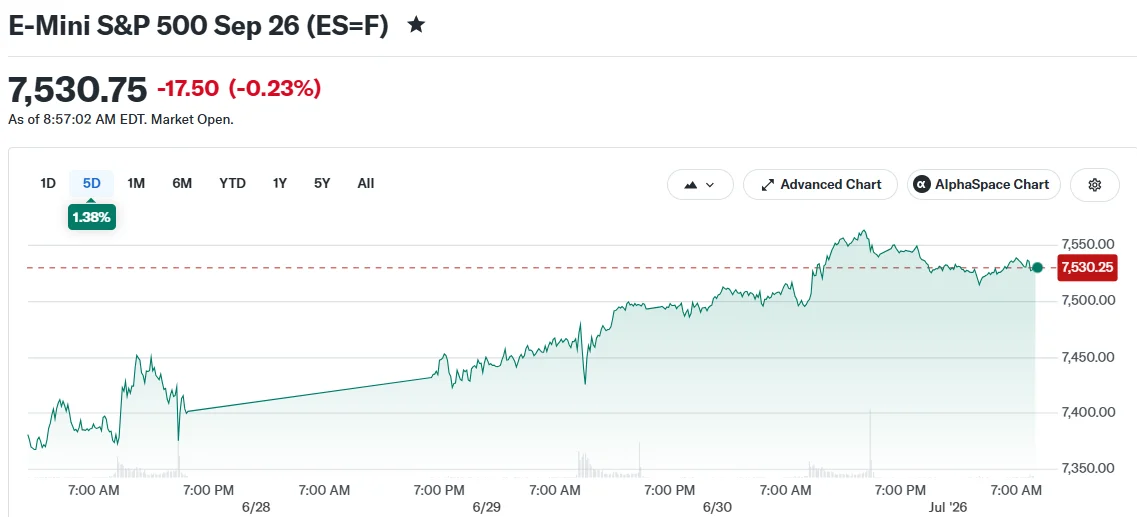
The morning weakness follows an impressive second-quarter performance. The S&P 500 advanced 15% during Q2, with the Nasdaq surging 21%. Both indices recorded their strongest quarterly gains since 2020. The Dow climbed 13%, marking its best three-month period since 2022.
Traders Await Warsh Commentary for Monetary Policy Clues
Warsh was set to deliver remarks at the ECB’s yearly policy gathering in Sintra, Portugal at 9 a.m. Eastern time Wednesday. Market participants monitored closely for any indications regarding future interest rate policy.

Wall Street anticipated Warsh would avoid explicit forward guidance. However, any observations on inflationary pressures or economic conditions could influence trading, particularly as speculation around rate increases intensifies.
ING analyst Chris Turner noted that consumer confidence readings have exceeded expectations while U.S. stock markets remain near recent peak levels. He suggested this environment would make it challenging for Warsh to adopt a more dovish stance.
The 10-year Treasury yield remained at 4.471%, essentially unchanged from Tuesday’s close. The Japanese yen touched a fresh four-decade low versus the dollar, partially reflecting heightened expectations for Fed tightening.
ADP’s employment report revealed the U.S. private sector added 98,000 positions in June. This data, combined with Challenger job cut figures, was establishing context for Thursday’s official June employment report from the Labor Department.
The government jobs data is being published one day earlier than usual due to the Independence Day holiday. Market observers were simultaneously monitoring manufacturing indicators for additional insights into U.S. economic momentum.
Iranian Diplomatic Efforts Collapse, Energy Markets React
Negotiations in Qatar reached an impasse Wednesday. Iranian officials announced their delegation would refuse to engage with President Trump’s representatives, diminishing prospects for a comprehensive agreement.
Oil prices erased morning advances and declined roughly 1%. Brent crude futures dropped toward $72 per barrel, while WTI crude fell beneath $69.
Crude had been trading near $70 per barrel, approximating price levels observed before the Iran conflict escalation. Iran’s Islamic Revolutionary Guard Corps had previously issued warnings about closing the Strait of Hormuz once more without assurances regarding control of the strategic waterway.
According to the Wall Street Journal, Trump has informed advisers he is willing to allow negotiations to extend beyond the August 18 deadline established for a nuclear agreement.
Micron and Sandisk numbered among technology stocks experiencing notable premarket losses. Gold retreated below $4,000 per ounce amid concerns about higher interest rates.
