



Key Highlights
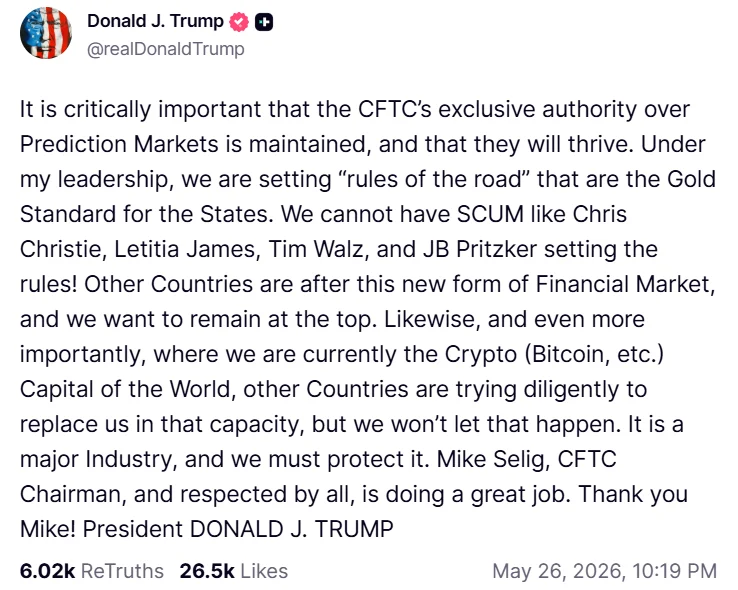
- President Trump declared via Truth Social that the CFTC should maintain “exclusive authority” over prediction market regulation
- Multiple states including New York, Illinois, and Minnesota have launched legal challenges or enforcement actions against prediction market operators
- The CFTC has initiated legal action against various states to defend its regulatory jurisdiction under federal commodity law
- Donald Trump Jr. holds advisory positions with both Polymarket and Kalshi
- Legal disputes have escalated to federal appeals courts with potential Supreme Court implications
President Donald Trump has issued a strong endorsement for the Commodity Futures Trading Commission to serve as the exclusive regulatory body overseeing prediction markets across America, declaring that maintaining this federal authority is “critically important.”
The president shared his position through his Truth Social account on Tuesday, directly addressing state-level officials who have pursued enforcement measures against prediction market operators.
President Challenges State Leadership Directly
Trump specifically named New York Attorney General Letitia James, Illinois Governor J.B. Pritzker, Minnesota Governor Tim Walz, and former New Jersey Governor Chris Christie in his statement.
James has initiated legal proceedings claiming certain prediction markets breach state gambling regulations. Illinois authorities issued cease-and-desist directives to several platforms. Minnesota recently enacted legislation establishing criminal sanctions for those running prediction markets within its borders.

Governor Pritzker responded on Bluesky, asserting that Illinois took action to “prevent and ban insider trading with online prediction markets.” He suggested Trump’s motivation was protecting his family’s business connections to the sector.
Donald Trump Jr., the president’s son, maintains advisory roles with both Polymarket and Kalshi, leading prediction market platforms operating in the United States.
Federal Versus State Regulatory Jurisdiction Clash
The fundamental question driving this conflict is whether prediction market contracts should be classified as financial instruments or gambling activities. The CFTC maintains these products fall within its regulatory scope as derivative contracts governed by the Commodity Exchange Act.
State governments contend these represent gambling operations that must comply with or be prohibited under state gaming statutes.
CFTC Chair Mike Selig has initiated legal proceedings and filed friend-of-the-court briefs challenging multiple states, including New York, Illinois, Minnesota, and Arizona.
Platforms such as Kalshi have launched their own lawsuits against state regulators, maintaining they operate exclusively under federal CFTC oversight.
These legal challenges have advanced to federal circuit court levels. Legal analysts suggest this constitutional question may ultimately require Supreme Court resolution.
International Competition and Cryptocurrency Strategy
Trump’s statement also addressed global competitive concerns. Multiple nations, including Indonesia, Spain, and India, have implemented bans on prediction markets within the last seven days.
“Other Countries are after this new form of Financial Market, and we want to remain at the top,” Trump stated. He connected this to his broader objective of maintaining America’s position as the “crypto capital of the world.”
This past March, the CFTC established a specialized advisory group dedicated to supervising event contract listings and trading activities while enforcing anti-manipulation regulations.
A congressional committee in the House of Representatives launched its own inquiry into prediction markets, as confirmed in recent days.
Gemini, the cryptocurrency exchange established by Cameron and Tyler Winklevoss, recently unveiled its prediction market offering and submitted documentation to self-certify parlay-style contracts.
