


Key Takeaways
- The 30-year U.S. Treasury yield surged to 5.14%, marking a 20-year peak, while the 10-year climbed to 4.62%, its strongest reading in over a year
- Elevated yields threaten stock market valuations, with the S&P 500’s forward P/E ratio at 21.3x — significantly above the historical norm of 16x
- Robust first-quarter earnings growth of 28% year-over-year continues to support equity prices
- Oil prices exceeding $100 per barrel due to Middle East tensions and Strait of Hormuz disruptions are intensifying inflation worries
- Market strategists caution that equities haven’t adequately factored in the possibility of sustained inflationary pressures
U.S. government bond yields soared to their highest points in years during Monday’s trading session as a widespread selloff gripped fixed-income markets worldwide. Market participants are increasingly questioning whether equity markets have properly accounted for escalating inflation threats.
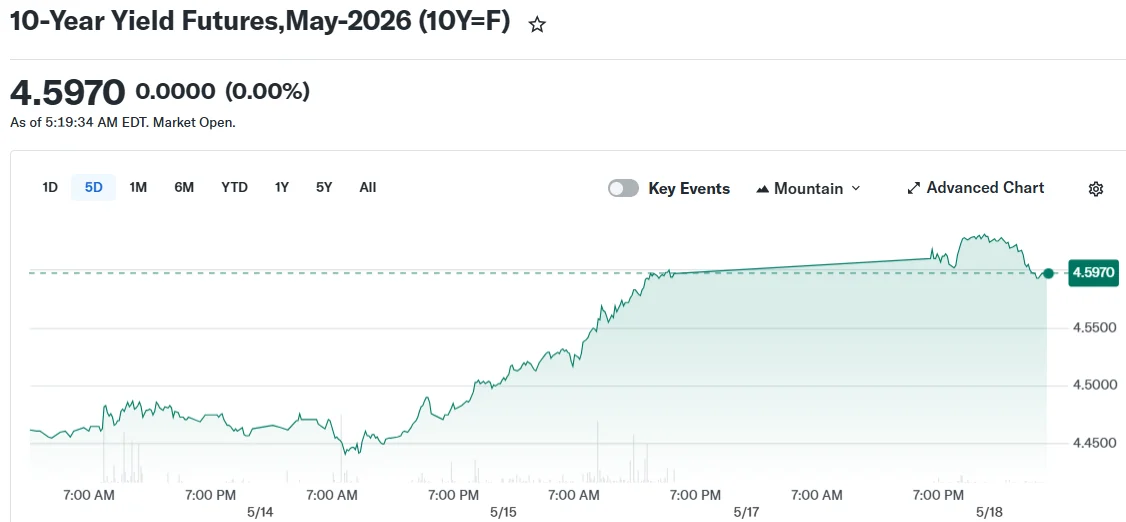
The benchmark 10-year Treasury note yield climbed to 4.62%, representing its most elevated level in 15 months. Meanwhile, the 30-year Treasury bond yield pushed to 5.14%, marking the highest reading in two decades.
The bond market rout extended across international borders. Germany’s 10-year bund yield advanced to 3.18%, while Japanese 10-year government bonds jumped 13 basis points to reach 2.74%.
This surge in borrowing costs arrives as newly appointed Federal Reserve Chair Kevin Warsh confronts accelerating consumer inflation and elevated import prices. Monetary policymakers find themselves under intensifying scrutiny with a critical G7 finance ministers gathering in Paris approaching.

Oil markets are amplifying inflation anxieties. Brent crude climbed to $111.16 per barrel on Monday, while U.S. West Texas Intermediate futures settled at $107.56. Prices remain elevated amid ongoing uncertainty surrounding a fragile ceasefire agreement between the United States and Iran.
What’s Keeping Equities Resilient
Despite significant volatility in bond markets, American equities have demonstrated remarkable resilience. The S&P 500 index has gained over 8% since the beginning of the year, despite experiencing a nearly 1% decline last Friday.
Corporate profitability provides the primary explanation. American companies reported first-quarter earnings approximately 28% higher compared to the previous year, representing the most substantial increase since the end of 2021.
Jeremiah Buckley, a portfolio manager at Janus Henderson, highlighted artificial intelligence-powered productivity improvements as a crucial driver. He suggested these efficiency gains might continue influencing results through 2027.
However, the S&P 500 currently trades at 21.3 times projected forward earnings. This valuation substantially exceeds the long-term historical average of 16x, prompting concerns about how much additional upside remains for stocks.
“Traders don’t want to turn bearish if there is a possibility that the Strait of Hormuz situation could be cleared up in just a few weeks’ time,” said Tim Murray of T. Rowe Price.
Key Concerns on Investors’ Radar
Certain investment professionals aren’t waiting for clarity. Paul Karger of TwinFocus indicated he maintains substantial allocations to cash instruments, gold, and commodity positions alongside large-cap technology stocks.
Jack Ablin of Cresset Capital warned that even a few months of delay in reopening the Strait of Hormuz could create “a brand new inflation regime for which investors just aren’t prepared.”
Wholesale price indicators recorded their sharpest increase in four years during April. Peter Tuz of Chase Investment Counsel observed that inflation appears deeply rooted in the economic system and could trigger market declines if it continues.
Capital Economics cautioned their clients that equity markets aren’t incorporating the risk of an extended Hormuz shutdown to the same degree that bond markets have.
Matthew Gertken of BCA suggested the Iranian situation possesses the capacity to fundamentally alter market trajectories for the remainder of the year.
The landscape continues evolving rapidly. With crude oil exceeding $100 per barrel, government bond yields at multi-year peaks, and the Iranian ceasefire remaining precarious, financial markets confront a period of heightened uncertainty in the coming weeks.
