



Key Takeaways
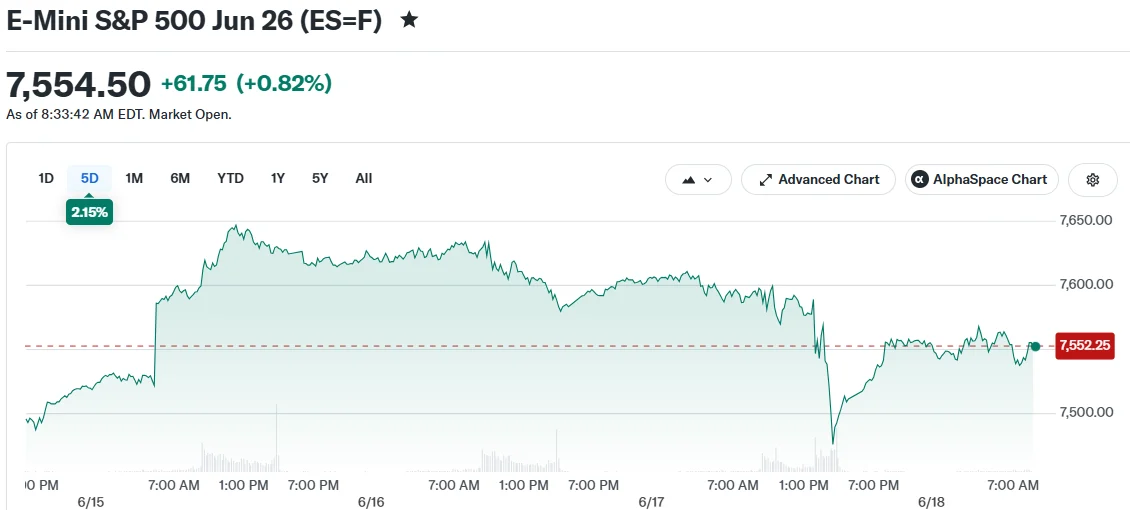
- Nasdaq 100 futures surged 1.3% while S&P 500 futures gained 0.7% in Thursday’s pre-market session
- Trump’s Wednesday signing of a US-Iran peace memorandum came ahead of the anticipated Friday timeline
- Potential reopening of the Strait of Hormuz could ease oil supply concerns and reduce energy costs
- Brent crude dropped approximately 3%, dipping under $78 per barrel before seeing modest recovery
- Federal Reserve maintained rates Wednesday while indicating a potential increase later in 2024, with October now fully priced in
Equity futures showed strong gains Thursday morning as market participants digested a dual narrative: an unexpected US-Iran diplomatic breakthrough and the Federal Reserve’s increasingly hawkish monetary policy stance.
The tech-heavy Nasdaq 100 futures posted the strongest performance, climbing 1.3%. S&P 500 futures advanced 0.7%, while Dow Jones futures registered a modest 0.2% increase. Wednesday’s session had seen substantial declines across all three benchmark indices.
Trump Accelerates Iran Peace Timeline
In a development that caught many analysts off guard, President Trump put his signature on a memorandum of understanding with Iran on Wednesday evening, two days before the widely anticipated Friday ceremony. The comprehensive 14-point agreement establishes a roadmap for normalized relations between Washington and Tehran.
Market optimism stems primarily from expectations that the Strait of Hormuz—a critical chokepoint for global oil transport—may soon reopen for commercial traffic. Such a development would enable Iranian crude exports to resume at scale, potentially applying downward pressure on global energy markets.

Brent crude futures responded immediately, plunging as much as 3% to trade beneath the $78 threshold. West Texas Intermediate similarly declined roughly 2%, settling near $74.57. Both benchmarks clawed back portions of these losses as traders questioned the timeline for actual shipping operations through the strait.
Diplomats indicated that discussions regarding Iran’s nuclear capabilities and additional contentious matters will extend through a 60-day negotiation period.
Central Bank Adopts Cautious Tone
The Federal Reserve left its benchmark interest rate unchanged during Wednesday’s policy meeting, though Chairman Kevin Warsh’s accompanying commentary suggested the possibility of monetary tightening before year’s end. Persistent inflation readings and resilient employment data justify the vigilant approach.
Deutsche Bank economist Peter Sidorov noted that futures markets now reflect 100% probability of a Fed rate increase by October.
Equities tumbled Wednesday following the central bank’s hawkish messaging, with the Dow shedding over 500 points. However, overnight optimism surrounding the Iran diplomatic progress helped reverse risk-off sentiment ahead of Thursday’s opening bell.
The benchmark 10-year Treasury yield declined 5 basis points to 4.45%. Meanwhile, the US dollar index strengthened 0.3% against major trading partners’ currencies.
Bitcoin retreated 1.7% during the preceding 24-hour period, trading around $64,347. The cryptocurrency’s weakness reflected diminished risk appetite following the Federal Reserve’s less accommodative stance.
Investors awaited Thursday’s weekly jobless claims report for additional insight into labor market conditions.
With markets scheduled to close Friday for the Juneteenth federal holiday, Thursday represents the week’s final trading opportunity.
Asian markets contributed to positive global sentiment, with Japan’s Nikkei crossing the 70,000 milestone for the first time in its history ahead of the US market open.
