



Key Highlights
- Futures for the S&P 500 and Nasdaq advanced 0.2% and 0.5% respectively during Tuesday’s pre-market session
- President Trump indicated willingness to pursue additional diplomatic discussions with Iran, boosting ceasefire extension prospects
- Crude oil prices dropped beneath the $100 threshold, with Brent trading around $99 and WTI falling under $97
- The Nasdaq extended its winning run to nine consecutive sessions Monday, marking its longest rally since late 2023
- Q1 earnings season launches with JPMorgan posting 13% profit growth; additional major financial institutions report throughout the week
Equity futures in the United States posted gains Tuesday morning as market participants reacted favorably to emerging indications that Washington and Tehran might prolong their current ceasefire arrangement and pursue comprehensive peace negotiations.
Futures contracts for the S&P 500 advanced 0.2%, while Nasdaq 100 futures jumped 0.5%, and Dow Jones futures hovered marginally in positive territory. Monday witnessed gains across all three primary benchmarks, extending a period of measured optimism that has developed since the April 7 announcement of a two-week cessation of hostilities.
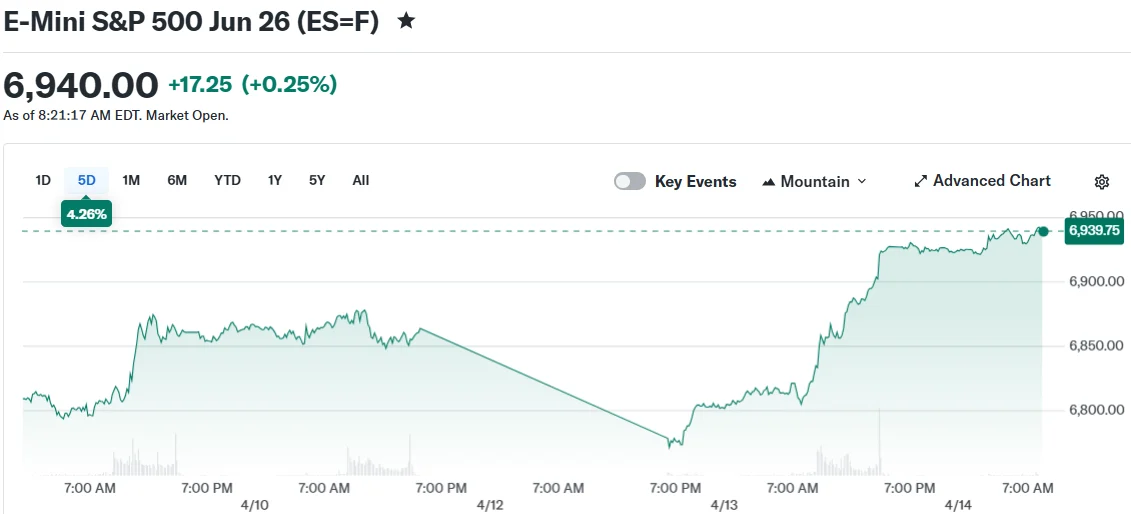
On Monday, President Trump revealed that “the right people” from Iran had initiated contact to negotiate a potential agreement. Financial markets interpreted this development positively, despite the fact that weekend diplomatic efforts concluded without achieving a breakthrough.
Following Monday’s trading session, the S&P 500 had essentially recovered all the ground lost since hostilities began. The Nasdaq’s ninth consecutive day of gains Monday represented its most extended winning sequence since December 2023.

According to Henry Allen, macro strategist at Deutsche Bank, market sentiment “steadily improved after Monday’s open,” identifying Trump’s statements as the primary driver. He noted that oil futures curves remain “heavily downward-sloping,” indicating market expectations that the conflict represents a short-term disruption.
Oil prices extended their decline during Tuesday’s session. West Texas Intermediate crude slipped beneath $97 per barrel, declining approximately 2.1%. Brent crude eased to roughly $99 per barrel. Both benchmark grades had maintained levels above $100 for several weeks as the American blockade of the Strait of Hormuz created significant disruptions to global energy supplies.
Energy Costs and Inflation Concerns
For approximately six weeks, Wall Street analysts have maintained vigilant monitoring of petroleum markets, anxious that elevated energy costs could trigger renewed inflationary pressures. Tuesday’s release of the March producer price index is anticipated to provide crucial insights into the conflict’s impact on wholesale pricing dynamics.
The US dollar weakened 0.2% relative to a basket of major global currencies as investors reduced positions in traditional safe-haven assets. The benchmark 10-year Treasury note yield declined 2 basis points to settle at 4.27%. Gold climbed to $4,800, benefiting from dollar weakness.
European equity markets similarly posted advances as petroleum prices retreated, signaling a widespread adjustment in investor risk appetite.
Financial Sector Earnings Command Attention
The first quarter earnings reporting period has officially commenced. JPMorgan Chase disclosed a 13% increase in quarterly profits Tuesday. Chief Executive Jamie Dimon acknowledged that the economic landscape presents an “increasingly complex set of risks.”
Johnson & Johnson also published results Tuesday. Bank of America, Wells Fargo, Citigroup, BlackRock, and Morgan Stanley are scheduled to report financial results during the coming days.
The current US-Iran ceasefire agreement is scheduled to lapse next week. Reports suggest both Washington and Tehran are evaluating options for additional negotiations to extend the pause in hostilities.
As of Tuesday morning, the American naval blockade targeting Iran’s energy export facilities remained operational.
