



TLDR
- Stock futures advanced Monday morning, with Dow Jones futures gaining 0.4% and S&P 500 futures rising 0.2% ahead of the opening bell
- May proved exceptional for the Nasdaq, climbing more than 8%, marking its strongest consecutive two-month performance since 2002 when paired with April’s 25% surge
- Robust earnings reports from artificial intelligence and technology companies fueled the impressive May performance
- Escalating military actions between the US and Iran over the weekend continue to create market uncertainty and support higher crude prices
- Market participants are closely monitoring this week’s nonfarm payrolls data scheduled for Friday
Equity index futures advanced Monday morning as market participants aimed to maintain the momentum from an exceptional May performance.
Futures tied to the Dow Jones Industrial Average climbed 0.4%, while those tracking the S&P 500 increased 0.2%. Futures linked to the Nasdaq 100 similarly rose 0.2% during early morning activity.
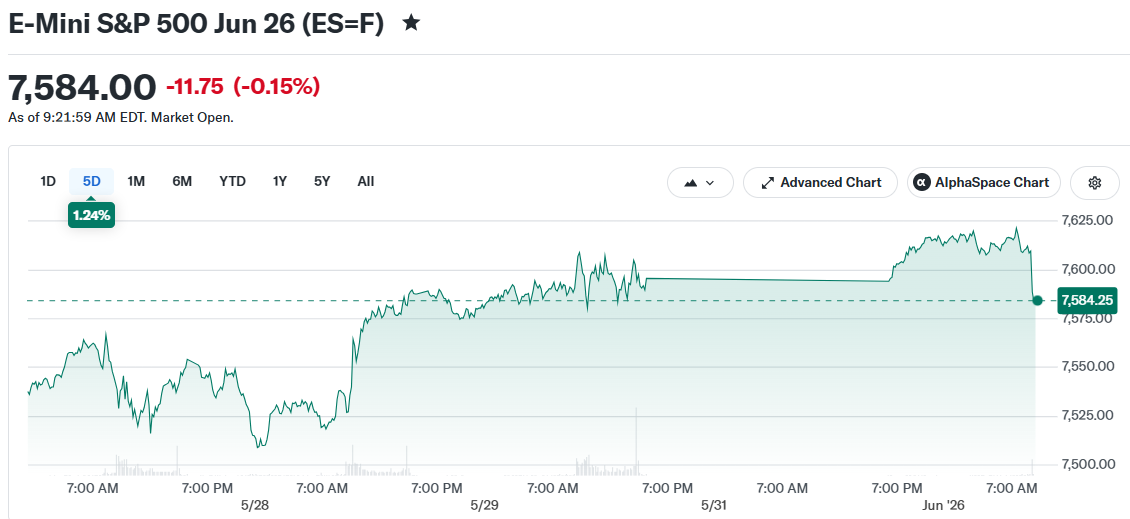
Monday’s advance builds on an impressive conclusion to the previous month. The Nasdaq Composite delivered a remarkable gain exceeding 8% throughout May, and together with the 25% April advance, represents the technology-heavy index’s strongest consecutive two-month period since the fourth quarter of 2002.
The S&P 500 delivered approximately 5% returns during May. Meanwhile, the Dow Jones Industrial Average contributed nearly 3% throughout the same timeframe.

Each of the three primary benchmarks concluded last week at all-time peaks. Technology equities have predominantly powered the advance, with AI chipmakers capturing substantial attention from market participants.
Impressive quarterly results from technology corporations have provided crucial support. Financial institutions have generously valued numerous prominent companies operating within the artificial intelligence and semiconductor sectors.
Middle East Tensions Inject Market Volatility
Notwithstanding the positive market sentiment, international conflicts continue generating investor anxiety. American military aircraft targeted Iranian radar installations and unmanned aerial vehicle facilities during weekend operations, with Iran’s Islamic Revolutionary Guard Corps announcing retaliatory measures.
President Trump indicated he would consult with senior advisers before reaching a “final determination” regarding subsequent actions. He additionally demanded the immediate resumption of commercial traffic through the Strait of Hormuz, an essential corridor for worldwide petroleum transportation.
Oil prices strengthened following the weekend military engagements. Brent crude advanced 3.1% to reach $93.98 per barrel, while West Texas Intermediate increased 3% to settle at $90.40 per barrel.
Despite Monday’s recovery, WTI registered its most significant monthly decline since April 2025, dropping nearly 17% throughout May.
The US dollar strengthened 0.1% relative to a collection of primary international currencies. Yields on benchmark 10-year Treasury securities increased 2 basis points to reach 4.47%, reflecting investor rotation toward traditionally defensive holdings.
Deutsche Bank analyst Jim Reid suggested June’s trajectory depends substantially on whether Washington and Tehran can reach an agreement. “We’ve never felt closer to a deal but potentially never felt closer to it all falling apart,” he said.
Employment Data Takes Center Stage
Friday’s nonfarm payrolls release will command significant market attention. The employment statistics will provide updated insights into labor market conditions and potentially shape projections regarding Federal Reserve monetary policy adjustments throughout the remainder of the year.
Expectations surrounding a potential diplomatic resolution between the United States and Iran had supported market strength in preceding weeks. Nevertheless, the weekend military operations have reintroduced considerable uncertainty regarding the timeline for achieving a negotiated settlement.
Financial markets remain cautiously positioned regarding geopolitical developments, as participants weigh robust technology sector performance against persistent Middle Eastern instability.
