


Key Takeaways
- Pre-market Wednesday shows S&P 500 futures declining 0.1%, Dow futures dropping 0.4%, while Nasdaq futures gain 0.2%
- The S&P 500 extended gains for a ninth consecutive session Tuesday, approaching its longest rally since 1995
- Military confrontations between the U.S. and Iran following oil tanker strikes drove Brent crude up approximately 2.5%
- Brent crude approached $98 per barrel while WTI surged past $96, intensifying concerns about Strait of Hormuz disruptions
- Fresh U.S. tariff announcements targeting 60 nations with minimum 10% levies contributed to market uncertainty
Equity futures showed divergent movement in Wednesday’s early hours as traders balanced an extraordinary market rally against surging energy costs and escalating Middle Eastern hostilities.
Futures tied to the Dow Jones Industrial Average declined 0.4%, while S&P 500 futures retreated 0.1%. Nasdaq 100 futures bucked the trend, advancing 0.2% during pre-market activity.
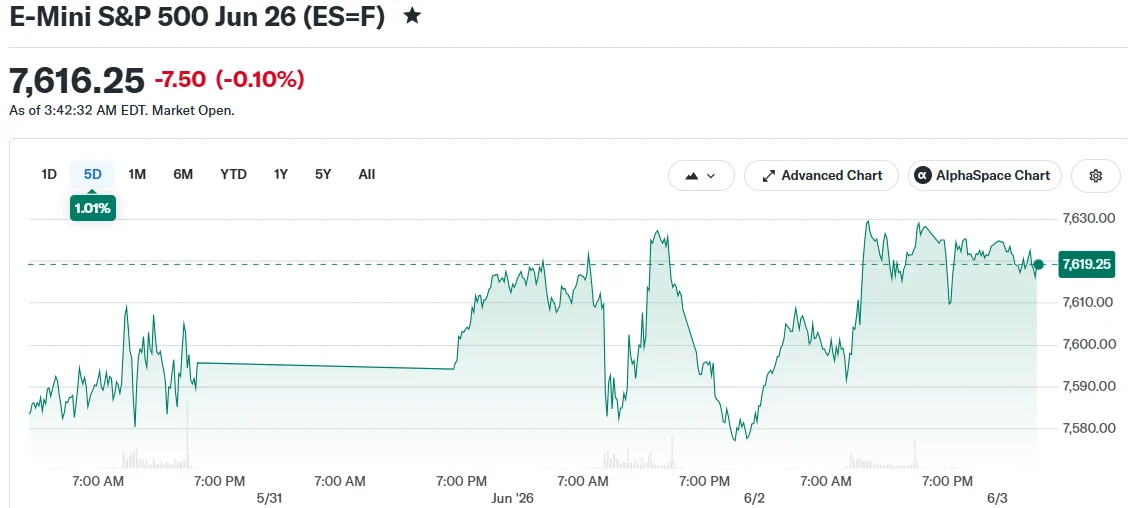
Tuesday marked the ninth consecutive positive close for the S&P 500. The three principal benchmarks simultaneously reached fresh all-time highs for an unprecedented fifth straight trading day. Should the S&P 500 secure a tenth consecutive gain, it would represent the index’s most extended winning sequence in three decades.
The phenomenon of six straight days where all three major indexes close at record levels has occurred just once previously in market history during 1992.

Tuesday’s rally received momentum from robust corporate earnings reports emphasizing artificial intelligence expansion. Financial results from Dell and HPE both underscored AI-driven revenue acceleration as a central theme.
Energy Markets React to Escalating Conflict
Market sentiment deteriorated during overnight trading as renewed military hostilities between Washington and Tehran disrupted energy markets. American forces targeted a vessel allegedly violating a blockade. Iranian forces retaliated with defensive fire.
Brent crude jumped roughly 2.5% in early sessions. WTI crude crossed the $96 threshold per barrel, while Brent traded near $98. Anxiety regarding possible disruptions through the strategically vital Strait of Hormuz fueled the price surge.
U.S. Central Command confirmed Tuesday evening that ceasefire negotiations were “ongoing.” However, Israel’s ongoing military operations targeting Hezbollah forces in Lebanon have hindered progress toward a comprehensive agreement.
President Trump indicated via social media posts earlier this week that diplomatic discussions with Iran were advancing “at a rapid pace.” Nevertheless, financial markets have maintained a skeptical posture despite these optimistic signals.
According to Hargreaves Lansdown analyst Matt Britzman, market sentiment stays “broadly upbeat” even as participants attempt to assess the evolving situation across the Middle East.
Trade Policy Concerns Resurface
Trade tensions reemerged as a focal point Wednesday. The U.S. Trade Representative unveiled proposed duties of no less than 10% targeting numerous trading partners following a comprehensive review of forced labor concerns.
The proposal encompasses roughly 60 economies, including the European Union, Canada, Mexico, the United Kingdom, and Taiwan.
Regarding corporate earnings, Broadcom, CrowdStrike, and Macy’s are scheduled to release quarterly results Wednesday.
Market participants are also monitoring Wednesday’s ADP employment figures in anticipation of Friday’s comprehensive May jobs report, which could significantly influence trading activity entering the weekend.
