


Key Highlights
- Shares of SK Hynix climbed approximately 7% on Tuesday, contributing to South Korea’s KOSPI index crossing the 8,000 threshold for the first time ever.
- Nvidia reported first-quarter revenue reaching $81.6 billion, representing an 85% increase compared to the previous year, triggering a surge in memory semiconductor equities.
- SK Hynix delivered Q1 operating profit of 37.61 trillion won, marking a 405% year-over-year increase, accompanied by an impressive 72% operating margin.
- Market research firm TrendForce anticipates DRAM pricing to climb 58–63% while NAND flash prices could surge 70–75% during Q2 2026.
- The company unveiled “iHBM,” an innovative thermal management technology reducing heat resistance by 30% for advanced AI processors.
Shares of SK Hynix experienced a significant rally of nearly 7% during Tuesday’s trading session, propelling South Korea’s KOSPI benchmark index past the historic 8,000 level for the first time.
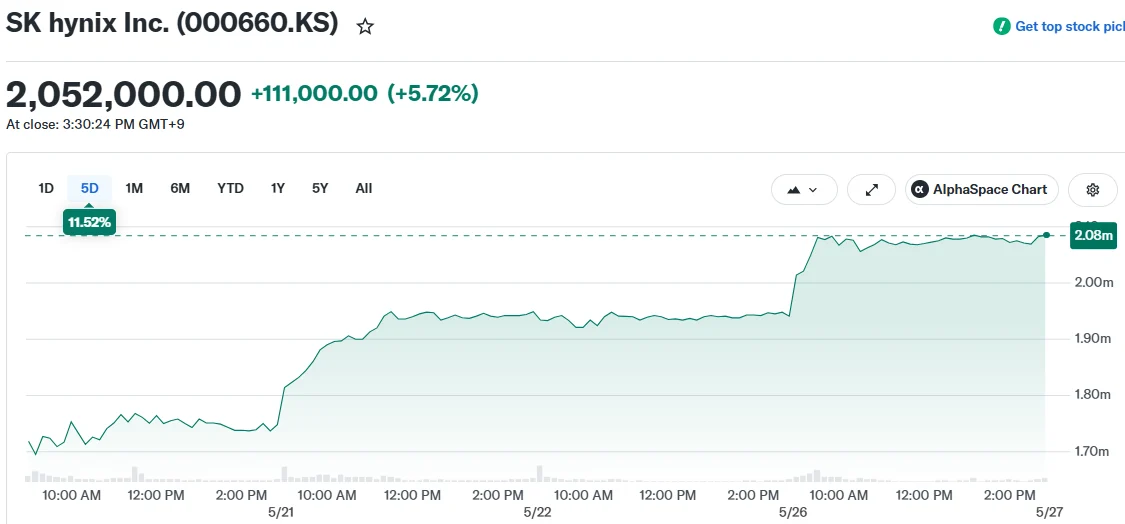
The stock demonstrated strength with gains of approximately 5.72% during the most recent session, while the overall index benefited from widespread enthusiasm surrounding AI-focused semiconductor growth.
The momentum originated from Nvidia’s recently disclosed fiscal first-quarter performance. The graphics processing unit leader announced revenue totaling $81.6 billion, representing an 85% annual increase, while data centre segment revenue surged 92% to reach $75.2 billion.
Chief Executive Jensen Huang described demand conditions as having “gone parabolic.”
This characterization resonated strongly among memory chip investors. SK Hynix serves as a crucial supplier of high-bandwidth memory utilized in Nvidia’s AI accelerators, prompting the market to rapidly incorporate the positive implications.

The memory manufacturer reports that customer orders for HBM products spanning the next three years have already surpassed its existing manufacturing capabilities.
First Quarter Results Validate Optimistic Outlook
SK Hynix’s financial performance has proven equally impressive. During Q1 2026, the firm reported revenue of 52.58 trillion won alongside operating profit of 37.61 trillion won — representing a 405% increase compared to the corresponding period one year prior.
The operating margin reached 72%, propelled by robust sales of HBM chips, high-capacity server DRAM products, and enterprise-grade SSDs.
Financial analysts responded swiftly with upgraded price targets. UBS elevated its target to 1.7 million won, increasing its 2026 and 2027 earnings per share projections by 22% and 29% respectively. Mirae Asset Securities advanced its target to 3.2 million won, while SK Securities presented a bullish scenario of 3 million won.
TrendForce reinforced the optimistic sentiment, forecasting conventional DRAM contract pricing to increase 58–63% on a sequential basis during Q2 2026. NAND flash pricing is anticipated to climb 70–75% over the identical timeframe.
These projections aren’t speculative — they indicate a memory semiconductor market experiencing legitimate supply constraints across numerous product segments.
Company Introduces iHBM Thermal Management Innovation
Beyond the quarterly results, SK Hynix revealed a groundbreaking product on Tuesday: the iHBM solution, representing a thermal management breakthrough engineered for future HBM chip generations including HBM5.
The innovation integrates cooling components directly within the Die-to-Die Physical Layer — the critical junction between HBM and GPU — where thermal concentration reaches peak levels. This approach delivers a 30% decrease in thermal resistance.
The technology builds upon SK Hynix’s established MR-MUF packaging methodology, enabling customers to implement it with limited design modifications.
The manufacturer positioned it as a targeted solution addressing thermal management obstacles associated with stacking additional dies at accelerated speeds to satisfy AI computational requirements.
Kangwook Lee, Senior VP and Head of PKG Development, stated the iHBM solution “combines memory design capabilities with advanced packaging technology” to meet demands in high-density AI applications.
The KOSPI index, having gained approximately 75% year-to-date in 2026, has emerged as among the globe’s most transparent public market vehicles for AI infrastructure investment. Samsung Electronics and SK Hynix collectively represented 44% of the index’s aggregate value when it surpassed 7,000 earlier this month.
