


Key Highlights
- South Korean semiconductor giant SK Hynix has launched mass production of its 192GB SOCAMM2 memory module, specifically engineered for Nvidia’s forthcoming Vera Rubin AI platform.
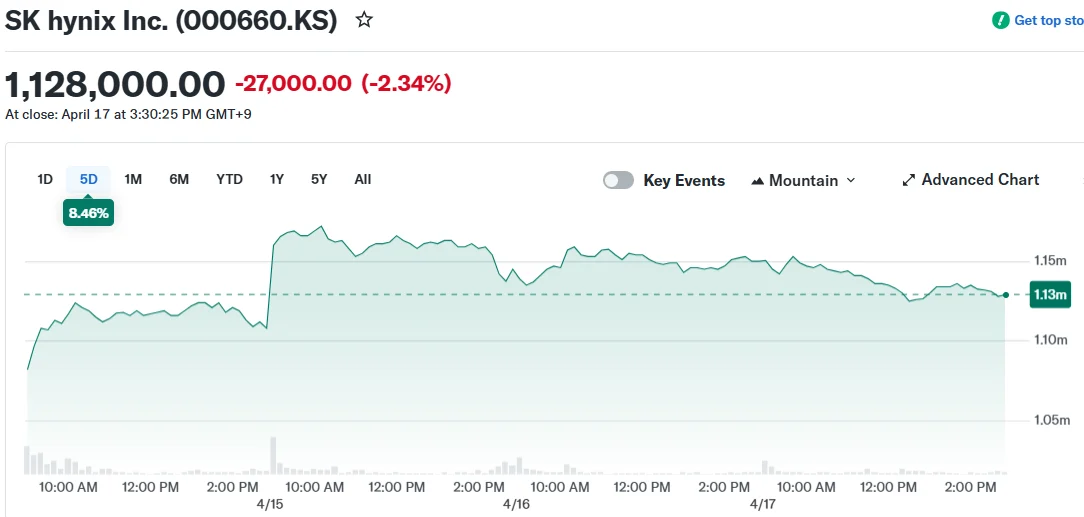
- HXSCL shares gained 3.4% during Korean trading hours following the announcement; Nvidia (NVDA) experienced a 1.4% decline in pre-market activity.
- The advanced SOCAMM2 module aims to reduce energy consumption and address memory bandwidth limitations that impact AI training and inference operations.
- Nvidia’s Vera Rubin platform is slated to replace the Blackwell architecture, with commercial availability anticipated during the latter half of 2026.
- Bernstein’s David Dai characterized Vera Rubin as “a monster,” forecasting inference improvements up to 5x and training acceleration of 3.5x versus existing systems.
SK Hynix, a leading global manufacturer of memory semiconductors, announced Monday the commencement of volume production for its 192GB SOCAMM2 module — an advanced memory solution purpose-built for Nvidia’s upcoming Vera Rubin artificial intelligence platform.
The disclosure triggered a 3.4% rally in SK Hynix shares during Seoul’s trading session. Competitor Samsung Electronics saw its stock decline 1% during the same period. NVDA shares were trading approximately 1.4% lower in pre-market activity, though analysts suggested the movement was disconnected from the SK Hynix news.
The SOCAMM2 represents more than an incremental upgrade. According to SK Hynix, the module delivers enhanced power efficiency for AI server deployments while addressing critical memory bandwidth constraints that limit performance during both training cycles and inference operations for large language models.
This positions the product as a strategic solution for Nvidia’s dominant data center clientele, where energy efficiency has become increasingly critical for enterprises scaling AI infrastructure.

Understanding the Vera Rubin Platform
Nvidia introduced its Vera Rubin architecture earlier this year as the successor to the Blackwell processor family. Commercial shipments are scheduled to begin during the second half of 2026, although industry reports have indicated possible timeline extensions due to capacity limitations at critical suppliers.
Bernstein’s David Dai labeled Vera Rubin “a monster,” estimating performance gains reaching 5x for inference workloads and 3.5x acceleration for training operations relative to current-generation architectures. These metrics represent the type of advancement that captures attention from data center procurement teams.
SK Hynix initiating volume production at this stage provides an encouraging indication that supply chain readiness aligns with the targeted launch timeline.
The broader KOSPI index advanced approximately 1% on Monday, receiving partial support from the SK Hynix momentum.
SK Hynix’s Strategic Role in AI Infrastructure
SK Hynix maintains a critical supplier relationship with Nvidia, delivering advanced memory solutions including high-bandwidth memory (HBM) utilized in AI accelerators. This positioning has established the company as a primary beneficiary of the ongoing AI infrastructure expansion.
The memory manufacturer also maintains supply agreements with Apple and other major technology firms, providing diversified exposure across multiple market segments.
Samsung Electronics, its primary competitor in advanced memory production, has been pursuing progress in HBM manufacturing but has encountered qualification challenges with Nvidia. Monday’s 1% decline in Samsung shares contrasted sharply with the Hynix surge.
According to TipRanks, NVDA stock maintains a Strong Buy consensus rating supported by 41 Buy recommendations, one Hold, and one Sell across the past three months. The average analyst price target of $237.57 suggests approximately 35.6% upside potential from present levels.
SK Hynix shares advanced 2.1% in one reporting source and 3.4% in another based on different data points — the variance likely reflects intraday fluctuation versus final session closing prices.
