


Key Highlights
- Securitize (SECZ) began trading on the New York Stock Exchange Thursday following its SPAC merger with Cantor Fitzgerald
- In an unprecedented move, the firm tokenized its own equity on both Solana and Avalanche blockchains on its first trading day
- Launch day saw $295 million in tokenized SECZ equity held by investors
- The public offering generated $400 million in capital at a market capitalization exceeding $1 billion
- Market analysts at Citigroup estimate the tokenization sector could balloon to $5.5-$8.2 trillion within six years
Securitize commenced trading on the New York Stock Exchange this Thursday under the symbol SECZ. The firm achieved its public listing via a combination with a special-purpose acquisition vehicle supported by Cantor Fitzgerald. The transaction generated $400 million in proceeds with a market valuation surpassing $1 billion.
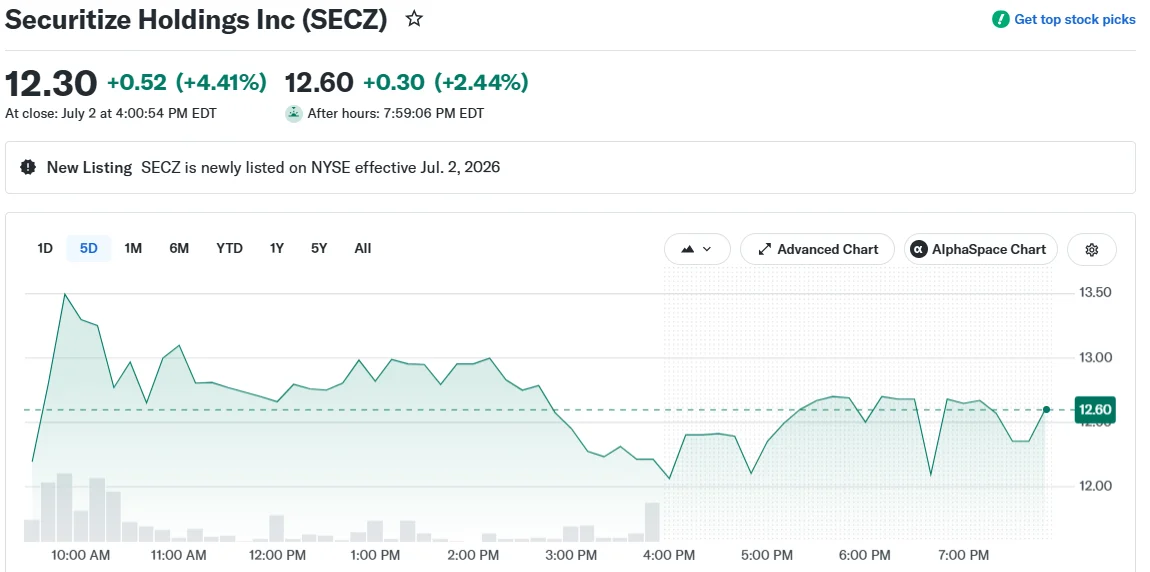
Shares concluded their inaugural trading session with a 4.4% gain at $12.30, having reached an intraday peak of $13.70. Extended trading saw an additional 2.4% advancement, bringing the price to $12.60.
Coinciding with its market debut, Securitize converted its own equity into digital tokens on the Solana and Avalanche blockchain networks. This milestone established the company as the first publicly traded entity to digitize its stock on the same day as its exchange listing.
Blockchain analytics from RWA.xyz reveal that investors possessed $295 million in tokenized SECZ equity at launch. According to the company, these digital tokens correspond to identical common stock available on the NYSE rather than constituting a distinct security classification.

How This Tokenization Approach Stands Apart
Most existing tokenized equity offerings come from third-party providers or operate beyond U.S. borders. Securitize emphasizes that its offering is issuer-sponsored, granting the company direct oversight of the tokenization mechanism.
Qualified American investors can obtain the tokenized equity through Securitize’s digital platform following identity verification and compliance with securities regulations.
“SECZ is not a synthetic token or offshore wrapper,” said CEO Carlos Domingo. “It is issuer-sponsored tokenization of the same common stock trading on the NYSE.”
The Securities and Exchange Commission announced in January that issuer-sponsored tokenized securities fall under U.S. securities regulations. Reports indicated the SEC was preparing an exemption framework for tokenized equity trading in May, though implementation stalled following pushback from traditional exchange operators.
Securitize’s Position in Digital Asset Infrastructure
Established in 2017, Securitize has constructed tokenization systems for prominent financial institutions including BlackRock, Apollo, KKR, Hamilton Lane, and VanEck.
BlackRock and Morgan Stanley count among the company’s financial backers.
This past March, Securitize formed an alliance with Intercontinental Exchange, the parent organization of the NYSE, to create infrastructure supporting tokenized equity securities. Additional collaborations with transfer agents Computershare and Continental aim to facilitate blockchain-based share issuance for publicly traded corporations.
Current Market Landscape
The aggregate value of tokenized real-world assets has surpassed $43 billion. Tokenized money market instruments comprise the largest segment, while tokenized commodities represent approximately $7 billion and tokenized equities account for $1.6 billion, per Token Terminal data.
Citigroup published forecasts last month suggesting the tokenization industry could expand to $5.5-$8.2 trillion by decade’s end. Boston Consulting Group, collaborating with Ripple, projects an even more ambitious figure of $18.9 trillion by 2033.
Securitize’s public market entry establishes the company as a significant participant in this anticipated expansion, with its proprietary equity now accessible across two prominent blockchain platforms from its opening day.
