


Key Takeaways
- Shares of Samsung Electronics plummeted approximately 9% on Korea’s stock market Friday following the largest union’s refusal to cancel an upcoming 18-day work stoppage scheduled to commence May 21.
- Negotiations facilitated by government mediators broke down earlier in the week after management and labor representatives couldn’t reach agreement on compensation structures and performance incentive limits.
- Union members are pushing for elimination of existing bonus limitations and implementation of an earnings-based profit distribution model, pointing to more favorable terms recently secured by workers at competitor SK Hynix.
- Senior Samsung leadership made the trip to the company’s Pyeongtaek facility for direct discussions with union representatives, while the corporation issued a formal apology regarding the ongoing controversy.
- Financial analysts at JPMorgan project the work stoppage could reduce Samsung’s operational earnings by 21 trillion to 31 trillion won ($14 billion–$20.8 billion), alongside approximately 4.5 trillion won in revenue losses.
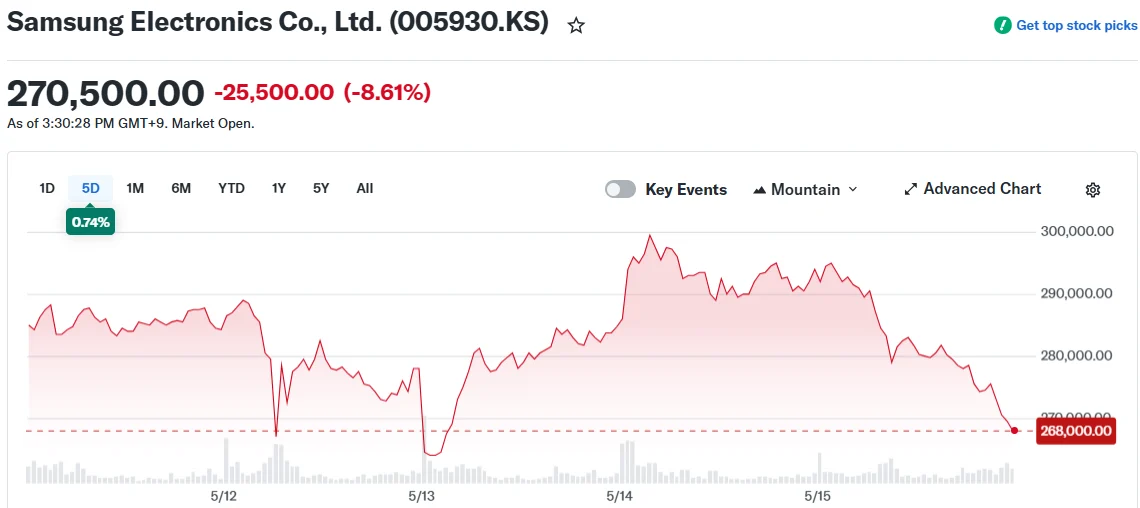
Shares of Samsung Electronics experienced a sharp decline of roughly 9% during Friday trading on the Korea Stock Exchange, settling at 273,500 won in early Seoul market activity. The sell-off followed confirmation from the National Samsung Electronics Union that it intends to proceed with its planned 18-day work stoppage beginning May 21, notwithstanding the corporation’s proposal to restart unconditional compensation discussions.
Union leadership indicated willingness to engage in renewed discussions — though not until after June 7. This timeline ensures the strike period remains intact.
The electronics giant saw its market capitalization contract by as much as 99.07 trillion won ($66.18 billion) during Wednesday’s session alone when compensation negotiations collapsed. Friday’s trading session compounded those declines.
Tensions have been escalating over several months. Labor representatives organized demonstrations at a manufacturing site south of Seoul during April, advocating for enhanced compensation packages. Their primary objectives include: elimination of performance bonus restrictions and establishment of a profit distribution mechanism linked to Samsung’s operational earnings figures.

A significant point of contention involves compensation disparities with competing semiconductor manufacturer SK Hynix. SK Hynix recently finalized more advantageous bonus arrangements with its employees, creating a comparison that Samsung workers find troubling.
Government-brokered discussions between Samsung management and union representatives collapsed in recent days. The parties remained divided on methodologies for bonus calculations and ceiling structures.
South Korean government officials have been monitoring developments intensively. Both the prime minister and the minister responsible for industrial affairs have encouraged continued dialogue, cautioning that a work stoppage risks harming export performance, capital markets, and overall economic expansion.
The presidential administration also commented Friday, expressing hope that the strike might still be prevented. Government representatives noted that circumstances warranting activation of emergency intervention mechanisms had not yet materialized.
Samsung responded swiftly following the union’s declaration. Corporate leadership traveled to the Pyeongtaek campus for face-to-face meetings with union officials. The company additionally released a public statement apologizing for disruptions stemming from the labor dispute, committing to participate in negotiations with genuine openness.
Projected Financial Impact
JPMorgan analysts quantified the potential economic consequences. The investment bank suggested production disruptions could exceed initial projections, attributable to wider employee participation than earlier forecasts indicated.
JPMorgan calculated the reduction to Samsung’s operational profit between 21 trillion and 31 trillion won ($14.08 billion to $20.79 billion). Revenue losses could approximate 4.5 trillion won.
These represent substantial figures for an organization already contending with challenging semiconductor market conditions.
Looking Ahead
Union leadership has maintained flexibility — discussions following June 7 remain a possibility. However, with the work stoppage scheduled to begin May 21, the timeframe for achieving resolution before manufacturing interruptions is limited.
Samsung executives were en route to Pyeongtaek as of Friday morning, though the corporation has not yet publicly confirmed whether a subsequent meeting schedule has been established.
