



Key Highlights
- The MEGA token from MegaETH went live after 10 ecosystem applications successfully achieved the initial KPI milestone
- Trading commenced simultaneously across Binance, KuCoin, Bitget, Coinbase, Bybit, and additional platforms
- MegaETH paid zero tokens to any exchange for listing privileges—an uncommon approach for Layer 2 projects
- The token’s fully diluted market capitalization touched approximately $1.7 billion following its debut
- The USDM stablecoin experienced explosive growth, expanding from $63 million to over $300 million throughout the launch phase
On April 30, 2026, MegaETH officially released its MEGA token following a week-long countdown and the successful completion of its first on-chain performance benchmark.
The token generation was activated once 10 applications within the “Mega Mafia” ecosystem launched and satisfied the project’s initial key performance indicator criteria. The team had pledged to delay the launch until demonstrable network usage was established.
Binance initiated trading at 11:00 UTC, offering spot trading pairs such as MEGA/USDC and MEGA/USDT. KuCoin and Bitget synchronized their listings at the identical moment. Additional major platforms including Coinbase, Bybit, Upbit, Bithumb, OKX, and MEXC rolled out MEGA support on the same day.
[[EMBED_0]]

Regulatory constraints prevent deposits and trading activities for users located in the United States, Canada, and the Netherlands.
Exchange Listings Secured Without Fee Payments
The aspect that captured significant market attention was MegaETH’s firm stance against paying for exchange listings. Earlier in 2026, the project had publicly declared it would not distribute MEGA tokens to any trading platform as listing compensation, liquidity incentives, or promotional allocations.
Despite this position, every major exchange proceeded with listing MEGA. Simon Dedic, who leads Blockhead Capital as CEO, shared his perspective on the development: “Honestly, I wouldn’t have expected them to bend the knee and list it for free, so kudos to Binance here. Imagine being such a sought-after project that every major CEX lists you without receiving a single token.”
DeFi analyst Ignas suggested that Binance’s decision to list MEGA aligned with the exchange’s public commitment to supporting development teams with substantial community backing.
Members of the crypto community characterized the simultaneous multi-platform listing as achieving a “royal flush” in the context of Layer 2 token launches.
Token Economics and Opening Price Action
The MEGA token features a capped maximum supply of 10 billion units. Notably, 53.3% of the entire supply is allocated to performance-driven staking incentives instead of conventional time-locked vesting arrangements.
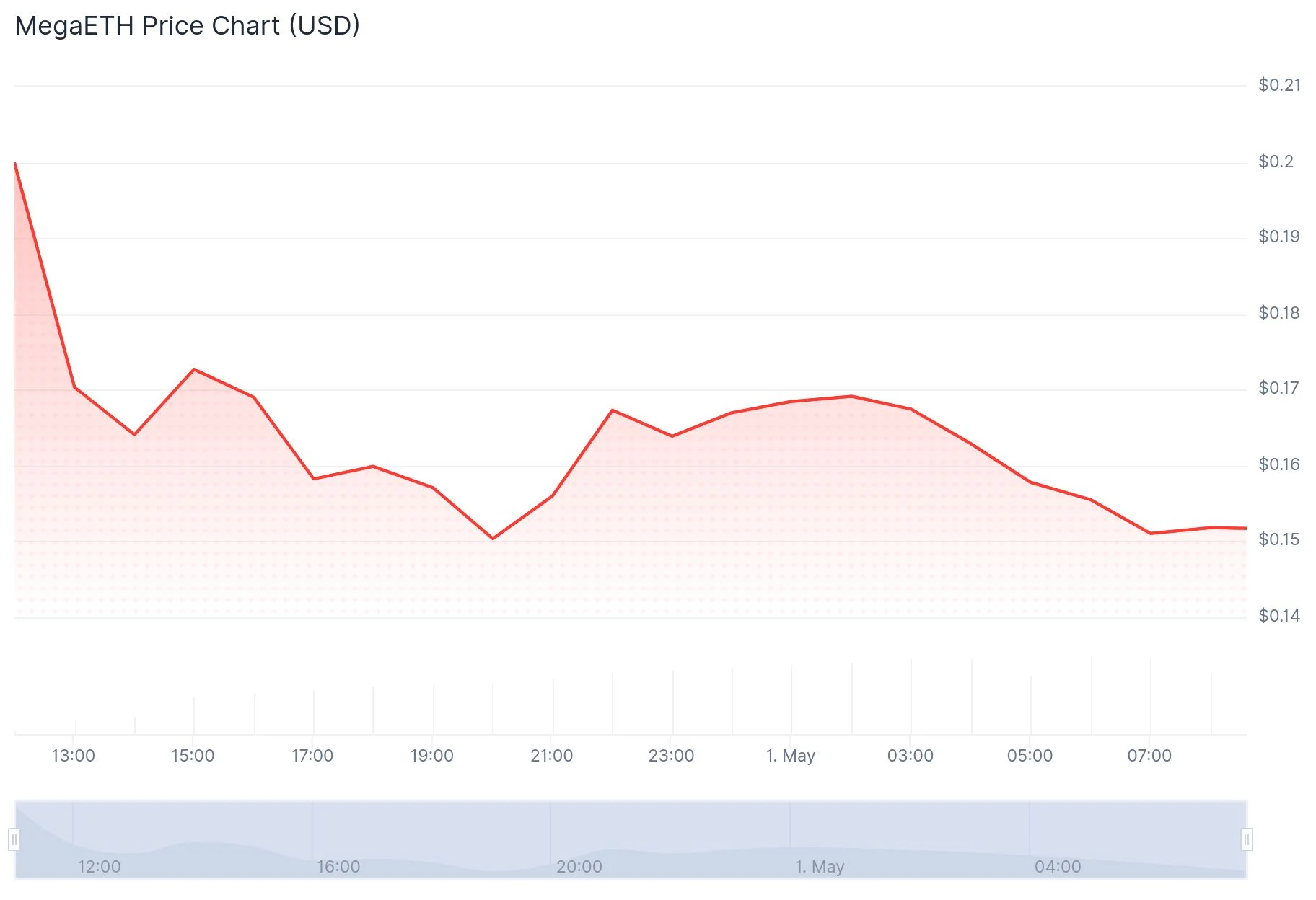
In the initial hours after the Binance listing went live, MEGA exchanged hands around the $0.16 price level. This valuation positioned the circulating supply market cap near $190 million, while the fully diluted valuation approached $1.7 billion. Data showed that approximately 50% of airdrop recipients maintained their token holdings on launch day.
Participants from the initial coin offering phase realized approximate paper profits of 2x, including those whose tokens remained under a 12-month lockup period.
USDM Stablecoin Expansion and On-Chain Metrics
MegaETH’s proprietary stablecoin USDM, created in partnership with Ethena, experienced substantial adoption momentum preceding the token launch. The total supply surged from approximately $62.9 million in the week prior to exceeding $300 million during the launch window.
According to statements from the MegaETH Foundation, revenue generated from USDM operations will be deployed to purchase MEGA tokens, establishing a direct connection between stablecoin utilization and token buying pressure.
Co-founder Namik Muduroglu characterized the launch timeframe as “very intense.”
A single security incident emerged involving a user who suffered losses of roughly $31,920 in USDC. Community analysis pointed to compromised wallet permissions or phishing attacks as the likely cause rather than any vulnerability in the protocol infrastructure.
