


Key Takeaways
- Tron founder Justin Sun alleges World Liberty Financial concealed a blacklisting mechanism within its token’s smart contract architecture
- Sun reports his cryptocurrency wallet containing approximately $9 million in WLFI was restricted in September 2025
- World Liberty Financial utilized approximately $75 million in stablecoin loans backed by its native governance tokens
- WLFI’s token value plummeted to a record low between $0.07 and $0.08, experiencing a 21% decline over thirty days
- World Liberty Financial responded to Sun’s allegations with threats of litigation, stating “See you in court pal”
Justin Sun, the founder of Tron, has leveled explosive allegations against World Liberty Financial, a cryptocurrency venture associated with the Trump family. According to Sun, the project covertly integrated a backdoor mechanism into its token’s smart contract, enabling the development team to freeze, limit, and seize control over any investor’s digital assets.
Sun identified himself as “the first and single largest victim” of this alleged functionality. According to his account, his cryptocurrency wallet was placed on a blacklist in September 2025 following a transfer of approximately $9 million in WLFI tokens across different addresses. Initially, he characterized the restriction as “unreasonable.” Today, he frames it as evidence of systematic wrongdoing.
“What was never disclosed is that World Liberty embedded a backdoor blacklisting function in the smart contract,” Sun stated on X. He characterized it as “a trap door marketed as an open door.”
Sun’s initial investment in WLFI totaled $30 million in late 2024, and he subsequently joined the project as an advisor. His holdings eventually expanded to approximately $75 million. The restricted wallet contains roughly 545 million WLFI tokens that have depreciated by over $80 million since the freeze was implemented.
Sun further challenged the legitimacy of a March governance referendum concerning token vesting schedules. He claimed that over 76% of the voting power originated from merely 10 wallets, suggesting that “outcomes were predetermined.” He accused project leadership of deliberately withholding critical information from the voting community.

World Liberty Financial’s $75 Million Leverage Dispute
Independent of Sun’s accusations, World Liberty Financial has encountered criticism regarding its treasury management practices. Blockchain analytics reveal the project deposited approximately 5 billion of its proprietary WLFI tokens on Dolomite, a decentralized lending platform, to secure roughly $75 million in stablecoins such as USDC and USD1.
Notably, Dolomite’s co-founder Corey Caplan simultaneously holds the position of chief technology officer at WLFI. The project currently accounts for approximately 55% of Dolomite’s aggregate supplied assets. The USD1 lending pool operates at roughly 93% utilization, triggering concerns regarding liquidity constraints.
Over $40 million of the borrowed capital was transferred to Coinbase Prime. World Liberty Financial defended its position, claiming it functions as an “anchor” borrower that produces yield and ecosystem value. The organization dismissed scrutiny of its borrowing strategies as “FUD” and insisted it remains “nowhere near liquidation.”
World Liberty Financial Issues Legal Threat to Sun
Within hours of Sun’s public statement, World Liberty Financial countered on X, dismissing his assertions as “baseless allegations to cover up his own misconduct.” The official account declared: “See you in court pal.”
Sun responded by challenging the individual managing the account to reveal their identity rather than “hiding in the shadows.”
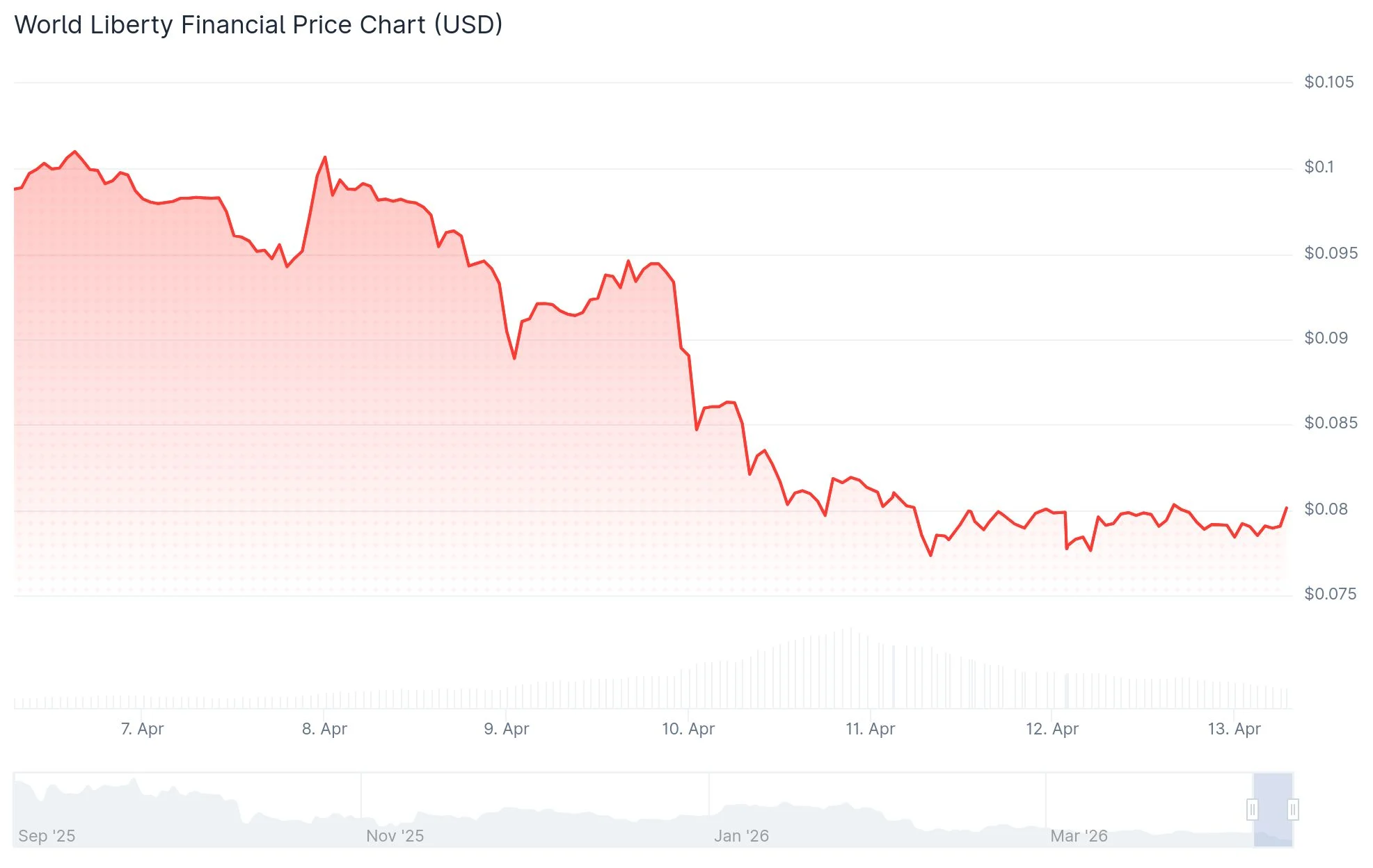
The WLFI token reached an all-time low of $0.07 this week and presently trades near $0.08. Its market capitalization hovers around $2.5 billion. World Liberty Financial announced intentions to introduce a governance proposal establishing a graduated unlock mechanism for early retail participants, approximately 75% of whose tokens remain locked.
During the first week of April, the development team transferred 3 billion WLFI tokens, intensifying scrutiny of the project’s operational transparency.
