



Key Highlights
- Investment bank J.P. Morgan reduces Brent crude oil projections for late 2026
- New forecast shows Brent averaging $86/barrel during Q3 and $80/barrel in Q4 2026
- Price projections indicate Brent closing 2026 at $78/barrel with 2027 average of $64
- Disappointing inventory withdrawals and diminished demand drive forecast reduction
- Commercial operators increasingly depend on Strategic Petroleum Reserve releases rather than depleting private inventories
Investment banking giant J.P. Morgan has significantly reduced its price projections for Brent crude oil in the latter half of 2026, attributing the revision to underwhelming demand patterns and lackluster inventory depletion rates.
The financial institution’s updated analysis anticipates Brent crude will reach an average of $86 per barrel during the third quarter of 2026, declining to $80 per barrel in the year’s final quarter.
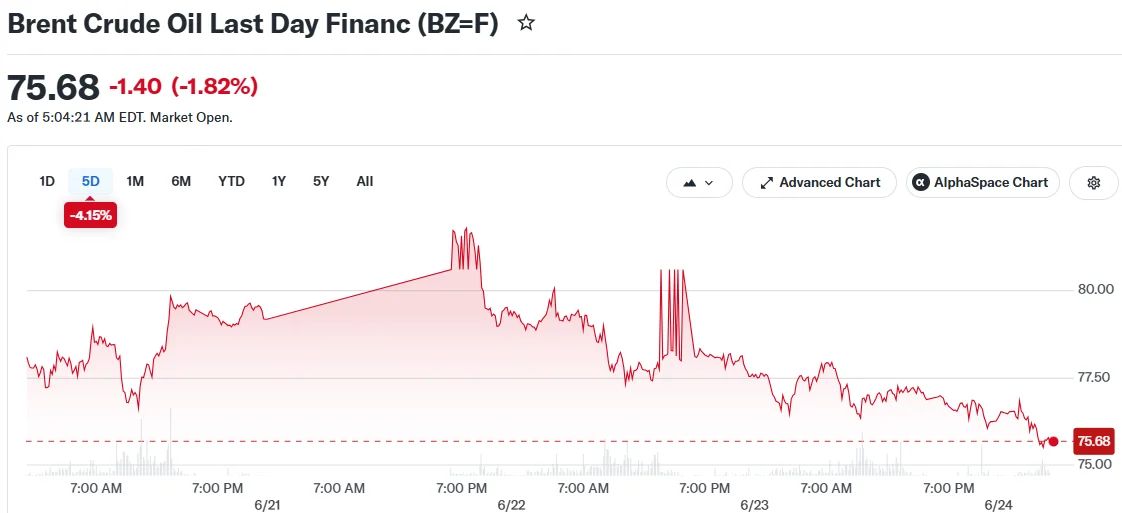
As 2026 draws to a close, J.P. Morgan anticipates pricing will settle around $78 per barrel. Extending the forecast into 2027, the bank’s analysts predict Brent will maintain an average of $64 per barrel throughout the year.
Market Dynamics Fall Short of Projections
Withdrawals from OECD commercial petroleum inventories have significantly underperformed relative to the bank’s initial estimates. Simultaneously, demand erosion has proven more substantial than anticipated.

These converging factors have relieved upward pressure on oil prices. According to J.P. Morgan, the market has achieved equilibrium through mechanisms that diverge considerably from their original modeling.
The dual impact of softening demand and sluggish inventory depletion eliminates much of the price support the bank had previously factored into its calculations.
Strategic Reserve Utilization and Flow Patterns
Current petroleum flows are operating at approximately 8.6 million barrels daily. Throughout June to date, flows have maintained an average of 6.3 million barrels per day, representing an increase compared to April and May figures.
Despite this uptick in flow volumes, commercial operators have predominantly avoided drawing from their proprietary oil reserves. Instead, these entities have relied almost exclusively on government Strategic Petroleum Reserve disbursements to maintain refinery operations.
J.P. Morgan projects OECD inventory levels will decline by an additional 50 million barrels during the April through July timeframe under its updated second-half projections.
The institution also highlighted the possibility of excess supply accumulating during the fourth quarter of 2026 and continuing into early 2027. Should this scenario materialize, producers would likely implement production cuts in the opening months of 2027 following a period of maximized output in late 2026.
J.P. Morgan’s analysis does not identify any particular catalyst that might alter this trajectory before the year concludes.
The revised projections signal a more conservative stance on worldwide petroleum demand as the year’s second half approaches. The $64 average anticipated for 2027 represents a substantial decline from the $80 and $86 benchmarks forecast for the second half of 2026.
The research communication contained no modifications to the bank’s perspectives on other energy sector commodities.
This forecast revision was released on June 24, 2026.
