



Key Points
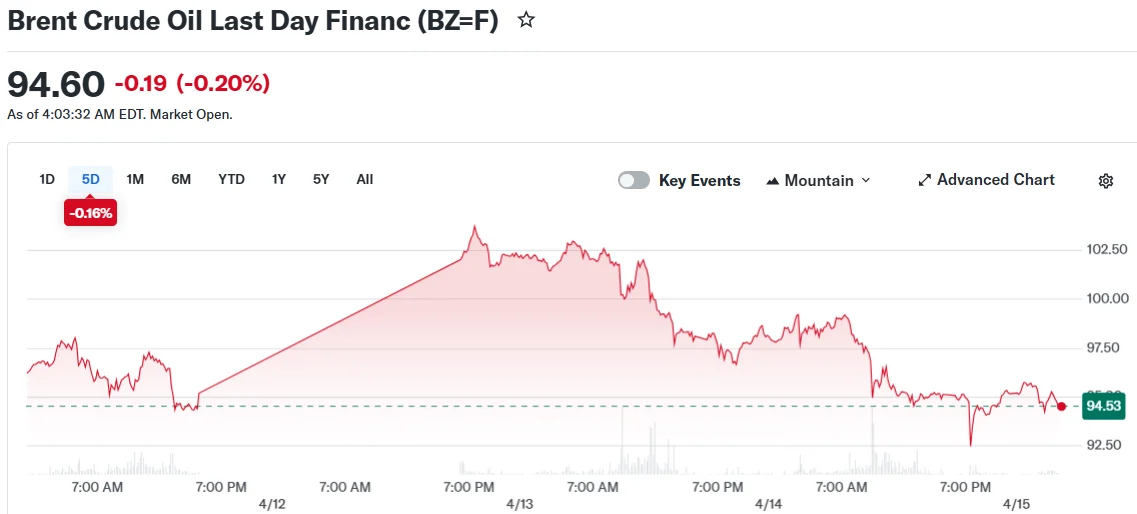
- Brent crude plunged 4.6% Tuesday, settling below $95; WTI hovers around $91
- Pentagon confirms complete implementation of Iran naval blockade
- President Trump indicates conflict “very close to over,” expects negotiations within 48 hours
- Tehran weighing voluntary suspension of Hormuz shipments to sidestep US naval cordon
- Global energy agencies slash demand projections; Japan preparing emergency reserve release in May
Energy markets experienced dramatic volatility this week as investors navigate conflicting developments: a fully operational US naval blockade surrounding Iran and mounting indications that diplomatic negotiations may soon resume.
Brent crude experienced a sharp 4.6% decline Tuesday, dropping beneath the $95 per barrel threshold. West Texas Intermediate similarly retreated to approximately $91. Markets saw modest recovery during Wednesday’s Asian session following Pentagon confirmation that the blockade had reached full operational status.
Admiral Brad Cooper announced that American military assets have “completely halted economic trade going into and out of Iran by sea.” President Trump subsequently posted on social platforms, asserting the US had placed Iran in a “chokehold” and suggesting the nation could face storage capacity limitations.
The maritime blockade was initiated merely two days following the collapse of ceasefire negotiations in Pakistan. Washington now urgently seeks to convene a second negotiation round before the existing ceasefire arrangement lapses next week.

Speaking with the New York Post, Trump suggested fresh diplomatic discussions could commence “over the next two days.” He separately informed Fox Business host Maria Bartiromo that he viewed the conflict as “very close to over.”
One diplomatic scenario under consideration involves reconvening in Pakistan for subsequent talks, though alternative venues remain under evaluation.
Meanwhile, Iranian officials are reportedly deliberating a voluntary halt to shipments traversing the Strait of Hormuz to prevent direct confrontation with the American naval presence, according to sources with knowledge of internal discussions.
Asian Markets Face Supply Disruption
The Strait of Hormuz facilitates approximately 20% of global oil supply. Since hostilities commenced in late February, Iranian forces have effectively blocked virtually all commercial shipping through this critical waterway.
Analysts at ANZ estimate the conflict has eliminated at least 10 million barrels daily from world markets. Their assessment indicates that supply constraints alone suffice to maintain elevated Brent pricing, regardless of whether the situation deteriorates further.
Japanese authorities are arranging a second emergency release from national petroleum reserves scheduled for early May. Refining operations throughout the Asia-Pacific basin may face forced reductions, diminishing available supplies of aviation fuel and diesel.
Both the International Energy Agency and OPEC have revised their global oil demand projections downward, attributing the adjustment to price pressures constraining consumer activity.
Market Analyst Perspectives
Dilin Wu of Pepperstone Group forecasted that crude prices will probably trade in a range with a “softer bias” near-term as markets digest the diplomatic pivot. He emphasized that even with de-escalation, physical supply restoration would lag considerably due to logistical complications surrounding the Hormuz region.
ANZ projected that should escalation risks diminish, Middle Eastern supply could experience phased recovery, with 2 to 3 million barrels daily potentially restored within the initial four-week period.
Rebecca Babin, senior energy trader at CIBC Private Wealth Group, indicated markets are “leaning toward a normalization of flows by the end of April.”
The American Petroleum Institute documented that US crude stockpiles increased by 6.1 million barrels during the previous week, potentially representing the eighth consecutive weekly accumulation pending official government confirmation Wednesday.
The Trump administration has additionally verified that a waiver permitting restricted Iranian crude purchases will be allowed to lapse this weekend.
