


Key Highlights
- First quarter 2026 sales reached €4.07 billion, reflecting 5.6% organic growth versus 7.1% analyst expectations.
- Shares plummeted more than 13% during Paris trading, erasing over $20 billion in market capitalization.
- Escalating Middle East tensions shaved approximately 150 basis points from quarterly revenue performance, with the region posting a 13.4% decline.
- The Asia-Pacific region excluding Japan expanded only 2.2%, dramatically slower than the prior quarter’s 8% pace, fueling China demand worries.
- North American operations emerged as a bright spot with robust 17.2% expansion, exceeding analyst projections.
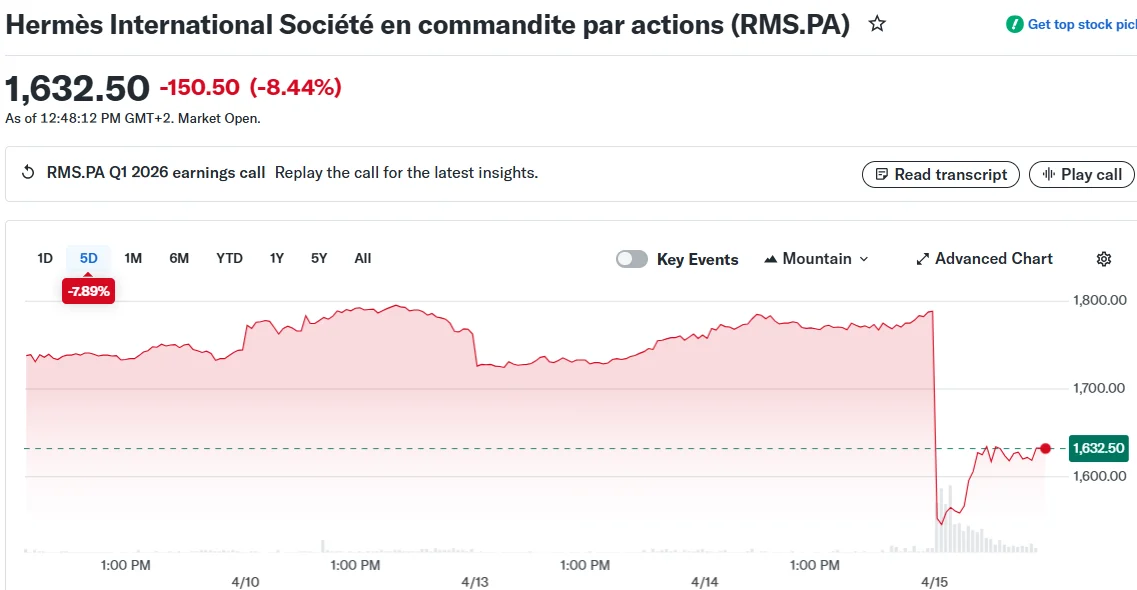
Shares of Hermès experienced a severe downturn Wednesday following the disclosure of first-quarter financial results that underwhelmed Wall Street expectations. The disappointing performance, primarily attributed to softness across Middle Eastern and Asian markets, triggered a devastating 13% decline in Paris—representing one of the steepest single-session losses in recent memory for the luxury powerhouse.
[[EMBED_0]]
The Parisian fashion house disclosed quarterly sales of €4.07 billion spanning January through March 2026, representing a 5.6% advancement on a constant currency basis. While positive on the surface, this figure pales in comparison to the 7.1% expansion Wall Street had anticipated. The performance also represents a notable deceleration from the 9.8% organic growth achieved during the fourth quarter of 2025.
When measured at actual exchange rates, the results appeared considerably worse. Foreign exchange fluctuations totaling €290 million pushed reported revenue into year-over-year contraction. Market forecasters had projected approximately €4.16 billion in total sales.

The ongoing conflict involving Iran played a measurable role in the shortfall. According to Jefferies research team estimates, Middle Eastern turmoil stripped roughly 150 basis points from quarterly revenue expansion. Wholesale distribution through regional concession partners and airport retail channels suffered the most significant damage. Collectively, Middle Eastern markets contracted 13.4% compared to the prior year period.
Chinese Market Deceleration Sparks Investor Alarm
While the Middle East weakness garnered attention, the region causing the greatest investor anxiety was actually Asia-Pacific, excluding Japan.
This critical segment registered merely 2.2% growth during the opening quarter—substantially below the 5.7% consensus projection and representing a dramatic deceleration from the previous quarter’s 8% clip. For a luxury brand with substantial exposure to Chinese consumer expenditure like Hermès, such pronounced weakness immediately raises red flags.
Jefferies research team stated bluntly: the Asia-Pacific ex-Japan outcome “will be a major point of debate” and represents a “clear source of concern for fundamental investors.” Investors now face uncertainty regarding whether this represents a temporary disruption or signals more fundamental deterioration in Chinese consumer appetite.
The stock’s pre-announcement weakness had already incorporated two primary concerns, Jefferies noted—Middle Eastern geopolitical risk and decelerating Chinese consumption trends. Wednesday’s financial disclosure validated both anxieties.
North American Strength Provides Silver Lining
Not all regional performance disappointed during the quarter. The Americas segment generated impressive 17.2% growth, substantially surpassing analyst estimates. This represents exceptionally strong execution in a geography that has gained increasing significance for luxury consumption.
Despite the first quarter disappointment, Hermès reaffirmed its medium-term strategic outlook. Management stated the organization has “moved into 2026 with confidence” notwithstanding a challenging economic and geopolitical environment.
The equity tumbled as much as 13.6% during early Paris trading hours before closing approximately 12.93% lower at €1,551.50. The single-session selloff destroyed more than $20 billion in shareholder value.
Hermès currently trades at a price-to-earnings multiple of 41.69x, consistent with its premium market positioning within the luxury goods industry. The company maintains a GF Score of 96/100, while its financial strength commands a 9/10 rating.
Management indicated that Middle Eastern business trends have demonstrated improvement during the early weeks of the second quarter.
