


Key Takeaways
- David Solomon, CEO of Goldman Sachs, projects oil prices will reach $80–$100 per barrel over the next three to six months
- In a worst-case scenario involving severe Iran conflict escalation, Solomon believes crude could surge to $170 per barrel
- Tuesday’s trading saw Brent crude decline 0.5% to $94.95 while WTI fell 1.8% to $88.04
- The Strait of Hormuz has remained mostly shut since hostilities commenced in late February
- Gulf nations Saudi Arabia and UAE have increased alternative route shipments to 6.5 million barrels daily
During remarks at the Paley Center on Tuesday, Goldman Sachs CEO David Solomon outlined his expectations for crude oil markets, projecting prices between $80 and $100 per barrel within a three-to-six-month timeframe.
Solomon further cautioned that a significant escalation involving Iran could send oil prices soaring to $170 per barrel. While noting that U.S. recession risks remain relatively stable at present, he emphasized that market conditions are fragile and could shift dramatically—describing the situation as being “only one tweet away” from transformation.
Oil prices retreated on Tuesday amid uncertainty surrounding diplomatic efforts between the U.S. and Iran. A temporary cessation of hostilities is scheduled to end within days, though officials have not disclosed the precise expiration date.
Brent crude futures declined 0.5% to settle at $94.95 per barrel. Meanwhile, U.S. West Texas Intermediate experienced a steeper 1.8% drop, closing at $88.04 per barrel.

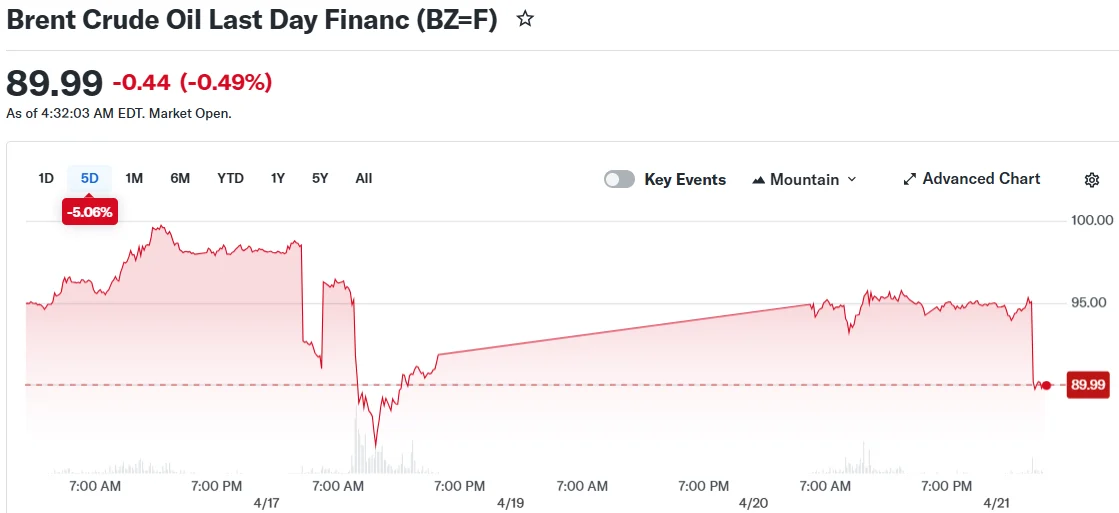
The previous trading session had witnessed significant gains following weekend developments that heightened regional tensions. U.S. forces intercepted and seized a cargo vessel flying the Iranian flag, prompting Tehran to issue retaliatory warnings.
Subsequently, Iran reimposed its closure of the Strait of Hormuz—reversing the Friday reopening. Iranian authorities justified the action by citing continued U.S. naval blockades affecting Iranian maritime access and coastal areas.
Diplomatic Negotiations Face Obstacles
President Trump announced Monday that the naval blockade would remain operational until a comprehensive peace agreement is finalized. The president indicated that fresh diplomatic discussions with Iran were anticipated this week, with a U.S. delegation expected to travel to Pakistan on Tuesday or Wednesday.
However, Iranian leadership has openly resisted additional negotiations. Mohammad Bagher Ghalibaf, Iran’s Parliamentary Speaker and chief negotiator, declared that Iran would refuse to engage in talks “under the shadow of threats” emanating from Washington.
Multiple Iranian state-controlled media outlets echoed this stance. Conversely, other sources suggested that Iran had privately informed regional intermediaries of its intention to dispatch a delegation to Pakistan within the week.
ANZ analysts noted that “ongoing uncertainty continues to overshadow any peace agreement, as Iran remains reluctant to attend a second round of talks in Pakistan.”
The two-week ceasefire was formally announced by Trump on April 7 at 6:32 p.m. ET.
Strategic Waterway Remains Disrupted
The Strait of Hormuz serves as a critical chokepoint, transporting approximately one-fifth of global oil supplies. The passage has been predominantly closed since the outbreak of hostilities in late February.
Although the initial dramatic price surge has moderated somewhat, crude oil prices continue trading substantially above pre-conflict levels.
Both Saudi Arabia and the United Arab Emirates have adapted by redirecting their oil exports away from Hormuz. Alternative export facilities include the Yanbu terminal on the Red Sea and the Fujairah terminal positioned in the Gulf of Oman.
According to ANZ research, combined throughput at these two alternate facilities has climbed to 6.5 million barrels per day, representing an increase from the pre-war rate of 5.0 million barrels per day.
As Iran’s ceasefire deadline rapidly approaches, no confirmed peace agreement has been secured.
