



Key Highlights
- ETH tumbled beneath $2,300 following the Federal Reserve’s decision to maintain rates at 3.50–3.75%, signaling reluctance toward additional cuts.
- A surge of 226,000 ETH landed on exchanges within a 72-hour window, suggesting mounting sell-side pressure.
- Transactions from addresses associated with Fenbushi Capital, Genesis Trading, and an ICO whale dormant for 11 years sent ETH to trading platforms.
- Trader Daan Crypto Trades suggests clearing $2,400 resistance could propel ETH into the $2,600–$2,700 territory.
- Critical floor levels exist at $2,211 and $2,107; reclaiming $2,335 would indicate bullish momentum returning.
Ethereum (ETH) declined beneath the $2,300 threshold on Wednesday following the United States Federal Reserve’s resolution to keep interest rates unchanged within the 3.50%–3.75% corridor. The central bank’s choice emerged from an 8-4 voting split, with three regional presidents advocating for the elimination of any “easing bias” language from official communications. This hawkish positioning intensifies downward pressure on speculative assets throughout the cryptocurrency sector.
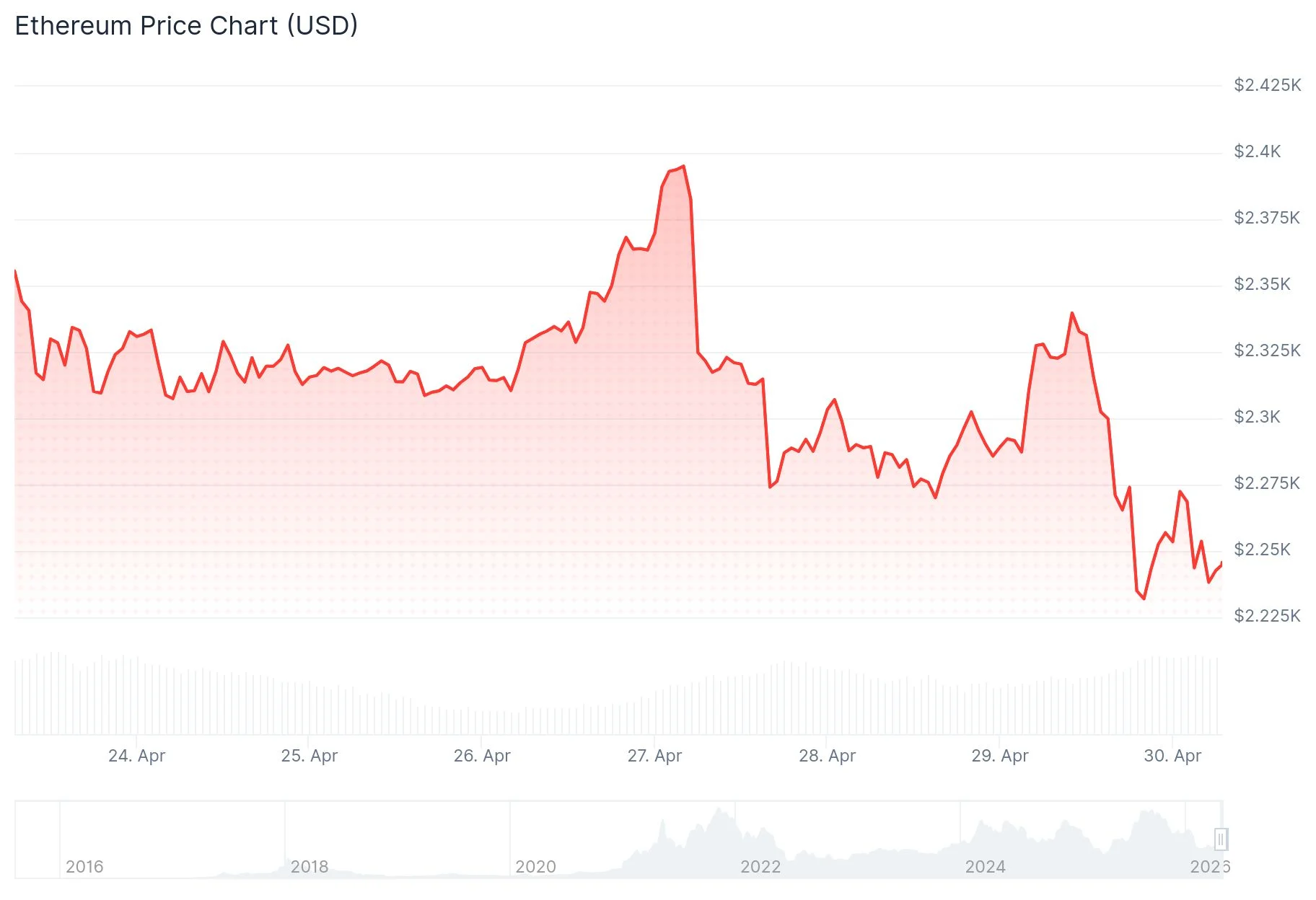
ETH reached an intraday bottom at $2,220 and currently trades marginally above this threshold. The digital asset has breached below an ascending channel formation that previously provided support near $2,295 on shorter timeframes.
Exchange Inflows and On-Chain Movements Indicate Distribution
Data from CryptoQuant reveals that exchange balances have expanded by approximately 226,000 ETH across the previous three-day period. Elevated deposit activity to trading platforms generally indicates heightened intentions to liquidate holdings.

Blockchain analytics platform Lookonchain identified specific addresses responsible for these transfers. Wallets connected to Fenbushi Capital alongside Genesis Trading dispatched ETH to centralized exchanges throughout the last day. Additionally, an original Ethereum ICO participant transferred 10,000 ETH to a fresh address following nearly eleven years of inactivity.

Retail market participants contributed to downward momentum last week, collectively disposing of over 750,000 ETH.
The Coinbase Premium Index, which measures American institutional buying appetite, shifted into negative territory during this timeframe. Spot Ethereum ETFs in the United States recorded consecutive sessions of net withdrawals, based on figures from SoSoValue.
The total supply of staked ETH contracted by 140,000 tokens over the preceding seven days. Meanwhile, the validator withdrawal queue expanded dramatically from under 1,000 to surpass 414,000 ETH.
On a constructive note, BitMine Immersion Technologies committed an additional 106,200 ETH to staking protocols on Tuesday. This entity currently controls 5.078 million ETH in total, with 3.7 million tokens already deployed in staking contracts.
Critical Price Zones for Traders
Market analyst Daan Crypto Trades observed on X that Ethereum has demonstrated gradual upward movement in recent weeks yet failed to penetrate the $2,400 zone. He indicated that successfully breaking this barrier would probably drive ETH toward the $2,600–$2,700 range, though maintaining the diagonal trendline support remains essential for preserving the current upward trajectory.
ETH currently trades below its 20-day, 50-day, and 100-day exponential moving averages, positioned at $2,287, $2,242, and $2,366 respectively. The Relative Strength Index registers 47, indicating neutral to slightly bearish conditions, while the Stochastic Oscillator has descended into oversold readings.
Cryptocurrency analyst Ali Martinez highlighted on April 29 that ETH was attempting to recapture its Realized Price threshold of $2,335. This metric represents the aggregate average acquisition cost for on-chain participants. Historical patterns demonstrate that sustained trading above $2,335 typically precedes substantial upward movements.
ETH experienced $149.7 million in forced liquidations during the past 24-hour cycle, with long position closures accounting for $110.3 million of this figure.
Near-term support zones are established at $2,211, with secondary backing at $2,107. Overhead resistance appears at $2,265, followed by barriers at $2,280 and $2,300.
