


Key Takeaways
- Banking institution Standard Chartered maintains its forecast of $40,000 for ETH by 2030, with an intermediate milestone of $4,000 expected by late 2026
- Current ETH price around $2,000 represents a 60% decline from the August 2025 high near $4,953
- The network logged more than 200 million transactions during Q1 2026, establishing a new quarterly benchmark
- Ethereum’s DeFi ecosystem commands $43B–$45B in total value locked, accounting for 53% of worldwide DeFi capital
- The institution’s decade-end projection assumes an ETH/BTC ratio of 0.08, which would require Bitcoin trading at $500,000
A research report issued Thursday by Standard Chartered’s analytical division doubled down on the bank’s ambitious Ethereum valuation forecasts, contending that current market pricing fails to reflect the robust activity levels across the network.
ETH currently changes hands near $2,000. This marks a dramatic 60% retreat from the approximately $4,953 peak recorded in August 2025.
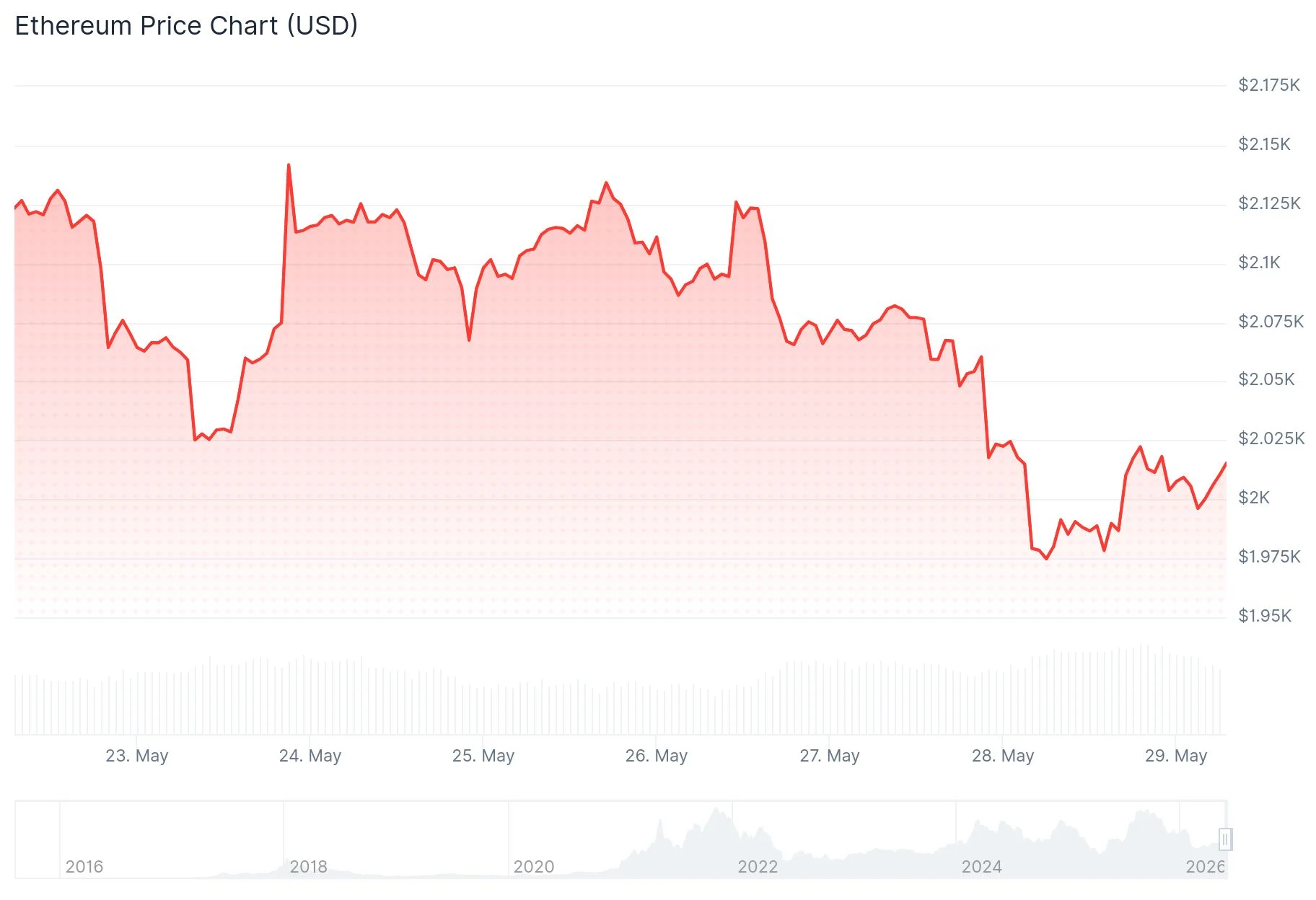
By contrast, Bitcoin has declined roughly 42% from its record high near $126,000 to approximately $72,800 today. According to Standard Chartered’s assessment, the more pronounced pullback in Ethereum lacks fundamental justification.
Analysts at the financial institution drew parallels between Ethereum’s present circumstances and Amazon’s position following the 2001 dot-com bubble burst. Despite Amazon’s stock plummeting 94%, then-CEO Jeff Bezos highlighted that operational performance indicators continued strengthening. Standard Chartered argues an identical dynamic characterizes Ethereum today — pricing deteriorates while network utilization reaches unprecedented levels.

The blockchain recorded over 200 million transactions throughout Q1 2026, representing the highest quarterly figure in its history. The network’s DeFi total value locked ranges between $43B and $45B, constituting 53% of global DeFi liquidity.
Network Fundamentals Versus Market Valuation
Standard Chartered’s research team emphasized that ETH possesses “significant scope” to “catch up to internal metrics.” Stablecoin transfers alone comprise 33% of Ethereum transaction volume year-to-date, with the bank anticipating continued expansion in this segment.
The Ethereum Foundation recently unveiled plans for an “economic zone” scheduled to debut this summer. This infrastructure aims to facilitate smoother movement of digital assets across various networks constructed atop Ethereum.
Approximately 36 million ETH — nearly 30% of circulating supply — remains secured in staking protocols. This mechanism withdraws substantial token quantities from active trading circulation. When combined with the deflationary burn mechanism implemented through EIP-1559, the accessible ETH supply continues contracting even as network adoption accelerates.
Rationale Behind the $40,000 Projection
The bank’s $40,000 end-of-decade forecast relies on the ETH/BTC valuation ratio climbing back to 0.08. This ratio last appeared during the 2021 cryptocurrency bull market apex. Achieving this would necessitate Bitcoin trading at $500,000.
The more immediate projection of $4,000 by year-end 2026 would constitute approximately a doubling from present price levels.
Standard Chartered additionally highlighted tokenized real-world assets as a critical growth catalyst. Industry projections estimate this sector could expand to $4–5 trillion by 2030. Should these assets primarily settle on Ethereum, demand for ETH as transaction fuel and collateral would surge correspondingly.
The institution stated: “If RWAs multiply by 50x over the next few years as we expect, the importance of this sector to Ethereum is set to increase dramatically.”
Prediction marketplace Myriad presently assigns a 65% probability that ETH descends to $1,500 before climbing to $3,000, indicating persistent near-term pessimism among platform participants.
