



Key Takeaways
- Ethereum has declined 31% year-to-date in 2026, with current pricing hovering around $2,066.
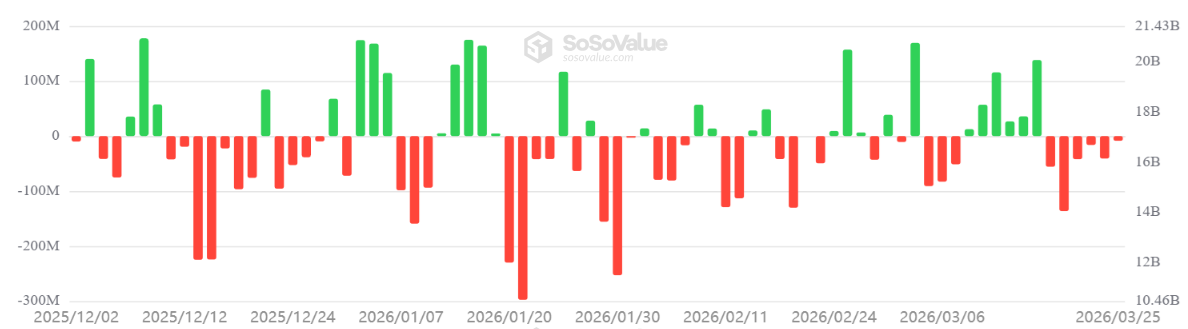
- Spot Ethereum ETFs in the United States have experienced $298 million in net withdrawals across six consecutive sessions.
- Decentralized exchange volume on Ethereum has contracted by approximately 50% compared to Q4 2025 figures.
- Futures contracts for ETH show only a 2% premium, significantly below the 4–8% neutral benchmark.
- Network participation reached an all-time high of 3.64 million weekly active addresses, while exchange-held supply dropped to decade lows.
Ethereum is currently changing hands around $2,066 following a 6% decline that occurred from Wednesday through Thursday this week, bringing the asset back to test support at $2,050. Year-to-date, the second-largest cryptocurrency has shed 31% of its value since the beginning of 2026.
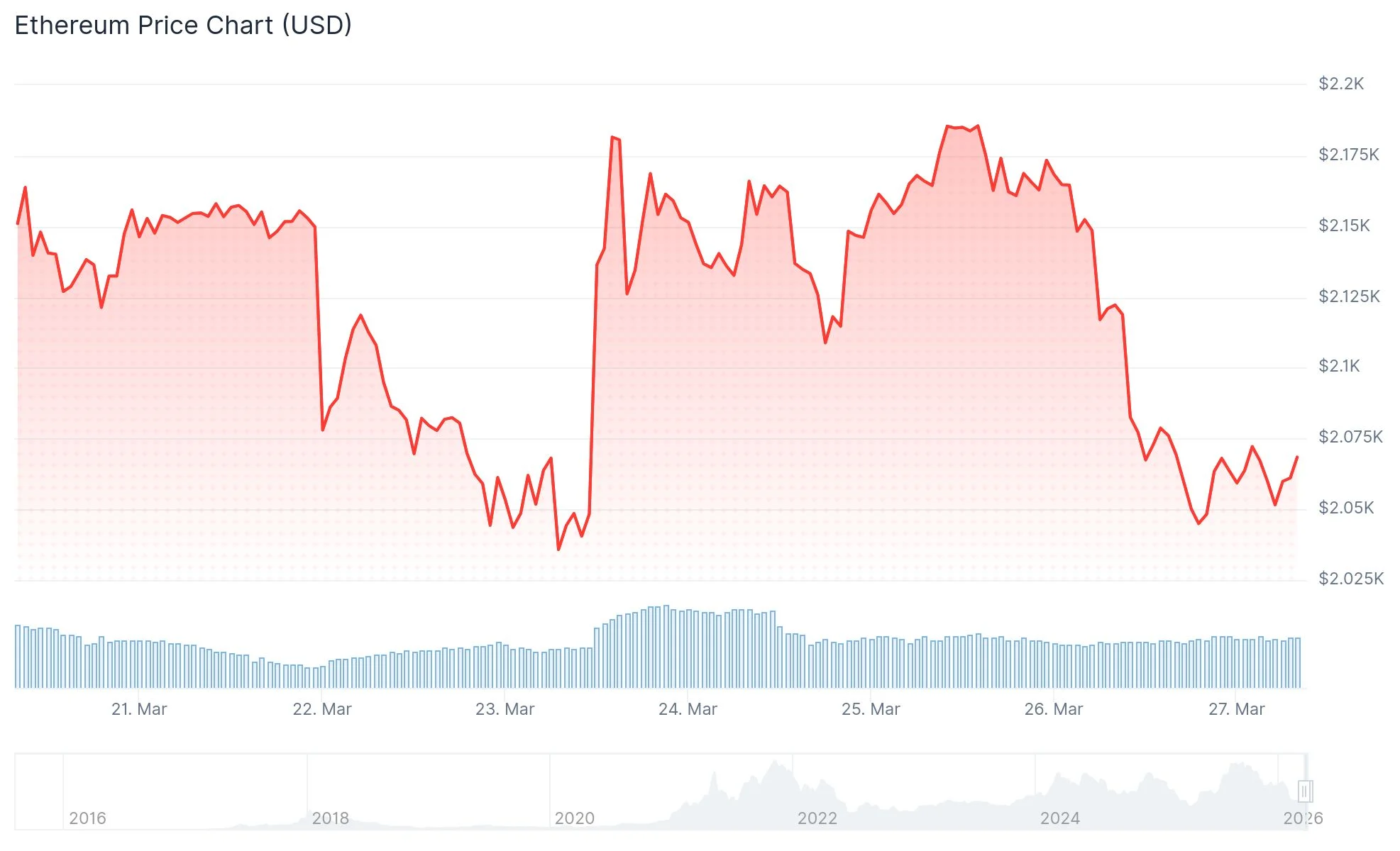
This bearish momentum mirrors broader risk aversion across financial markets, influenced in part by geopolitical tensions surrounding the US-Israel-Iran situation. Throughout this downturn, ETH has lagged the overall cryptocurrency market capitalization performance.
Regulatory developments are compounding the pressure. US lawmakers in the Senate are considering legislation to prohibit yield payments on stablecoins maintained on centralized platforms. While Coinbase has voiced opposition to such measures, traditional banking institutions contend that the GENIUS Act already restricts stablecoin issuers from distributing yields directly to token holders.
Additionally, the Financial Action Task Force has recently urged member countries to strengthen regulatory frameworks around stablecoins, highlighting concerns that peer-to-peer transfers and self-custodial wallets complicate efforts to monitor potentially illicit transactions.

ETF Redemptions and Futures Market Point to Diminished Appetite
Since March 18, United States-based spot Ethereum exchange-traded funds have registered $298 million in cumulative net outflows spanning six straight trading sessions. Even with Ethereum’s native staking return of 2.8%, institutional investors have not reversed their risk-averse positioning.
Futures contracts for Ethereum are currently priced at just a 2% annualized premium relative to spot markets. In balanced market conditions, this metric typically ranges from 4% to 8%. The compressed premium indicates limited bullish conviction among leveraged traders.
Decentralized exchange trading volume on the Ethereum network now averages $9.4 billion weekly. This represents roughly a 50% reduction from levels observed during the closing quarter of 2025. Diminished on-chain transaction activity continues to undermine demand for ETH in its capacity as a network utility asset.
Technical indicators paint a challenging picture. ETH is positioned below all major exponential moving averages—the 20, 50, 100, and 200-day levels. The Relative Strength Index remains in bearish territory, while the MACD indicator reflects deteriorating momentum. Critical support is established in the $2,000–$2,050 zone. A decisive breach of this range could accelerate selling toward $1,800, with $1,750 representing the next major level of interest.
Network Usage Hits All-Time Highs While Exchange Inventory Contracts
Despite downward price pressure, Ethereum’s underlying network continues to demonstrate robust growth. Weekly active addresses surged to an unprecedented 3.64 million, marking a 97% increase year-over-year and a 13% gain over the past month alone.
Competing networks show substantially lower engagement: Polygon PoS recorded 2.84 million active addresses, Base registered 1.99 million, and Arbitrum posted 785,000.
The quantity of Ethereum held on centralized exchanges has fallen to its lowest point since 2016. On March 22 specifically, market participants withdrew $1.67 billion worth of ETH from exchanges in a single 24-hour period, signaling accumulation strategies rather than distribution.
Institutional acquisition continues unabated. Entities such as BitMine, SharpLink, and The Ether Machine have actively added to their Ethereum holdings. Large-scale transaction activity surged from 123 events on March 21 to 2,055 on March 24, though whale movements have since normalized to approximately 239 transactions according to the most recent tracking data.
