


Key Takeaways
- Elon Musk revealed “Terafab,” a semiconductor production venture in Austin, Texas, partnering Tesla, SpaceX, and xAI
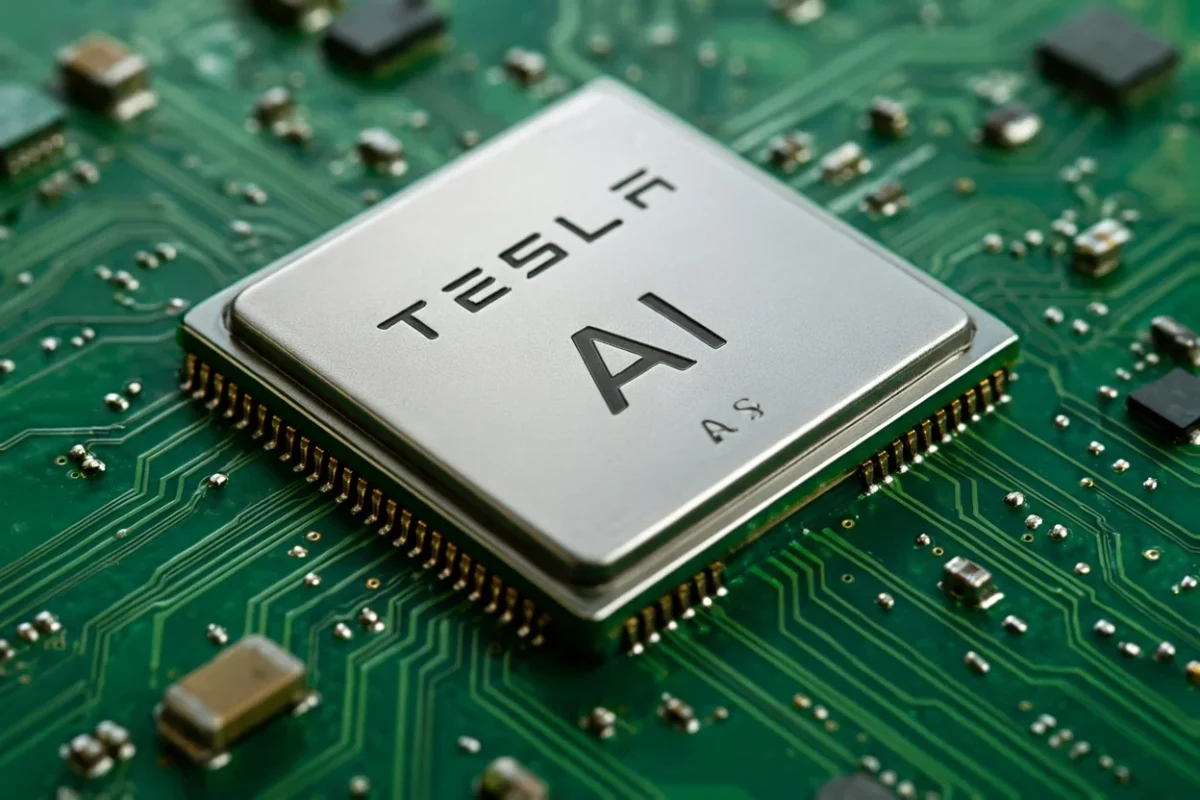
- The complex will manufacture two distinct chips — one for Tesla automobiles and Optimus robots, another for space-based AI satellites
- According to Musk, worldwide chip production currently satisfies merely 3% of his companies’ projected requirements
- First production phase scheduled for late 2027, with full-scale manufacturing expected in 2028
- Tesla stock declined approximately 2–3% during premarket trading after the reveal
Elon Musk revealed ambitious plans for a significant semiconductor manufacturing facility dubbed “Terafab” this past Saturday evening, confirming it as a collaborative effort between Tesla, SpaceX, and xAI. The announcement triggered a decline in Tesla stock during Monday’s premarket session.
Musk disclosed the project details at a decommissioned power facility in Austin, Texas. He characterized Terafab as comprising two distinct fabrication plants, with each dedicated to manufacturing a unique chip architecture.
The first chip will serve Tesla automobiles and the Optimus humanoid robot platform. The second will be specifically designed for artificial intelligence processing in space environments, engineered to withstand extreme conditions and elevated operating temperatures.

Musk indicated that current worldwide semiconductor manufacturing capacity would satisfy merely 3% of his enterprises’ future requirements. While acknowledging Samsung, TSMC, and Micron as present suppliers, he projected that demand would ultimately surpass global production capabilities.
The “Terafab” designation reflects Musk’s ambition to manufacture chips requiring one terawatt of power to operate — approximately equivalent to one billion Nvidia Blackwell chips annually.
SpaceX’s participation came as a surprise revelation. The aerospace company, which recently completed a merger with xAI, is gearing up for a public offering potentially valued at approximately $1.75 trillion.
Financial Investment and Production Schedule
The project’s early stages will require investments reaching tens of billions of dollars. Tesla has already committed to approximately $20 billion in capital expenditure for new equipment in 2026, a significant increase from under $9 billion in 2025. Terafab expenditures exist beyond these current projections.
Musk aims for initial chip output in late 2027, with maximum capacity production achievable by 2028. This timeline is notably aggressive considering semiconductor facilities generally require approximately three years from construction commencement to volume production.
Musk stated Terafab would ultimately deliver one terawatt of computational power annually. To provide perspective, current United States electricity generation totals roughly half that capacity.
Space-Based AI Computing Takes Priority
Among the more unexpected revelations: Musk anticipates 80% of Terafab’s chip production will support space-based artificial intelligence computing operations. SpaceX intends to perform orbital computing functions that hyperscale providers currently execute in terrestrial data centers.
The Terafab facility will concentrate on two-nanometer chip technology, representing the industry’s current cutting-edge standard.
Tesla stock fell approximately 3.2% on Monday. Entering the week, shares were down 18% year-to-date, though maintaining a 48% gain over the trailing twelve months.
The stock currently trades at approximately 190 times projected 2026 earnings, with market valuations incorporating anticipated AI-driven revenue sources including autonomous taxi services and robotics products.
Tesla initiated its robo-taxi operations in Austin this past June and has yet to deploy the service in additional markets. The company continues developing a third-generation version of its Optimus robot.
Musk has not announced a definitive construction start date for the Terafab facility.
