



Key Highlights
- The Dow Jones Industrial Average shattered the 52,000 threshold on Tuesday, fueled by encouraging signals surrounding a potential U.S.-Iran peace agreement.
- Under the framework being discussed, Iran would gain immediate authorization to restart oil exports, causing crude oil values to decline.
- Market participants anticipate the Federal Reserve will maintain current interest rate levels, with newly appointed Chair Kevin Warsh preparing for his inaugural media briefing.
- Traders are analyzing Warsh’s messaging for insights into monetary policy direction, as persistent inflation and robust employment have eliminated near-term rate reduction possibilities.
- Bitcoin declined 1.3% in the previous 24-hour period to $64,469, demonstrating market hesitancy before the central bank’s announcement.
American equity markets advanced during premarket hours on Wednesday, extending Tuesday’s historic performance for the Dow Jones Industrial Average as anticipation builds that Washington and Tehran are approaching a formal resolution to their longstanding tensions.
The Dow achieved an unprecedented milestone by surpassing 52,000 points during Tuesday’s trading session. Wednesday’s early indicators showed Dow futures climbing approximately 50 points, representing a 0.1% increase. The S&P 500 futures registered a 0.3% uptick, while Nasdaq 100 futures demonstrated stronger momentum with a 0.8% gain, primarily driven by technology sector strength.
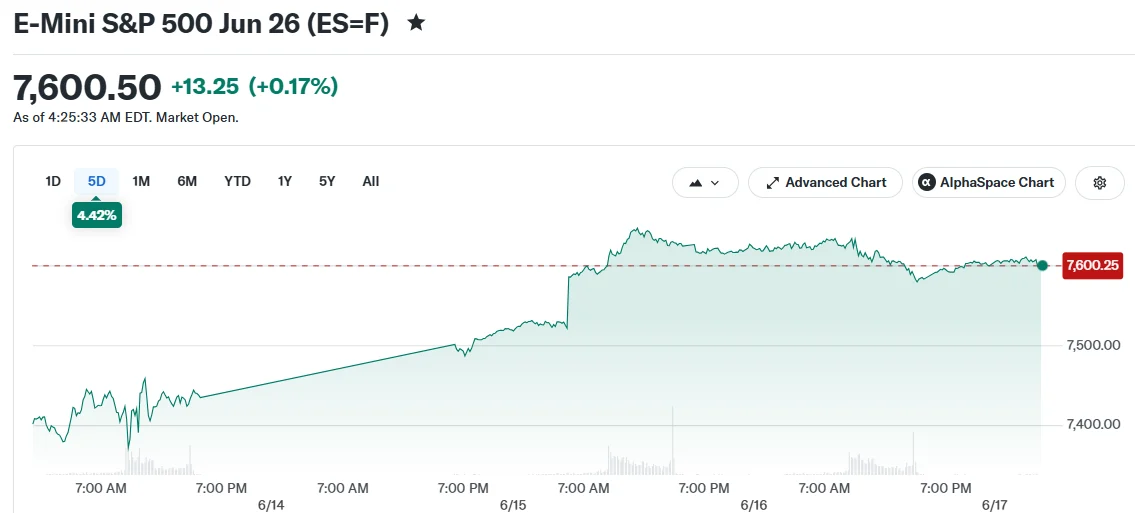
The broader market indices — specifically the S&P 500 and Nasdaq Composite — experienced modest pullbacks on Tuesday as investors repositioned capital away from technology holdings toward underperforming market segments.
According to reporting from The Wall Street Journal, the proposed agreement would grant Iran authorization to commence immediate sales of petroleum and refined products. Negotiators from both nations are targeting Friday as the target date for official execution of the framework.

Oil prices responded negatively to these developments. Brent crude contracts decreased 0.7% to reach $78.43 per barrel, whereas West Texas Intermediate experienced a steeper 1.1% decline, settling at $75.25 per barrel.
Central Bank Announcement Under New Leadership
The Federal Reserve will reveal its most recent monetary policy determination at 2 p.m. Eastern time. Financial markets have overwhelmingly priced in a scenario where interest rates remain unchanged.
However, market watchers are intensely focused on Warsh’s debut press conference in his new capacity as Fed chair. The primary objective is understanding his communication approach and gathering clues about the trajectory of monetary policy.
“Investors will now have to get used to the new Fed Chair’s communication style, which is an adjustment period for markets,” said James Demmert, chief investment officer at Main Street Research.
Warsh has assumed leadership during a particularly challenging period. Elevated inflation readings, partially attributed to geopolitical tensions with Iran, coupled with resilient employment figures, have effectively ruled out rate reductions in the immediate future. Additionally, there’s speculation about potential rate increases if inflationary pressures persist.
Demmert suggested that any turbulence stemming from Warsh’s Wednesday remarks should be viewed as a strategic entry point, noting that “market fundamentals remain in place.”
Cryptocurrency Markets Show Caution Before Policy Announcement
Bitcoin experienced a 1.3% decline during the preceding 24-hour window, reaching $64,469, mirroring the risk-averse sentiment pervading markets ahead of the monetary policy decision.
The benchmark 10-year U.S. Treasury yield edged down 1 basis point to 4.44%. Meanwhile, the dollar index remained essentially unchanged against other major global currencies.
Market participants continue monitoring situation developments in the Strait of Hormuz, where petroleum transportation has faced challenges due to ongoing hostilities. The prospective peace agreement offers optimism that maritime commerce could normalize, potentially alleviating strain on international energy supplies.
Washington and Tehran are working toward formal execution of the 14-point memorandum of agreement on Friday, following Tuesday evening’s disclosure of the deal’s provisions.
