


Key Takeaways
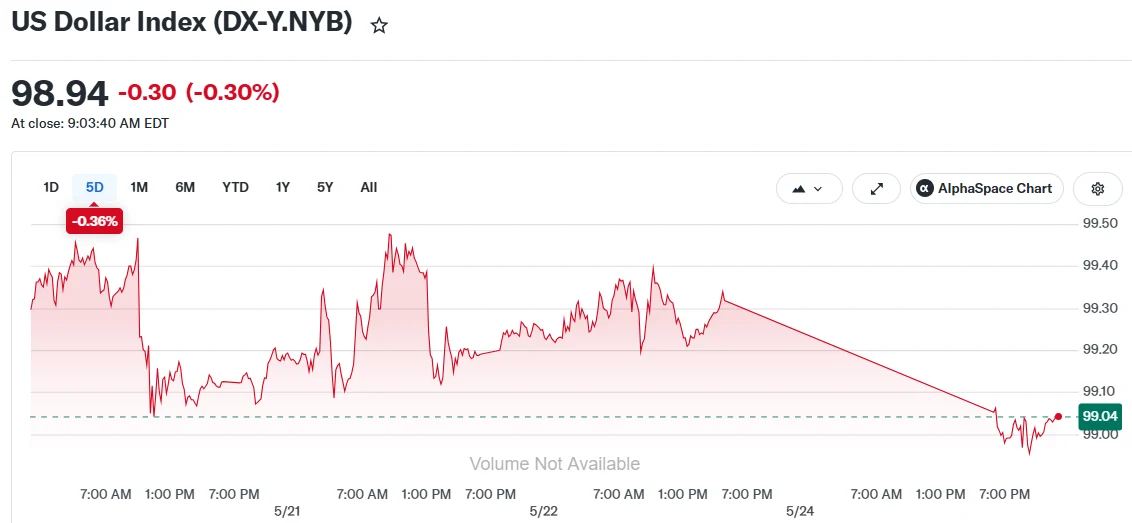
- The U.S. dollar index declined 0.3% to approximately 99.0 on Monday amid rising optimism about potential U.S.-Iran diplomatic breakthrough.
- Crude oil prices experienced significant declines, with Brent crude plummeting nearly 6% to trade below the $100 per barrel threshold.
- Major currencies including the euro, British pound, and Australian dollar strengthened relative to the greenback.
- Reports indicate a preliminary framework agreement between Washington and Tehran is under discussion, though no formal accord has been finalized.
- Market strategists anticipate near-term dollar weakness if negotiations succeed, followed by potential recovery driven by solid economic fundamentals.
The greenback experienced broad-based weakness against major global currencies Monday as market participants grew increasingly optimistic that diplomatic efforts between Washington and Tehran could yield a breakthrough agreement. Such a development would potentially reopen the strategically vital Strait of Hormuz, a critical artery for worldwide petroleum shipments.
Market liquidity was notably thin throughout the session. American financial markets remained shuttered for a federal holiday, while the majority of European trading venues were similarly closed. This reduced participation amplified price movements across asset classes.
The dollar index, which tracks the U.S. currency’s performance against a weighted basket of six major peers, retreated approximately 0.3% to settle at 98.97. This level represented the greenback’s weakest position in roughly ten trading days.
The euro advanced 0.4% to reach $1.1649. Sterling gained 0.55% to touch $1.3504. The Australian dollar, frequently viewed as a proxy for global risk sentiment, climbed 0.64%.

The Japanese yen also appreciated modestly versus the dollar. Japanese Prime Minister Sanae Takaichi unveiled a $19 billion energy subsidy program designed to shield households from escalating fuel expenses. She emphasized the initiative would not necessitate additional government debt issuance.
Crude Markets Tumble on Strait Reopening Speculation
Oil markets experienced pronounced downward pressure. Brent crude, the global pricing benchmark, plunged nearly 6% to settle at $97.61 per barrel. West Texas Intermediate, the U.S. standard, declined 5.3% to finish at $88.15 per barrel. Both contracts broke beneath the psychologically significant $100 level on expectations the strategic waterway could resume normal tanker operations.
The Strait of Hormuz facilitates approximately twenty percent of global petroleum flows. The passage has remained substantially inaccessible to commercial tanker traffic for several weeks following the outbreak of hostilities involving Iran, propelling energy costs upward and intensifying worldwide inflation concerns.
Weekend reports suggested negotiators from Washington and Tehran had substantially completed a framework understanding. A senior administration official indicated the proposed arrangement would encompass reopening the strait alongside termination of the U.S. naval embargo on Iranian maritime facilities.
Yet conflicting messages emerged subsequently. President Donald Trump declared via Truth Social Sunday that the naval blockade would persist until an agreement is “reached, certified, and signed.” He additionally instructed his negotiating team to avoid hasty decisions.
Iran’s foreign ministry contributed its own cautionary notes. A ministry representative stated that consensus had been achieved on multiple elements within a prospective memorandum of understanding but emphasized that formal signature remained distant.
One area of clarity emerged from Tehran: Iranian officials confirmed they would not impose transit fees on vessels navigating the strait, retreating from previous threats to implement such charges. The spokesperson acknowledged, however, that specific maritime services within the waterway would carry associated costs.
Expert Market Analysis
Currency strategists generally concur the greenback would face additional downward pressure should negotiations conclude successfully. Samara Hammoud, an economist with Commonwealth Bank of Australia, projected that a diplomatic accord would initially weaken the dollar. She projected subsequent recovery driven by comparatively robust economic fundamentals relative to other developed-market currencies.
Strategists at BCA Research indicated the dollar should maintain near-term stability, though their intermediate and extended outlook remains pessimistic.
Chris Weston at Pepperstone observed that markets have demonstrated patience awaiting a diplomatic resolution while maintaining expectations for eventual success. He noted that should Brent crude decline toward $90 per barrel, it could moderate inflation projections and diminish pressure on the Federal Reserve to pursue additional interest rate increases.
Market participants are also monitoring U.S. economic data scheduled for release later this week, including the ADP employment report Tuesday and eurozone sentiment indicators Thursday.
