


TLDR
- President Trump announced the termination of the U.S.-Iran peace memorandum during a NATO conference in Turkey, triggering a sharp rally in crude oil markets.
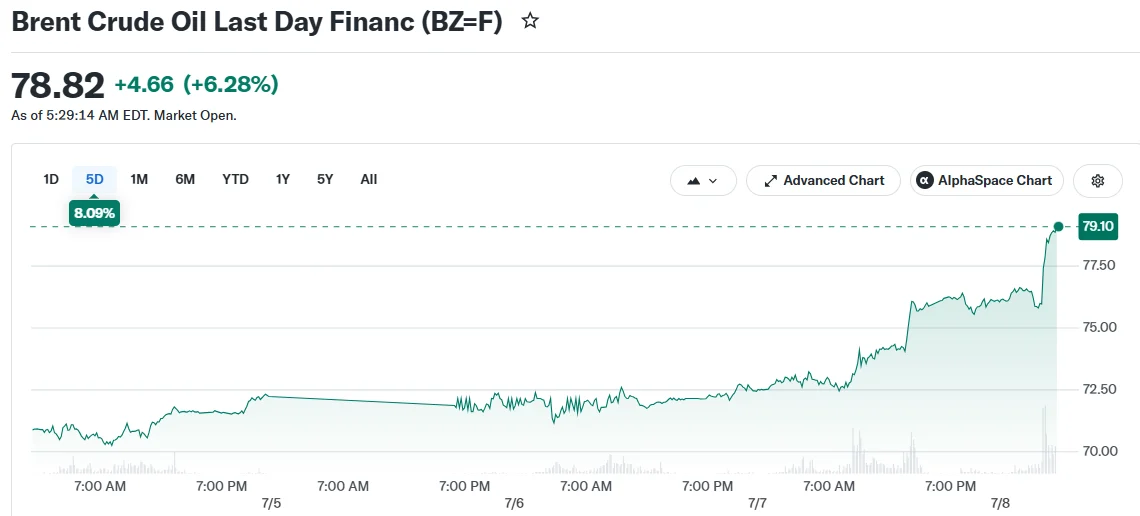
- Brent crude futures climbed 5.5% to reach $78.24 per barrel; U.S. West Texas Intermediate advanced approximately 3%.
- Iran’s IRGC reported launching attacks on 85 American military installations in Kuwait and Bahrain, along with shooting down a U.S. drone.
- Equity markets worldwide declined, with European indices falling 1.6% and U.S. futures dropping between 0.8–1.2%.
- Washington withdrew a sanctions exemption that previously permitted Iran to export oil globally, intensifying concerns about supply constraints.
Crude oil markets experienced a surge exceeding 5% on Wednesday following President Donald Trump’s declaration that the memorandum of understanding negotiated with Iran to resolve the Gulf crisis was finished.
During his address at a NATO conference in Turkey, Trump criticized Tehran for alleged duplicity. “In my view, this is finished,” he stated, further characterizing negotiations with Iran as “simply a waste of time.”
The president’s remarks sent shockwaves through financial markets already experiencing heightened anxiety following recent military confrontations between American and Iranian military forces.
Brent crude futures surged 5.5% to trade at $78.24 per barrel. U.S. West Texas Intermediate increased roughly 3% to settle at $72.49 per barrel. This represents Brent’s most significant single-session gain since the final days of May.
Gulf Region Military Confrontations Intensify
Iran’s Islamic Revolutionary Guards Corps announced it had targeted 85 American military installations across Kuwait and Bahrain, while simultaneously downing a U.S. MQ-9 unmanned aerial vehicle.

The Pentagon characterized its own military operations as retaliation for Iranian assaults on commercial shipping vessels navigating the Strait of Hormuz. U.S. Central Command confirmed it engaged more than 80 targets within Iran and approximately 60 Iranian small watercraft in and around the strategic waterway.
Tehran has declined to accept responsibility for Tuesday’s maritime attacks off Oman’s coastline, which affected a Saudi Arabian oil tanker and a Qatari vessel transporting liquefied natural gas.
Discussions aimed at achieving a lasting peace settlement have reportedly been suspended to accommodate funeral proceedings for former Iranian Supreme Leader Ayatollah Ali Khamenei, who perished during a combined U.S.-Israeli military operation against Iran in late February.
The Strait of Hormuz serves as a transit route for approximately one-fifth of global oil and LNG shipments. OCBC analysts suggested that a complete return to armed conflict seems improbable given domestic political considerations ahead of the November midterm elections, though they emphasized there remains “no definitive strategy to completely secure the Strait of Hormuz.”
Washington additionally canceled a sanctions exemption that had previously authorized Iran to market oil on international markets, a decision that may constrict global crude supplies in upcoming weeks.
Equity Markets Decline, Treasury Yields Climb
The oil surge delivered a significant blow to worldwide financial markets. European equity indices declined 1.6%, tracking toward the STOXX 600’s steepest single-day decline since mid-March. U.S. equity futures retreated between 0.8% and 1.2%.
The VIX volatility gauge surged nearly 13%, marking its most substantial single-day increase in more than a month.
U.S. 10-year Treasury yields climbed to a one-month peak of 4.56%. German and Italian government bond yields similarly reached one-month highs.
Recently published data revealed U.S. Strategic Petroleum Reserve inventories dropped to their lowest point since 1983, amplifying market vulnerability to supply disruptions.
Semiconductor and artificial intelligence equities were experiencing downward pressure prior to Trump’s announcement, as market participants reassessed elevated valuations. Samsung declined for a consecutive session despite disclosing a 19-fold profit increase. Mounting concerns suggest memory chip demand may decelerate during the year’s second half.
The U.S. dollar strengthened throughout the trading session, lifting the euro marginally above $1.14. The Federal Reserve’s June policy meeting minutes are scheduled for release later Wednesday.
