



TLDR
- Brent crude declined beneath $83 per barrel on Tuesday, marking its steepest weekly decline in 2026
- A diplomatic accord between Washington and Tehran to restore Strait of Hormuz access will be finalized in Switzerland this Friday
- Goldman Sachs revised its Q4 Brent projection downward to $80, representing a $10 reduction from earlier estimates
- Morgan Stanley similarly adjusted its forecast, now projecting Dated Brent to average $90 during Q3
- Strategic petroleum reserves in the United States reached their most depleted state since 1983, according to Monday’s data
Crude oil benchmarks extended their losing streak to a fourth consecutive session on Tuesday following news that the United States and Iran reached an understanding to restore passage through the Strait of Hormuz, fueling optimism for renewed supply flows. Both major international benchmarks are experiencing their most severe weekly downturn this year.
Brent crude slipped beneath the $83 threshold during early European market hours, with West Texas Intermediate hovering around $81. The two primary benchmarks have each shed approximately 9% over the past five trading days.
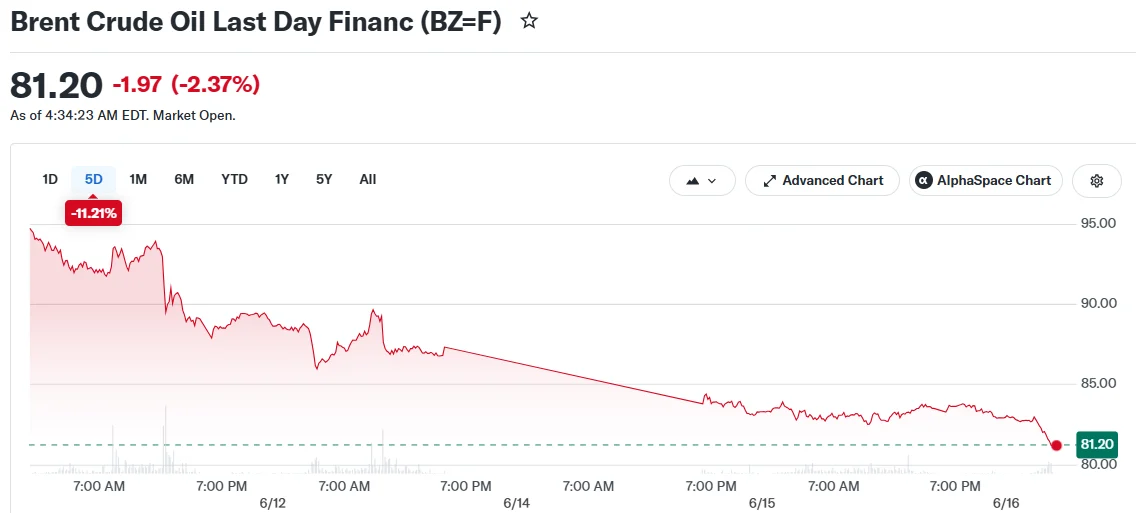
The diplomatic breakthrough between Washington and Tehran is scheduled to be formalized through an interim agreement in Switzerland on Friday. This arrangement is anticipated to permit crude shipments from the Persian Gulf region to flow once again through the strategic waterway, which handles approximately one-fifth of global oil supply.
President Donald Trump confirmed the strait’s imminent reopening during the G7 summit in France. “We have a lot of lanes right now already,” he informed reporters. “It’s going to be open and it’s toll-free.”

Wall Street Banks Cut Price Forecasts
Goldman Sachs anticipates that crude exports from the Persian Gulf will recover to pre-conflict volumes by late July. The investment bank slashed its fourth-quarter Brent outlook to $80 per barrel, down from a previous $90 projection.
Morgan Stanley implemented similar revisions to its commodities forecast. The firm now anticipates Dated Brent will settle at an average of $90 per barrel for the July-through-September period, reduced from an earlier $100 estimate. Its fourth-quarter prediction was lowered by $15 to reach $80.
RBC Capital Markets adopted a more conservative stance regarding the recovery timeline. The bank’s analysts suggested that returning to pre-conflict flow volumes could require several months. “Peak Hormuz flows may actually be in the rearview mirror,” the firm stated.
Market Caution Remains
The complete text of the memorandum of understanding between Washington and Tehran has not yet been made public. Maritime industry executives and commodity traders emphasized they require additional specifics before deploying vessels along the route.
Energy sector officials from Persian Gulf nations reported receiving substantial interest from potential purchasers inquiring about the feasibility of resuming crude movements through the strait. However, the absence of clear operational protocols and maritime security assurances has maintained a cautious atmosphere in the marketplace.
Brent’s prompt spread—a key indicator measuring immediate supply conditions—contracted to 83 cents per barrel. Just one month earlier, this metric exceeded $4, illustrating the dramatic shift in market psychology.
The effective blockage of Hormuz had already depleted America’s strategic petroleum reserves to their most diminished point since 1983, based on information published Monday.
The International Energy Agency is scheduled to publish its monthly market assessment on Wednesday, which may offer additional insight into the evolving supply dynamics.
