


TLDR
- Brent crude heads toward a 5% weekly increase, while WTI advances approximately 4%, even as Friday sessions remained relatively unchanged
- Washington executed new military strikes against Iranian installations Thursday aimed at safeguarding Strait of Hormuz navigation
- Tehran responded with missile and drone assaults targeting Bahrain, Kuwait, Qatar, and Jordan
- President Trump announced the unstable ceasefire had essentially collapsed following commercial vessel attacks
- Traders anticipate the confrontation will remain limited, with Persian Gulf oil shipments continuing at normal levels
Crude oil benchmarks maintained relatively flat positions on Friday while preparing to conclude the week with substantial gains following renewed hostilities between Washington and Tehran that unsettled energy traders earlier this week.
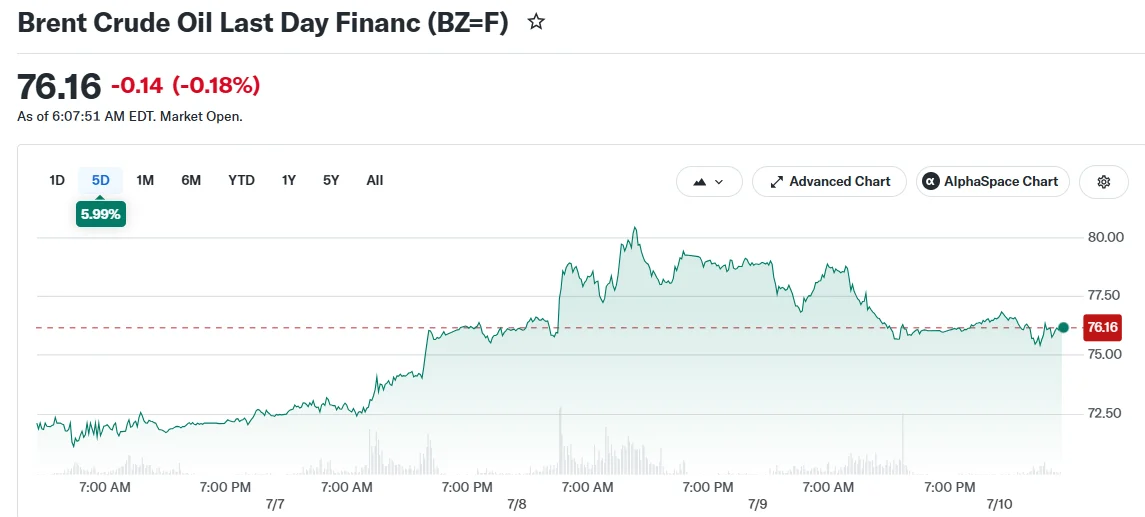
U.S. West Texas Intermediate crude dipped 0.1% to reach $72.01 per barrel during Friday’s session. Brent crude declined 0.07% to settle at $76.25. Notwithstanding the neutral Friday performance, both primary benchmarks were positioned for robust weekly advances — Brent climbing approximately 5% and WTI gaining roughly 4%.
The week’s upward movement stemmed from heightened tensions surrounding the Strait of Hormuz, among the globe’s most critical petroleum transit corridors. Recent assaults on merchant vessels in and near this strategic passage prompted certain maritime operators to postpone or abandon scheduled voyages.
Washington Targets Iranian Sites, Tehran Retaliates
On Thursday, Washington executed an additional series of military strikes against installations within Iranian territory. U.S. officials stated these operations were designed to diminish Tehran’s capacity to menace commercial maritime traffic navigating the Strait of Hormuz.

Tehran countered with ballistic missile and unmanned aerial vehicle strikes on multiple U.S.-allied nations, including Bahrain, Kuwait, Qatar, and Jordan. Market observers characterized these exchanges as among the most extensive military confrontations since the previous month’s temporary ceasefire arrangement.
President Donald Trump declared the assaults on commercial maritime traffic had effectively terminated the ceasefire. He cautioned that Washington would implement more aggressive responses should Iran target shipping vessels again.
Despite Trump’s stern warning, diplomatic initiatives persisted. Iranian Foreign Minister Abbas Araghchi conducted discussions with officials from Saudi Arabia, Oman, and Turkey in efforts to contain the conflict’s expansion.
Traders Perceive Minimal Threat to Petroleum Flows
Market specialists at IG noted in their analysis that crude oil’s measured price reaction demonstrates increasing trader conviction that hostilities will remain constrained rather than evolving into an extended regional emergency.
They emphasized that American strikes have concentrated on Iranian military assets, not petroleum production or export infrastructure. Persian Gulf crude shipments have proceeded with minimal interruption.
Vessel traffic navigating the Strait of Hormuz has steadily rebounded since the June accord reopened the critical passage. Nevertheless, movement remains beneath pre-confrontation volumes as insurance providers and vessel operators continue evaluating associated risks.
IG analysts indicated the primary upside catalysts for crude would materialize if Washington imposed stricter limitations on Iranian petroleum exports or if hostilities directly impacted energy facilities or maritime corridors.
Presently, Gulf region exports have maintained stability and regional reluctance to interrupt commercial shipping has helped contain additional price appreciation.
Traders are now monitoring weekend developments attentively, including potential new military operations, tanker activity patterns, and indicators that Persian Gulf crude shipments might begin experiencing delays.
