


Key Highlights
- Crude markets showed minimal movement Friday before the Independence Day holiday
- Brent benchmark hovered around $71.96 per barrel while WTI remained beneath $70
- Petroleum is tracking toward its fourth consecutive week of declines as Persian Gulf shipping normalizes
- Tehran has dismissed Washington’s request to abandon territorial claims over the Strait of Hormuz
- Brent’s forward curve displays contango structure, indicating anticipated near-term surplus
Crude petroleum markets demonstrated relative stability on Friday as market participants weighed diplomatic developments between Washington and Tehran against mounting indicators of excess supply.
Brent benchmark crude edged up 0.2% to reach $71.96 per barrel in early Friday trading. West Texas Intermediate hovered just beneath the $70 threshold. Both major benchmarks remained on course for their fourth straight week of losses.
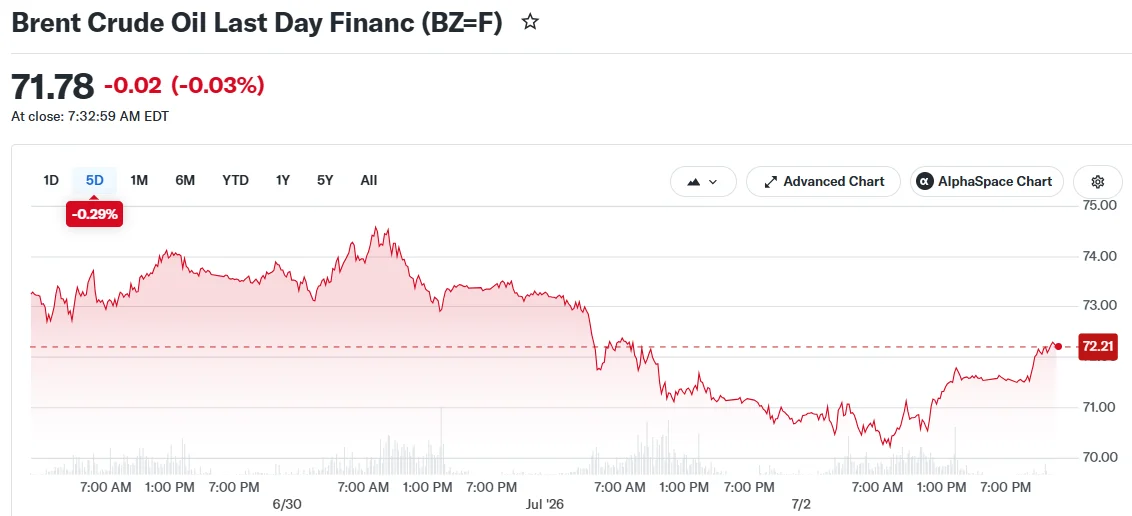
Valuations have retreated to levels comparable with pre-conflict prices throughout the past three weeks. The restoration of normal traffic through the Strait of Hormuz has emerged as a primary catalyst behind this downward trajectory.
Washington and Tehran formalized a memorandum of understanding aimed at negotiating a comprehensive agreement. This development alone transformed market psychology, with participants anticipating increased physical crude availability in coming weeks.

President Donald Trump expressed confidence that Tehran had “agreed to just about everything we need.” His statements suggested meaningful advancement in diplomatic discussions, despite lingering contentious issues.
The Wall Street Journal disclosed that Tehran has rebuffed Washington’s request to formally surrender its territorial assertions over the Strait of Hormuz. The United States had proposed releasing billions in frozen Iranian assets as compensation. Tehran has declined the offer thus far.
Sovereignty over the strategic waterway became a critical concern after Tehran essentially blocked it following coordinated U.S.-Israeli military actions in late February. Maritime traffic through the passage now demonstrates clear signs of recovery.
Persian Gulf Nations Accelerate Shipments as Diplomatic Timeline Shortens
Saudi Arabia has transported more than 10 million barrels of petroleum through the Strait of Hormuz over recent days. Very large crude carriers are loading at the Saudi terminal of Ras Tanura, as the kingdom intensifies shipments to Asian markets. Saudi export volumes have rebounded to approximately 90% of pre-conflict capacity.
Persian Gulf exporters, including Iran, are accelerating crude shipments while the diplomatic opportunity remains open. This window is scheduled to close in August, creating uncertainty regarding subsequent developments.
The Brent futures curve has deepened its contango position. This configuration means immediate delivery contracts trade at discounts compared to future-dated agreements — a pattern indicating market expectations of abundant near-term availability.
ING commodities strategists Warren Patterson and Ewa Manthey indicated that increasing oil flows are applying intensifying downward pressure on the front-month Brent contracts.
ANZ highlighted that accumulated short positions have additionally pressured petroleum valuations. Some bearish wagers were reduced before the holiday weekend.
Tehran continues experiencing difficulties marketing its petroleum. Approximately 58 million barrels remain stored on tankers at sea, with more than 90% still seeking purchasers, according to maritime analytics provider Vortexa.
Reduced crude valuations have attracted purchasing interest from Chinese independent refineries, facilitated by more adaptable pricing strategies from Saudi Arabia and Kuwait.
Certain market analysts suggest petroleum has entered oversold conditions, though the immediate-term supply outlook continues strengthening.
