



Key Highlights
- BTC slipped beneath the $76,000 threshold on Friday, declining approximately 2.3% to reach $75,933, marking its second consecutive weekly decline
- Cryptocurrency markets experienced $200 million in forced liquidations within a 24-hour window, fueled by growing expectations of interest rate increases linked to petroleum-based inflation
- Bitcoin exchange-traded funds recorded $1.26 billion in combined net withdrawals across five consecutive trading days
- Analytics platform Santiment characterizes these withdrawals as a “contrarian signal” potentially indicating favorable accumulation conditions
- ETF specialist James Seyffart notes aggregate ETF capital inflows are approaching their peak at $60 billion, with expectations for a new record
Bitcoin (BTC) breached the $76,000 level on Friday, May 22, continuing a downward trajectory that has pushed the leading digital asset into its second straight week of declining values. The cryptocurrency was changing hands at $75,933, representing a 2.3% daily decrease and approximately 3% weekly decline.
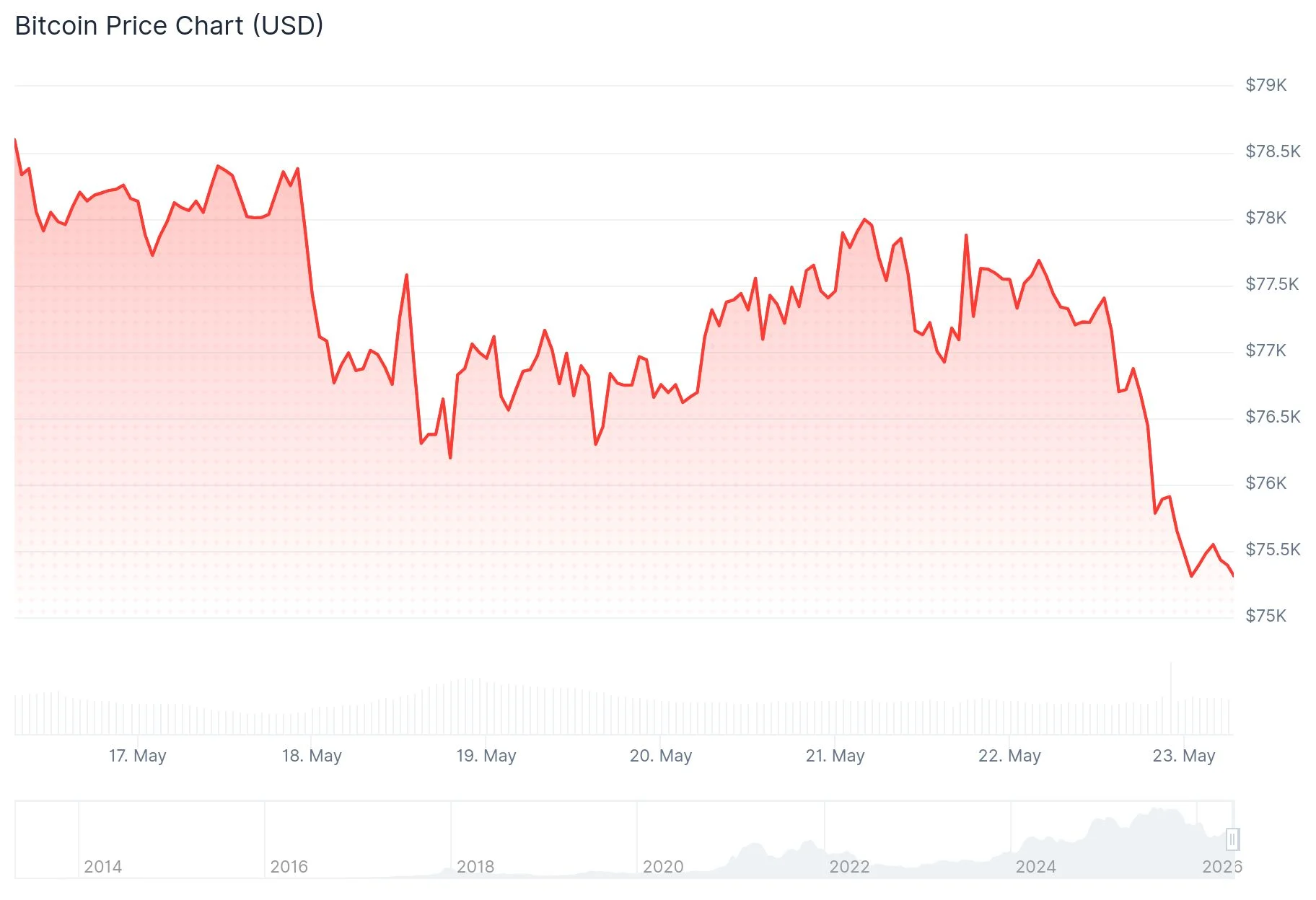
The price decline stemmed from a confluence of macroeconomic headwinds and forced closures of leveraged trading positions. According to CoinGlass tracking data, the cryptocurrency sector witnessed $200 million in liquidated positions within a 24-hour timeframe.
Market participants increased their wagers on potential interest rate increases throughout the week as crude oil valuations surged amid escalating Middle Eastern tensions. Iran has essentially blockaded the Strait of Hormuz since late February, restricting a critical passage that facilitates approximately one-fifth of global petroleum and natural gas transportation.
This supply disruption has amplified concerns regarding inflationary pressures. Documentation from the Federal Reserve’s April policy meeting revealed that a majority of policymakers are now considering rate increases should energy-related inflation persist.

Kevin Warsh assumed his position as the new Federal Reserve chairman on Friday, stepping into the role during a challenging economic period. While President Trump has advocated for rate reductions, the prevailing inflationary climate makes monetary easing appear improbable.
Dessislava Ianeva, an analyst at Nexo Dispatch, observed that the multi-asset landscape underwent a dramatic transformation mid-week. “Headlines suggesting U.S.–Iran de-escalation brought Brent crude down from above $110 to $105.7 per barrel, while dovish tones from the April FOMC minutes kept long-duration yields near cyclical peaks,” she explained.
Cryptocurrency analyst Daan Crypto Trades (@DaanCrypto) shared on X that Bitcoin maintains a definable trajectory on technical charts. He indicated that BTC must break through the lower $80K region, where both horizontal resistance levels and the 200-day moving average converge. He characterized this as the initial significant correction since Bitcoin’s April surge, noting that bulls must establish a higher low or risk validating a lower high within the broader downward trend that began following the October 2025 peak.
Exchange-Traded Fund Withdrawals Exceed $1.26 Billion
Spot Bitcoin exchange-traded funds documented withdrawals throughout six consecutive trading sessions. The 11 United States-domiciled funds collectively experienced $1.26 billion in net withdrawals during the most recent five-day period, based on Farside intelligence.
Bitcoin struggled to maintain support above $80,000 throughout May, reaching a peak of $79,052 on May 16 before retreating. The asset was trading at $75,410 when Santiment issued its Friday assessment.
Santiment Identifies Contrarian Purchase Opportunity
Cryptocurrency sentiment analysis firm Santiment challenged the pessimistic interpretation of these capital outflows. The organization argued that ETF movement patterns predominantly mirror retail investor sentiment rather than institutional allocation strategies.
“Prolonged ETF withdrawals have historically aligned with market conditions conducive to strategic accumulation by patient investors rather than capitulation selling,” Santiment stated.
ETF specialist James Seyffart commented during a YouTube podcast appearance that Bitcoin exchange-traded funds have recovered the majority of the $9 billion in outflows observed between October and February. Cumulative inflows currently hover near $60 billion since the products launched, approaching the historical maximum. Seyffart projected that this benchmark will be surpassed, citing additional ETF offerings entering the marketplace.
