



Key Takeaways
- An institutional trader executed a $1.3B sale of BlackRock’s Bitcoin ETF (IBIT) via dark pool trading, marking the largest transaction of its kind.
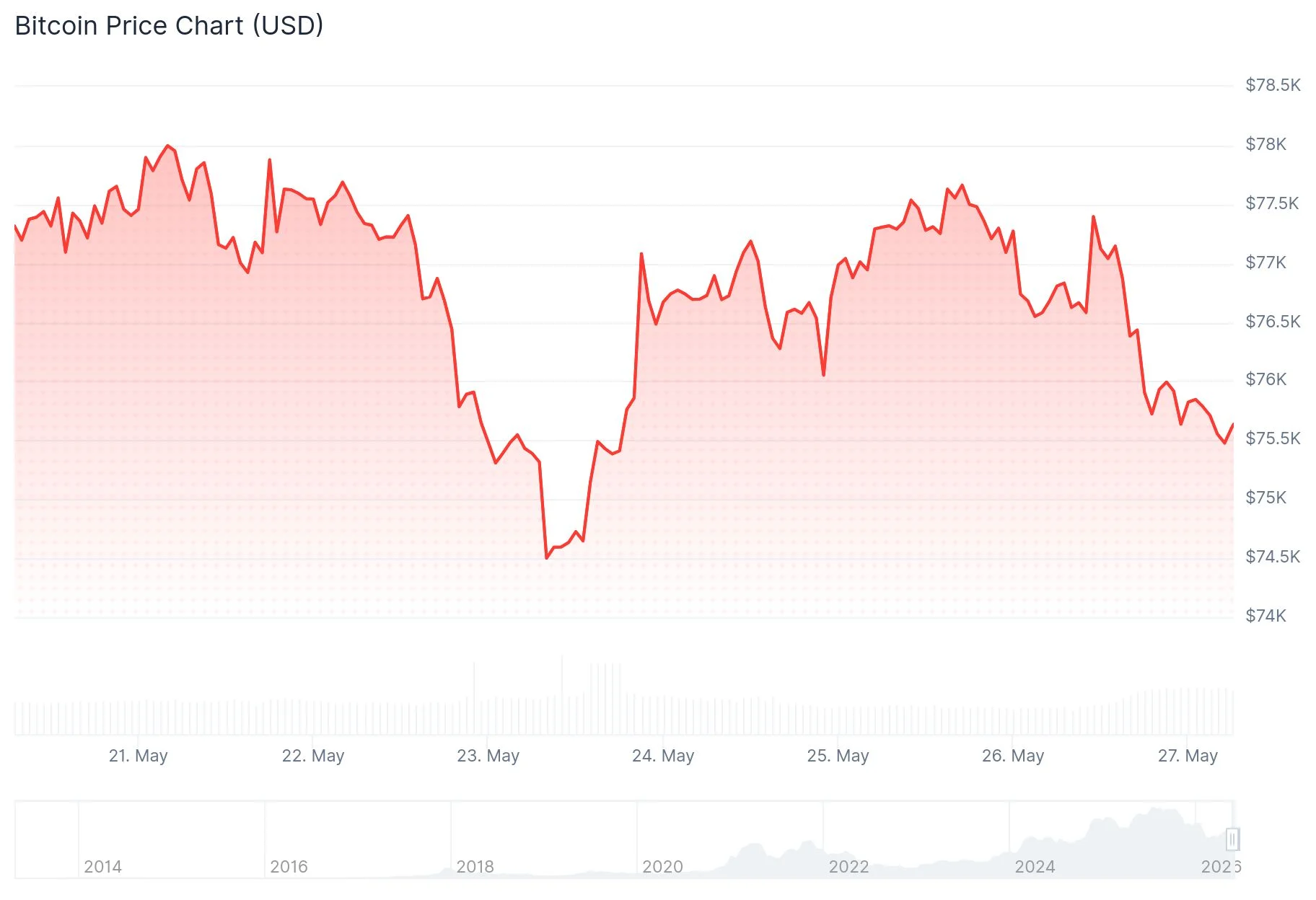
- Bitcoin’s price declined 2.8% in a 12-hour period following the trade, reaching a 24-hour bottom at $75,600.
- Escalating US military operations against Iran contributed to market volatility, with digital asset funds experiencing 2026’s third-largest weekly capital exodus.
- Bitcoin ETFs in the United States have experienced eight consecutive trading sessions of net capital outflows, totaling more than $2 billion since mid-May.
- Bitcoin must break above $79,000 to establish bullish momentum in the near term.
An institutional trader offloaded 29.2 million shares of BlackRock’s iShares Bitcoin Trust ETF (IBIT) at 2:30 pm UTC on Tuesday, May 27. This $1.3 billion deal was executed through a dark pool—a private exchange venue where institutional investors conduct substantial trades without affecting public market pricing.
[[EMBED_0]]
The market reaction was swift and significant. According to TradingView analytics, Bitcoin’s value plummeted 1.5%, sliding from $77,875 down to $76,720 within just ten minutes following the sale. The downward trajectory persisted, with BTC ultimately touching a 24-hour nadir of $75,600 approximately 12 hours after the initial drop—representing a complete decline of 2.8% for the trading session.
Alex Thorn, who leads firmwide research at Galaxy Digital, characterized this as the most substantial dark pool transaction in Bitcoin ETF market history that he’s observed. Bloomberg’s ETF analyst Eric Balchunas highlighted that this sale exceeded the second-largest IBIT sell order from that same trading day by more than 22 times.

Crypto analyst Daan Crypto Trades shared on X: “Clean retest of the April 2025 lows with a decent bounce so far. But the level to break for continuation remains the low $80Ks. Below $74K I’d say bears are back in control.” His analysis underscores how intensely market participants are monitoring critical support and resistance thresholds during this period.
[[EMBED_1]]
Consecutive Days of ETF Capital Flight
United States spot Bitcoin ETFs have now registered eight straight trading days of net capital withdrawals. Tuesday alone witnessed $333.6 million in outflows, with IBIT contributing $192.4 million to that figure. Collectively, over $2 billion has departed these funds since May 14, which marked the last session of positive net inflows.
Institutional liquidity provider Jane Street slashed its Bitcoin ETF exposure by approximately 70% during the first quarter. Goldman Sachs similarly trimmed its Bitcoin ETF stake by 10% throughout the same three-month span. These strategic reductions signal a broader institutional retreat from Bitcoin-linked investment vehicles.
[[EMBED_2]]
The broader cryptocurrency investment landscape experienced similar headwinds. According to CoinShares analytics, digital asset investment products shed $1.47 billion during the previous week. Bitcoin-focused products represented $1.315 billion of those outflows, while Ethereum funds contributed an additional $223 million in redemptions. This marked the third-most significant weekly outflow recorded in 2026.
Middle East Military Actions Intensify Market Uncertainty
Escalating geopolitical tensions provided an additional layer of market anxiety. The United States launched fresh military strikes against southern Iranian territory on Monday, focusing on missile deployment facilities and maritime vessels suspected of deploying explosive mines. US Central Command characterized the operation as defensive in nature.
Iran’s Islamic Revolutionary Guard Corps asserted that it successfully intercepted a US drone flying through Iranian airspace. State-controlled media additionally reported that Iranian forces engaged a fighter aircraft and an additional drone. Diplomatic negotiations between both nations continue in Qatar, though no settlement has materialized.
Despite these developments, Bitcoin and Ethereum commenced trading marginally above Monday’s closing levels. At the time of this analysis, BTC was exchanging hands around $77,686 on the 4-hour timeframe, representing a 0.74% gain following its rebound from recent bottoms.
The Relative Strength Index registered near 57.80, remaining below overbought conditions. The Chaikin Money Flow indicator climbed to 0.42, suggesting enhanced capital accumulation during the latest recovery phase. Should BTC maintain support above $77,500 and penetrate resistance at $79,000, market analysts project a potential advance toward $81,000. Conversely, a breach below $75,000 could expose the $73,500 level to testing.
