



Key Takeaways
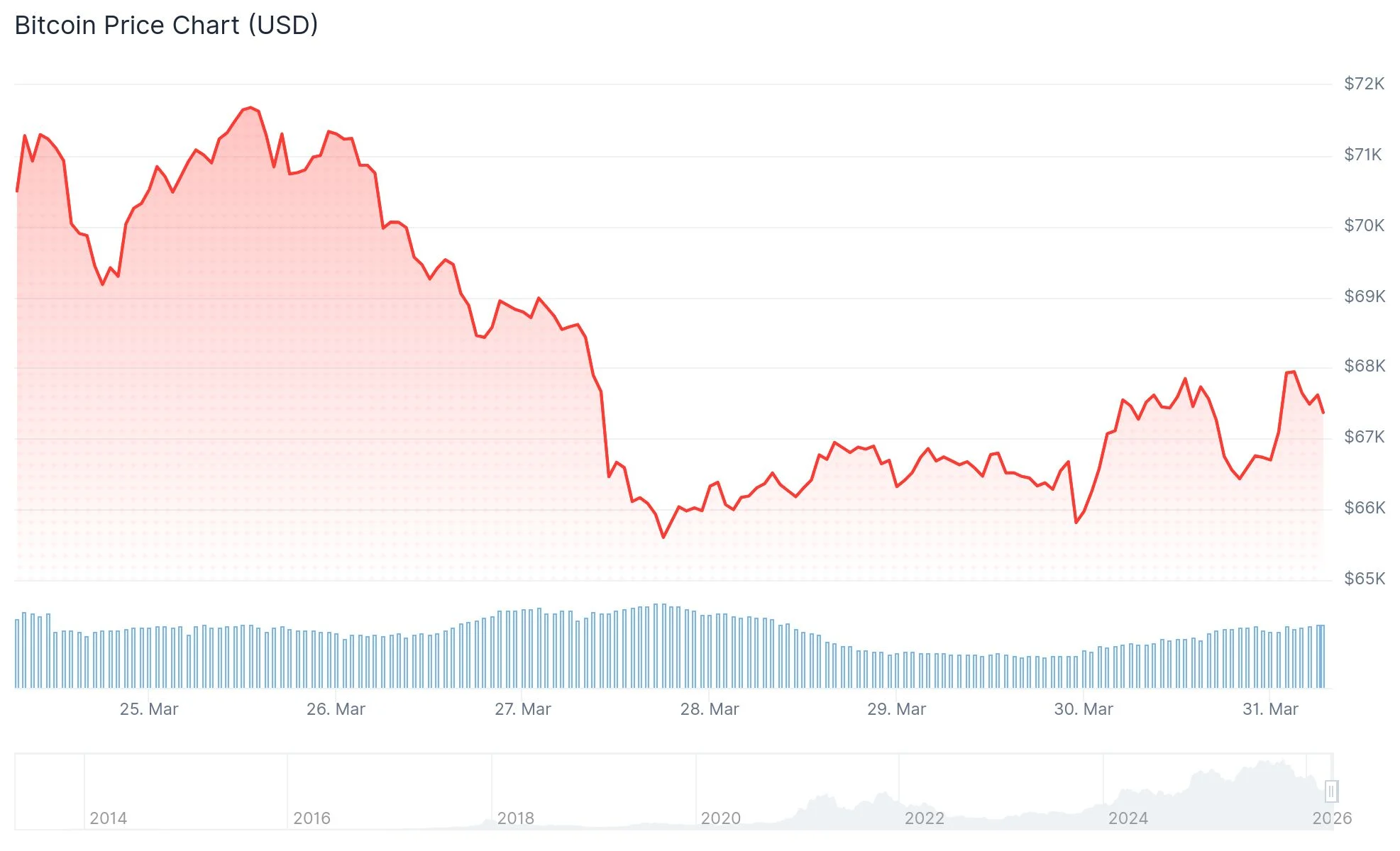
- BTC bounced back from sub-$65,200 levels and now trades in the $67,500–$67,700 zone
- President Trump indicated readiness to conclude US-Iran military operations regardless of Hormuz Strait status
- Crude oil declined following the announcement; S&P 500 futures advanced 0.8%
- Major altcoins registered 3–8% weekly declines, with SOL and XRP experiencing the steepest drops
- Overall cryptocurrency market capitalization remains at $2.32 trillion, showing strength against Nasdaq 100’s ~5% decline
Bitcoin is currently positioned around $67,500 this Tuesday following a rebound from Monday’s brief descent beneath the $65,200 threshold. The upward momentum gained traction after The Wall Street Journal disclosed that President Trump informed his advisory team of his willingness to conclude military operations against Iran, even if the strategically vital Strait of Hormuz continues operating under restricted conditions.
White House Press Secretary Karoline Leavitt clarified that reopening the strategic waterway doesn’t constitute the administration’s principal objective. According to her statement, the administration’s priorities center on dismantling Iran’s naval capabilities and missile arsenals, while simultaneously blocking any path toward nuclear weapons development.
The President seeks to establish a ceasefire arrangement within a four to six-week window. Internal assessments by his national security team concluded that attempting to forcibly reopen the strait would extend military engagement beyond this preferred timeline.
Crude oil valuations, which had surged to $107 per barrel, retreated to approximately $103 following the news release. S&P 500 futures responded with a 0.8% uptick. Bitcoin’s trading range over the 24-hour period spanned from $66,205 to $68,323.

During the trading session, Iran launched an attack on a Kuwaiti oil tanker positioned near a Dubai port facility. Behind closed doors, Saudi Arabia, the United Arab Emirates, Kuwait, and Bahrain are encouraging Trump to maintain military pressure. Conversely, Iran insists on sanctions elimination, financial reparations for conflict damages, and preserved authority over the strategic waterway.
Cryptocurrency Markets Demonstrate Resilience Amid Equity Weakness
The aggregate cryptocurrency market valuation stands at $2.32 trillion, showing minimal change across the previous seven days. During this identical timeframe, the Nasdaq 100 contracted approximately 5%. Bitcoin has maintained a trading corridor between $65,000 and $73,000 throughout the duration of regional hostilities.
JPMorgan analysts observed that Bitcoin is navigating the Iran crisis with greater stability compared to precious metals like gold and silver. Gold has experienced an atypical losing pattern despite escalating geopolitical tensions.
Alex Kuptsikevich, chief market analyst at FxPro, commented: “Crypto has pulled back, but appears stronger than stocks. It is finding support on dips to the lows seen since early February, demonstrating horizontal stabilization.”
Alternative Cryptocurrencies Trail Bitcoin Performance
Ether maintained its position above the $2,000 threshold at $2,062, registering a 0.4% daily gain. Solana’s SOL declined 0.9% to reach $83.07. XRP experienced a 2.2% decrease to $1.32. Dogecoin retreated 2.1% to $0.09.
SOL and XRP dominated weekly losses among top-ten cryptocurrencies, posting declines of 8% and 6.4% respectively.
Bitcoin trading volume surged 40% across the 24-hour measurement period. Market participants are closely monitoring this week’s Non-Farm Payrolls release for additional market direction signals.
Technical analyst Ted Pillows shared analysis on X suggesting BTC has broken its ascending trend pattern and drew parallels to a January 2026 fractal formation, cautioning that comparable price behavior could potentially drive Bitcoin toward the $45,000 level.
The latest market data indicates BTC maintaining support above $67,700 as of Tuesday morning hours.
