



Key Takeaways
- BTC declined approximately 1.5% during the week while the S&P 500 plummeted roughly 10% over two trading sessions
- Charles Schwab announces spot Bitcoin and Ethereum trading launch scheduled for the first half of 2026
- Arthur Hayes cautions that Bitcoin might drop beneath $60,000 before climbing to $250,000
- A pessimistic technical analyst forecasts BTC could plunge to the $12,000–$13,000 range by mid-2027
- Historical crisis data reveals Bitcoin typically surpasses both gold and S&P 500 performance within a 60-day window
Bitcoin demonstrated remarkable stability compared to traditional equities during last week’s market turbulence. As the S&P 500 experienced a devastating 10% collapse across two consecutive sessions, Bitcoin shed merely 1.5% of its value. This divergence in performance has prompted investors to reconsider cryptocurrency’s role in portfolios.
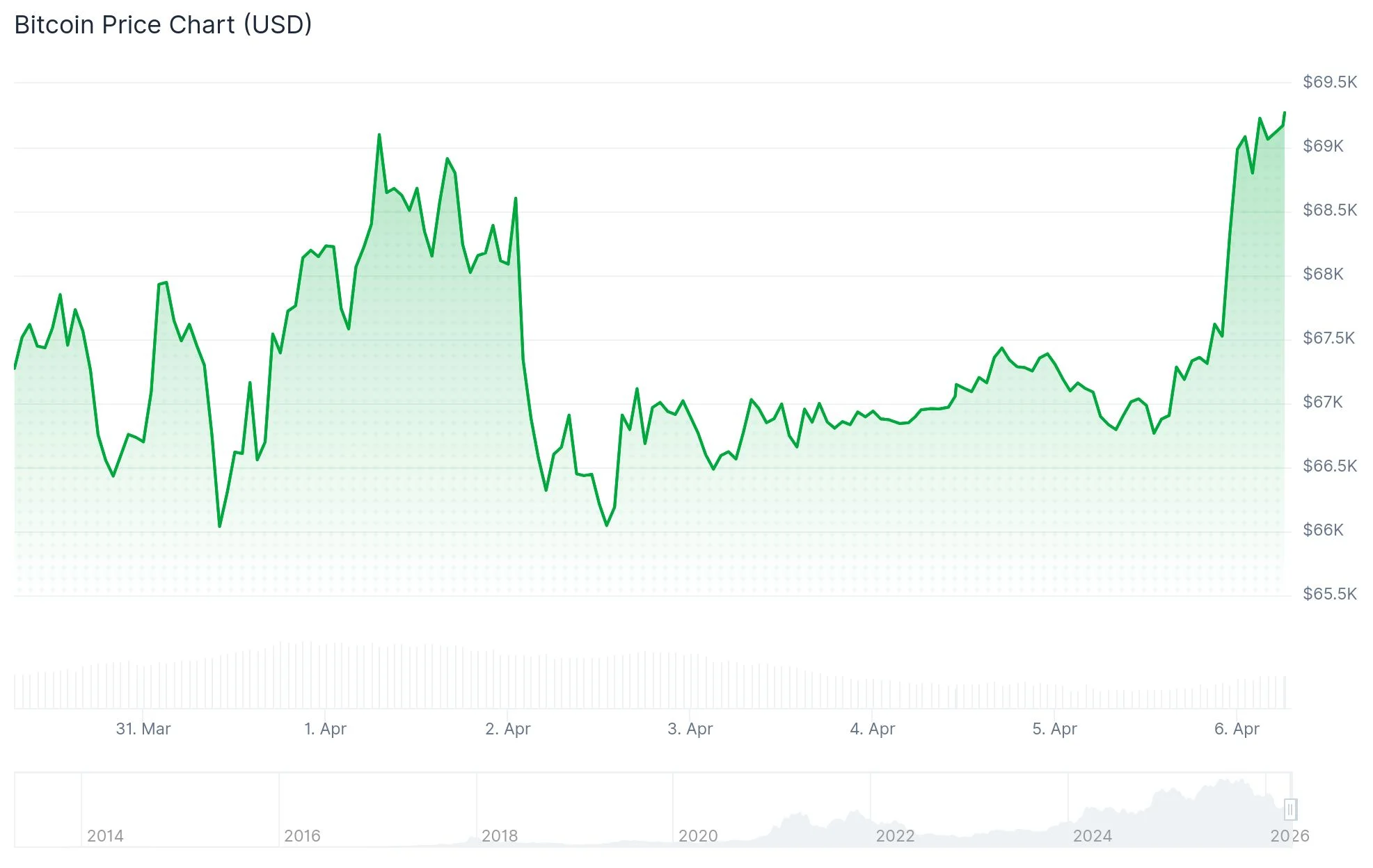
Traditional markets reeled following President Trump’s tariff policy revelations, which sent shockwaves through international trading partners. Throughout the volatility, Bitcoin maintained support above the $66,000 threshold, climbing back toward $67,300 even as stock indices continued their descent.
In a landmark development, Charles Schwab—overseeing approximately $12 trillion in client holdings—revealed plans to introduce direct spot cryptocurrency trading capabilities. The forthcoming “Schwab Crypto” platform is slated to debut during 2026’s first six months.
This offering represents a departure from traditional ETF exposure. Users will gain the ability to custody digital assets alongside conventional securities within a unified account structure.

Robinhood’s CEO Vlad Tenev generated buzz this week by criticizing traditional market hours as “a legacy design choice,” suggesting that tokenization could enable 24/7 trading similar to internet protocols.
Hayes Advises Caution Until Fed Intervention
Arthur Hayes, BitMEX co-founder and Maelstrom’s Chief Investment Officer, expressed cautious sentiment regarding current market conditions. During his appearance on the Coin Stories podcast, he acknowledged he wouldn’t deploy his final capital reserves into Bitcoin at present levels.
His rationale centers on the Federal Reserve’s current monetary stance. Hayes contends that policymakers have yet to face sufficient pressure to unleash liquidity expansion. He anticipates tariff policies will eventually generate enough electoral backlash to pivot U.S. strategy toward capital restrictions.
Such capital controls, according to Hayes’ thesis, would serve as a powerful bullish trigger for Bitcoin. His longer-term projections place BTC between $250,000 and $750,000 before the current cycle concludes.
However, he simultaneously cautioned that escalating U.S.-Iran tensions could temporarily force Bitcoin beneath the $60,000 level. Hayes additionally identified artificial intelligence-driven employment displacement as a potential catalyst for deflationary pressures and credit market seizures.
Historical Performance Analysis
Research conducted by Mercado Bitcoin examined the 60-day aftermath of significant global disruptions, encompassing previous tariff wars and the COVID-19 pandemic outbreak. The findings revealed Bitcoin systematically delivered superior returns versus both gold and traditional equity benchmarks.
During initial crisis phases, Bitcoin typically experiences sell-offs as market participants flee to cash positions. Nevertheless, historical patterns demonstrate cryptocurrency recoveries tend to be both swifter and more substantial than conventional asset classes.
Contrarian perspectives exist regarding near-term price floors. Technical analyst King of the Charts projects Bitcoin establishing a bottom within the $51,000-$53,000 band, followed by a devastating 80%-90% decline toward $12,000 by 2027’s midpoint.
The Crypto Fear and Greed Index has registered “Extreme Fear” territory for multiple consecutive weeks, with measurements hovering near single-digit levels.
In a separate conversation with David Lin, Hayes emphasized that straightforward Bitcoin accumulation remains the optimal strategy for protecting wealth against fiat currency erosion, particularly given increased complexity in equity selection strategies.
The Schwab cryptocurrency platform rollout remains on schedule for 2026’s first half.
