



Key Highlights
- Charles Guillemet, Ledger’s CTO, reveals that AI technology is dramatically reducing barriers to cryptocurrency cyberattacks
- Crypto losses exceeded $1.4 billion over the last year, with artificial intelligence anticipated to accelerate this troubling pattern
- Major security breaches this month include a $285 million hack targeting Drift protocol and a $25 million theft from Resolv
- Security experts advocate for formal verification methods, physical hardware wallets, and air-gapped storage solutions
- Crypto holders should operate under the assumption that digital systems face inevitable compromise
The cryptocurrency security landscape is facing an unprecedented challenge as artificial intelligence empowers malicious actors with tools that dramatically reduce attack barriers. Ledger’s chief technology officer is sounding the alarm about this emerging threat.
In a detailed conversation with CoinDesk, Charles Guillemet highlighted how AI is fundamentally reshaping the threat environment. Operations that previously required expert knowledge and extensive time investment can now be executed almost instantaneously with machine learning assistance.
“Discovering security flaws and weaponizing them has become extremely straightforward,” Guillemet explained. “The resource barrier is essentially disappearing.”
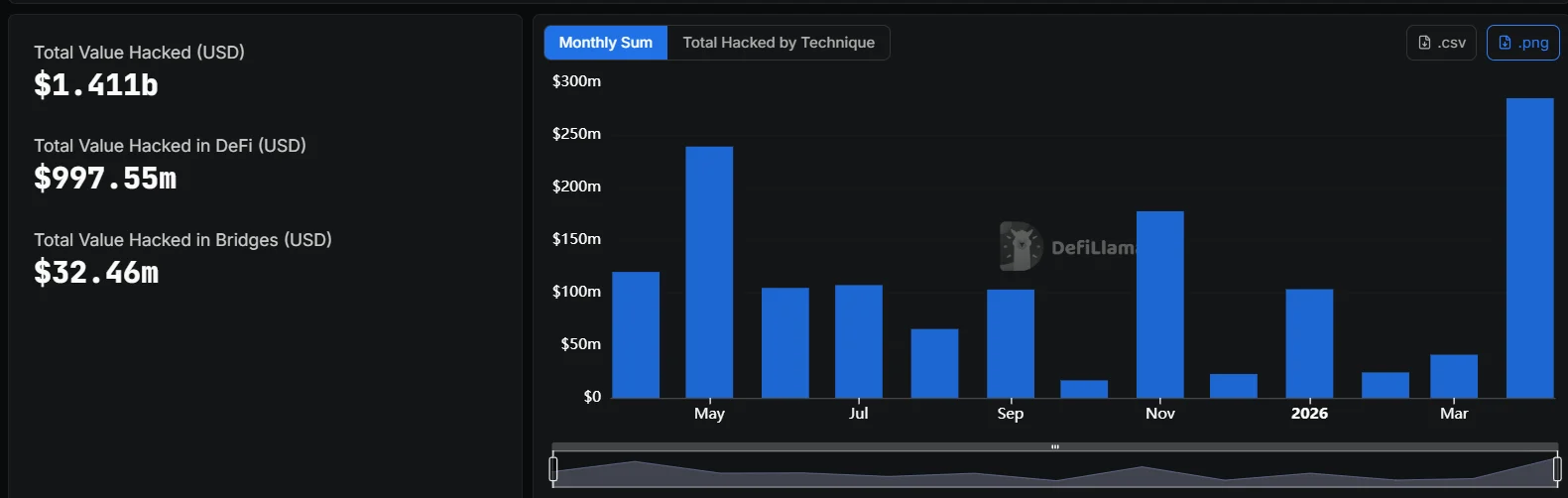
His concerns arrive amid a wave of high-profile breaches. The Solana ecosystem saw its Drift DeFi platform compromised for $285 million just days ago. Prior to that, the Resolv yield platform suffered a $25 million security incident.
DefiLlama’s tracking data paints a sobering picture: cryptocurrency platforms and users lost more than $1.4 billion in the previous twelve months. Guillemet anticipates artificial intelligence will drive these figures even higher.

The fundamental issue revolves around changing threat economics. Historically, cybersecurity maintained equilibrium because launching successful attacks required significant investment exceeding potential gains. Machine learning is upending this calculus.
Cryptocurrency platforms face particular vulnerability since smart contract code directly governs substantial financial reserves. As Guillemet emphasized: “Flawless execution is the only acceptable standard.”
Dangers of AI-Assisted Code Development
The security challenges extend beyond external threat actors. Development teams increasingly leverage AI coding assistants, inadvertently introducing security weaknesses during the creation process.
“No magical ‘security enhancement’ function exists,” Guillemet cautioned. “We’re entering an era where substantial amounts of inherently vulnerable code will be generated.”
He also detailed emerging malware variants that actively search compromised mobile devices for recovery phrases. Once discovered, attackers can empty accounts without requiring any victim action.
This attack vector proves particularly insidious because conventional security measures like third-party code reviews offer limited protection.
Guillemet’s Security Framework
Guillemet champions formal verification methodologies as superior alternatives to conventional security audits. These techniques employ mathematical proofs to validate that code functions precisely as designed, minimizing opportunities for concealed vulnerabilities.
Physical hardware wallet devices represent another critical defensive layer in his framework. By maintaining private keys on isolated devices disconnected from internet connectivity, users substantially limit their attack surface.
“Dedicated offline devices offer inherently superior security architecture,” he noted.
For typical cryptocurrency participants, his guidance was unambiguous: maintain skepticism about system security.
“Most platforms you interact with cannot be considered trustworthy,” Guillemet warned.
He predicts market segmentation will accelerate. Wallet providers and established protocols will likely prioritize enhanced security infrastructure and successfully evolve. General-purpose software ecosystems may struggle to maintain adequate defenses.
The latest breach data reinforces his warnings. This week’s $285 million Drift security failure ranks among 2026’s most significant cryptocurrency thefts to date.
